
If you are preparing for the CBSE Class 12 board exam or CUET, determinants are among the most important topics you will encounter. Chapter 4 of NCERT Class 12 Mathematics introduces determinants, builds on your knowledge of matrices from Chapter 3, and lays the groundwork for finding inverse matrices and solving systems of linear equations. This guide explains everything you need to know about determinants from the ground up, with clear definitions, examples, and practical insights.
What Is a Determinant in Mathematics?
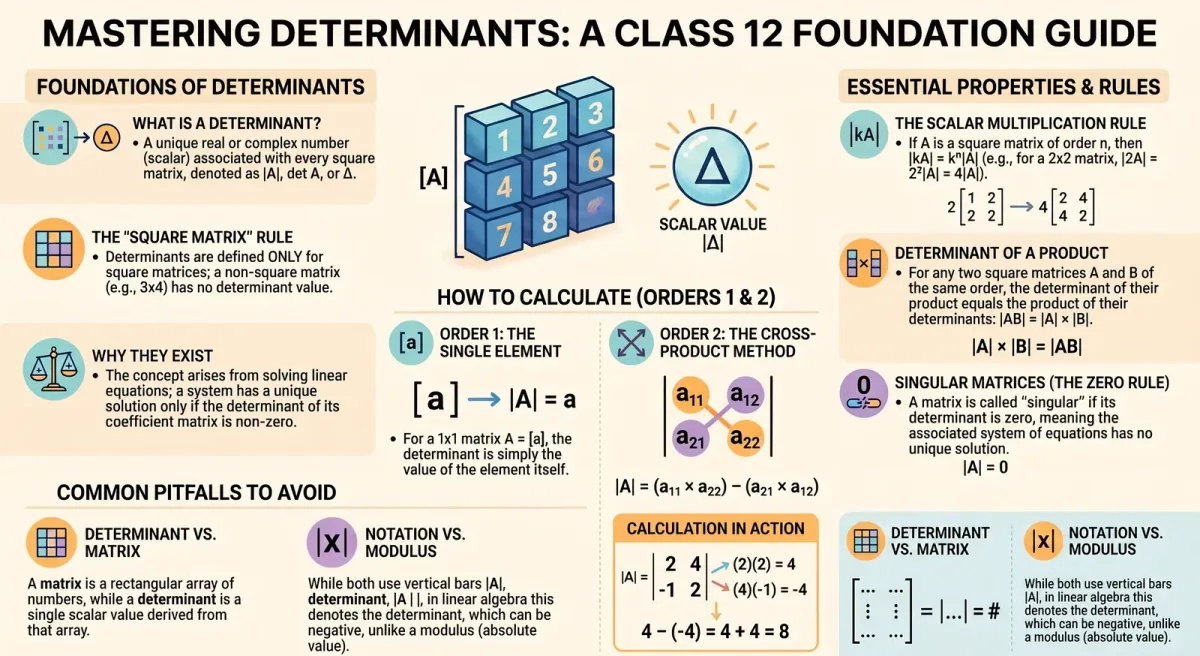
A determinant is a unique number — real or complex — associated with every square matrix. If A is a square matrix of order n, its determinant is written as |A|, det A, or Δ. Think of a determinant as a function that maps any square matrix to a single scalar value. This value carries critical information about the matrix, most importantly whether a system of linear equations has a unique solution.
It is essential to note two key facts from the start:
-
Only square matrices have determinants. A 3 × 4 or any non-square matrix has no determinant.
-
|A| denotes the determinant of A, not the modulus of A. This distinction matters in exam answers.
Why Do Determinants Exist? The Big Picture
The concept of a determinant arises naturally from solving pairs of linear equations. Consider:
a₁x + b₁y = c₁ a₂x + b₂y = c₂
This system has a unique solution only when a₁b₂ − a₂b₁ ≠ 0. The expression a₁b₂ − a₂b₁ is the determinant of the coefficient matrix A. In other words, the determinant tells you whether the system of equations you are working with actually has a solution that can be found. Determinants have wide and varied applications in Engineering, Economics, and the Social Sciences — and they appear in several important questions in Class 12 board exams.
Determinant of a Matrix of Order One
The simplest case: if A = [a] is a 1 × 1 matrix, then |A| = a. For example, if A = [−5], then det A = −5. This single-element case is the foundation on which all higher-order determinants are built.
Determinant of a Matrix of Order Two
For a 2 × 2 matrix of the form:
A = [a₁₁ a₁₂] [a₂₁ a₂₂]
the determinant is defined as:
|A| = a₁₁ · a₂₂ − a₂₁ · a₁₂
Simply put: multiply the main diagonal entries and subtract the product of the off-diagonal entries.
Worked Example 1
Evaluate |2 4; −1 2|.
Solution: (2)(2) − (4)(−1) = 4 + 4 = 8
Worked Example 2
Evaluate |x x+1; x−1 x|.
Solution: x(x) − (x+1)(x−1) = x² − (x² − 1) = 1
This result is independent of x — a type of question very commonly asked in Class 12 MCQs.
Important Properties of Determinants at Order Two
The Scalar Multiplication Rule
If A is a square matrix of order n and k is a scalar, then |kA| = kⁿ |A|. For a 2 × 2 matrix with |A| = 3, we get |2A| = 2² × 3 = 12. For a 3 × 3 matrix with |A| = 4, |3A| = 3³ × 4 = 108. This rule is frequently tested in Class 12 objective questions.
Determinant of a Product
For any two square matrices A and B of the same order, |AB| = |A| × |B|. This is known as Theorem 3 in the NCERT textbook and is used in verifying properties of inverse matrices.
Determinants in Context: What Comes Next
Understanding order-1 and order-2 determinants gives you the tools to tackle the 3 × 3 case, which involves a technique called cofactor expansion (covered in Section 4.2.3 of NCERT). From there, the chapter moves to finding the area of a triangle using a determinant formula, computing minors and cofactors, and finally finding the adjoint and inverse of a matrix. Each concept builds directly on the one before it.
Master Determinants with AI-Powered Support
Finding determinant problems tricky? ChampionsPrep gives Class 12 Maths students instant, AI-powered doubt resolution for just ₹10 per session — no subscriptions, no commitments. Get chapter-wise practice questions, step-by-step worked solutions, and targeted CBSE board exam prep at your own pace.
👉 Practice Determinants now at https://app.championsprep.in
Test Your Knowledge
What Is a Determinant? Class 12 Maths Chapter 4 Complete NCERT Guide
Frequently Asked Questions
What is the difference between a matrix and a determinant? +
A matrix is a rectangular array of numbers. A determinant is a single scalar value computed from a square matrix. Every square matrix has a determinant, but the determinant itself is a number, not a matrix.
Can a non-square matrix have a determinant? +
No. Determinants are defined only for square matrices — matrices where the number of rows equals the number of columns.
What does a zero determinant indicate? +
A zero determinant means the matrix is singular. The associated system of linear equations has either no solution or infinitely many solutions — never a unique one.
How is the 2x2 determinant formula derived? +
It comes from the condition for a system of two linear equations to have a unique solution: a₁b₂ − a₂b₁ ≠ 0. This expression is defined as the determinant of the 2×2 coefficient matrix.
Why is |A| not the same as the modulus of A? +
In linear algebra, |A| specifically denotes the determinant — a signed scalar that can be negative. The modulus of a number is always non-negative.
AI-powered practice — free to start