
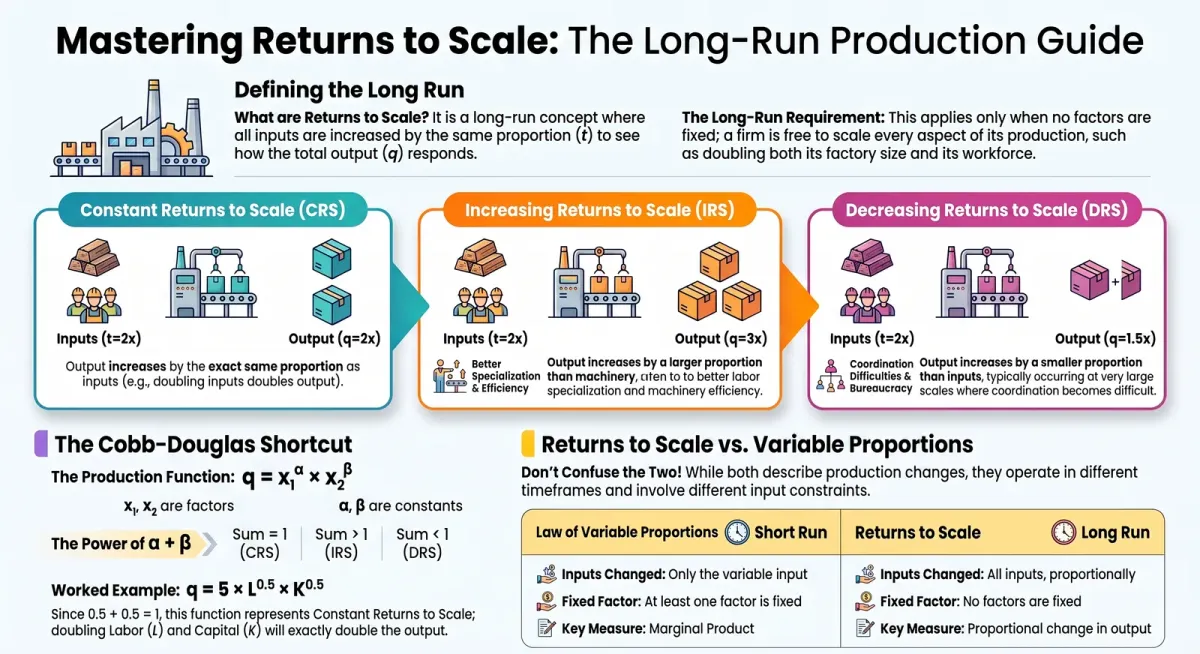
So far in this series, we have looked at what happens when a firm changes just one input while keeping the other fixed — the short run scenario governed by the Law of Variable Proportions. But what happens when a firm changes both inputs together, scaling its entire operation up or down? This is returns to scale, a long-run concept that is a favourite for both theory and numerical questions in CBSE Class 11 Economics and CUET.
This post explains the three types of returns to scale and shows how the Cobb-Douglas production function makes it easy to identify which type applies.
What Are Returns to Scale?
Returns to scale describes how a firm’s output responds when all its inputs are increased by the same proportion, simultaneously. This is strictly a long-run concept, since scaling every input together is only possible once no factor remains fixed.
Formally, consider q = f(x1, x2), where a firm uses x1 units of factor 1 and x2 units of factor 2. If it increases both factors by t times (t > 1), the new output is f(tx1, tx2). Comparing this to t times the original output tells us which type of returns to scale applies.
Constant Returns to Scale (CRS)
Constant Returns to Scale occurs when a proportional increase in all inputs produces an output increase of exactly the same proportion:
f(tx1, tx2) = t × f(x1, x2)
If a firm doubles both labour and capital, and output also exactly doubles, the function displays CRS — often treated as the “baseline” case in scale analysis.
Increasing Returns to Scale (IRS)
Increasing Returns to Scale occurs when a proportional increase in inputs results in a larger proportional increase in output:
f(tx1, tx2) > t × f(x1, x2)
If doubling both labour and capital more than doubles output, the firm is experiencing IRS — often seen at a relatively small scale, where scaling up allows better specialisation of labour and more efficient use of machinery.
Decreasing Returns to Scale (DRS)
Decreasing Returns to Scale occurs when a proportional increase in inputs leads to a smaller proportional increase in output:
f(tx1, tx2) < t × f(x1, x2)
If doubling both labour and capital raises output by less than double, the firm is experiencing DRS — typically at very large scales, where coordination becomes harder and the benefits of scaling up shrink.
Returns to Scale and the Cobb-Douglas Production Function
One of the most useful tools for identifying returns to scale is the Cobb-Douglas production function, a widely used form written as:
q = x1^α × x2^β
Here, α (alpha) and β (beta) are constants specific to the production process. Suppose a firm produces q₀ units using x̄1 units of factor 1 and x̄2 units of factor 2, so q₀ = x̄1^α × x̄2^β. Increasing both inputs t times gives:
q₁ = (t × x̄1)^α × (t × x̄2)^β = t^(α+β) × q₀
The question of which returns to scale applies now comes down to a single number: α + β.
How Alpha + Beta Determines Returns to Scale
-
If α + β = 1, then q₁ = t × q₀, meaning output rises by exactly the same proportion as inputs — Constant Returns to Scale.
-
If α + β > 1, then t^(α+β) exceeds t, meaning output rises by more than the proportional increase in inputs — Increasing Returns to Scale.
-
If α + β < 1, then t^(α+β) is less than t, meaning output rises by less than the proportional increase in inputs — Decreasing Returns to Scale.
This makes the Cobb-Douglas function a powerful shortcut in numerical problems: instead of testing input combinations, you simply add the exponents and compare the sum to 1.
Worked Example
Suppose q = 5 × L^(1/2) × K^(1/2). Here, α = 1/2 and β = 1/2, so α + β = 1, meaning CRS applies. With 100 units of labour and 100 units of capital, output is q = 5 × √100 × √100 = 500 units. Doubling both inputs to 200 each would make output exactly 1000 units — precisely double, confirming CRS.
Returns to Scale vs the Law of Variable Proportions
It is easy to confuse returns to scale with the Law of Variable Proportions, but they apply in fundamentally different situations:
| Feature | Law of Variable Proportions | Returns to Scale |
|---|---|---|
| Time period | Short run | Long run |
| Inputs changed | Only the variable input | All inputs, proportionally |
| Fixed factor | At least one input is fixed | No input is fixed |
| Key measure | Marginal product | Proportional change in output vs inputs |
Remembering this table is often enough to correctly answer conceptual “distinguish between” questions common in school exams.
Why Returns to Scale Matters for Firms
Understanding returns to scale helps explain real-world business strategy. A firm experiencing IRS has a strong incentive to expand, since scaling up boosts output more than proportionately, often lowering cost per unit. A firm already experiencing DRS may need to rethink further expansion, since growing bigger is becoming less efficient. This connection between returns to scale and cost becomes clearer in our upcoming post on long run cost curves.
Keep Learning with ChampionsPrep
Returns to scale numericals are a favourite in CBSE board papers, and the Cobb-Douglas shortcut can save you valuable exam time once practised. On ChampionsPrep, get topic-wise practice questions on Production and Costs and instant doubt resolution for just ₹10 per use. Visit ChampionsPrep to master this topic before your next assessment.
Catch up on the previous post: “Law of Variable Proportions Explained: Why Marginal Product Rises and Falls.” Next up: “Short Run Cost Curves Explained: TFC, TVC, TC, AFC, AVC, SAC, SMC.”
Test Your Knowledge

Returns to Scale Explained: CRS, IRS and DRS with Cobb-Douglas Production Function
Frequently Asked Questions
What is meant by returns to scale? +
It describes how output changes when all inputs are increased by the same proportion simultaneously, and it is a strictly long-run concept.
What is the difference between constant, increasing and decreasing returns to scale? +
CRS occurs when output rises by the same proportion as inputs; IRS occurs when output rises by a larger proportion; DRS occurs when output rises by a smaller proportion than the inputs.
How does the Cobb-Douglas production function help identify returns to scale? +
In q = x1^α x2^β, the sum of the exponents, α + β, directly determines returns to scale: equal to 1 means constant, greater than 1 means increasing, and less than 1 means decreasing.
Is returns to scale a short run or long run concept? +
It is exclusively a long run concept, since it requires all inputs, including those that would be fixed in the short run, to be varied together.
How is returns to scale different from the Law of Variable Proportions? +
The Law of Variable Proportions applies in the short run with one variable input against a fixed factor. Returns to scale applies in the long run, where all inputs change together in the same proportion.
AI-powered practice — free to start