
Microeconomics vs Macroeconomics: What’s the Real Difference?
If you’ve just started Class 11 Economics, one of the first big questions you’ll run into is this: what actually separates microeconomics from macroeconomics? The names sound technical, but the idea behind them is simple once you see it in context. This guide breaks the distinction down clearly, using the same logic your NCERT textbook uses — so you’re ready for board exams, CUET, and every economics class that follows.
What Is Microeconomics?
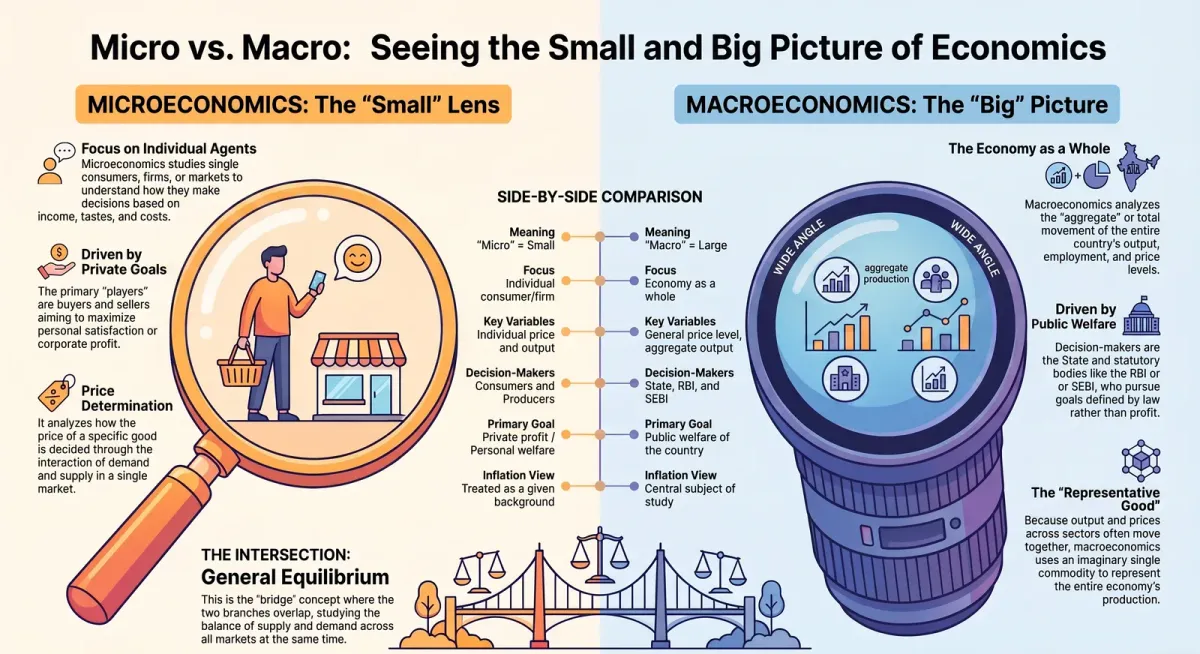
Microeconomics is the study of individual economic agents — a single consumer, a single firm, a single market. The word “micro” literally means “small,” and that’s exactly the lens microeconomics uses.
In microeconomics, you study:
-
How a consumer picks the best combination of goods to buy, given their income and tastes.
-
How a producer or firm decides how much to produce, aiming to earn maximum profit while keeping costs low.
-
How prices are determined in a single market through demand and supply.
Even a large company is considered “micro” in this context, because it still acts in the interest of its own shareholders — not the interest of the entire country. Big-picture issues like inflation or unemployment are treated as background conditions in microeconomics, not as things to be explained.
What Is Macroeconomics?
Macroeconomics flips the lens outward. Instead of looking at one consumer or one firm, it studies the economy as a whole — total output, the general price level, and overall employment across the country.
Macroeconomics tries to answer questions that concern every citizen:
-
Are prices, on average, rising or falling?
-
Is employment improving or getting worse across the economy?
-
What indicators tell us whether the economy is doing well or poorly?
-
What can the government or the people do to improve economic conditions?
To make this large-scale analysis manageable, macroeconomics often uses a representative good — a single imaginary commodity that stands in for all the goods and services produced in the economy. This works because output, prices, and employment levels across different goods tend to move together: when demand rises, production of food grains and industrial goods often rise together; when inflation hits, prices across sectors tend to rise together too.
Key Differences Between Microeconomics and Macroeconomics
1. Scope of Study
Microeconomics is disaggregated — it zooms into individual markets and agents. Macroeconomics is aggregated — it studies the economy in totality, looking at interlinkages between sectors like households, firms, government, and the external sector.
2. The Decision-Makers Involved
In microeconomics, the “players” are individual buyers and sellers trying to maximise their own profit or personal satisfaction. In macroeconomics, the key decision-makers are the State and statutory bodies like the Reserve Bank of India (RBI) or the Securities and Exchange Board of India (SEBI) — institutions pursuing public goals defined by law, not private profit.
3. Core Focus Areas
Microeconomics focuses on price determination, consumer choice, and firm-level output decisions. Macroeconomics focuses on aggregate output, general price levels (inflation), the overall employment rate, and policies related to taxation, money supply, interest rates, and wages.
4. Treatment of Inflation and Unemployment
In microeconomics, phenomena like inflation and unemployment are either ignored or simply taken as a given backdrop. In macroeconomics, these are the central subjects of analysis.
5. The Closest Overlap: General Equilibrium
Interestingly, microeconomics does come close to macroeconomics in one area — General Equilibrium analysis, which studies the equilibrium of supply and demand across all markets in the economy simultaneously. This is the bridge concept that connects the two branches.
Quick Comparison Table
| Aspect | Microeconomics | Macroeconomics |
|---|---|---|
| Meaning of the term | "Micro" = small | "Macro" = large |
| Focus | Individual consumer/firm | Economy as a whole |
| Key variables | Individual price, individual output | Price level, aggregate output, employment |
| Decision-makers | Consumers, producers | State, RBI, SEBI |
| Goal | Private profit/personal welfare | Public welfare of the country |
| Treats inflation/unemployment as | Given/background | Central subject of study |
Why This Distinction Matters for Your Exams
This isn’t just a definitional exercise — CBSE and Maharashtra Board exams frequently ask direct questions like “Distinguish between microeconomics and macroeconomics” or “What is the difference between micro and macro variables?” Understanding this distinction also sets up everything else you’ll study in macroeconomics this year, from national income accounting to money and banking, since every new topic builds on the idea that macroeconomics looks at the economy in aggregate.
For competitive entrance exams like CUET, IPMAT, and NPAT, this concept often appears in a slightly twisted form — as an applied question where you’re given a scenario and asked to identify whether it’s a microeconomic or macroeconomic issue. Practising with varied question formats, not just definitions, is the key to scoring well here.
Keep Learning with ChampionsPrep
Understanding the difference between microeconomics and macroeconomics is just the first step in mastering Class 11 Economics. For chapter-wise practice questions, mock tests, and concept explainers built specifically for CBSE and Maharashtra Board Commerce students, explore more resources at championsprep.in . Practice smart, pay only for what you use, and build the strong foundation you need for CUET, IPMAT, and beyond.
Test Your Knowledge
Frequently Asked Questions
What is the simplest way to remember the difference between microeconomics and macroeconomics? +
Think 'micro = small = individual' and 'macro = large = whole economy.' Microeconomics studies one consumer or firm; macroeconomics studies the entire country's economy.
Is inflation a microeconomic or macroeconomic concept? +
Inflation is a macroeconomic concept, since it refers to the general rise in prices across the whole economy, not the price of a single good.
Where do microeconomics and macroeconomics overlap? +
They overlap in General Equilibrium analysis, which examines the equilibrium of supply and demand across all markets in an economy simultaneously.
Who are the main decision-makers in macroeconomics? +
The State and statutory bodies like the RBI and SEBI are the primary macroeconomic decision-makers, since they pursue public policy goals rather than private profit.
Why does macroeconomics use a representative good instead of studying every product separately? +
Because the outputs, prices, and employment levels of different goods tend to move together, a single representative good can reasonably reflect the general condition of the whole economy, making analysis simpler.
Keep practising Economics
AI-powered feedback and structured revision for Economics — free to start, at your own pace.
AI-powered practice — free to start