
Introduction to Economics: Understanding Scarcity, Choice and a Simple Economy
Every day, without realising it, you make economic decisions — choosing between studying an extra hour or relaxing, or deciding how to spend your pocket money. These are small examples of a bigger idea at the heart of economics: scarcity forces choice. This idea is your entry point into Class 11 Economics, and understanding it well will make every chapter that follows far easier to grasp.
In this post, we’ll build a simple, intuitive picture of what economists call a “simple economy,” and see how limited resources versus unlimited wants shapes the behaviour of every individual and every society.
What Do We Mean by a “Simple Economy”?
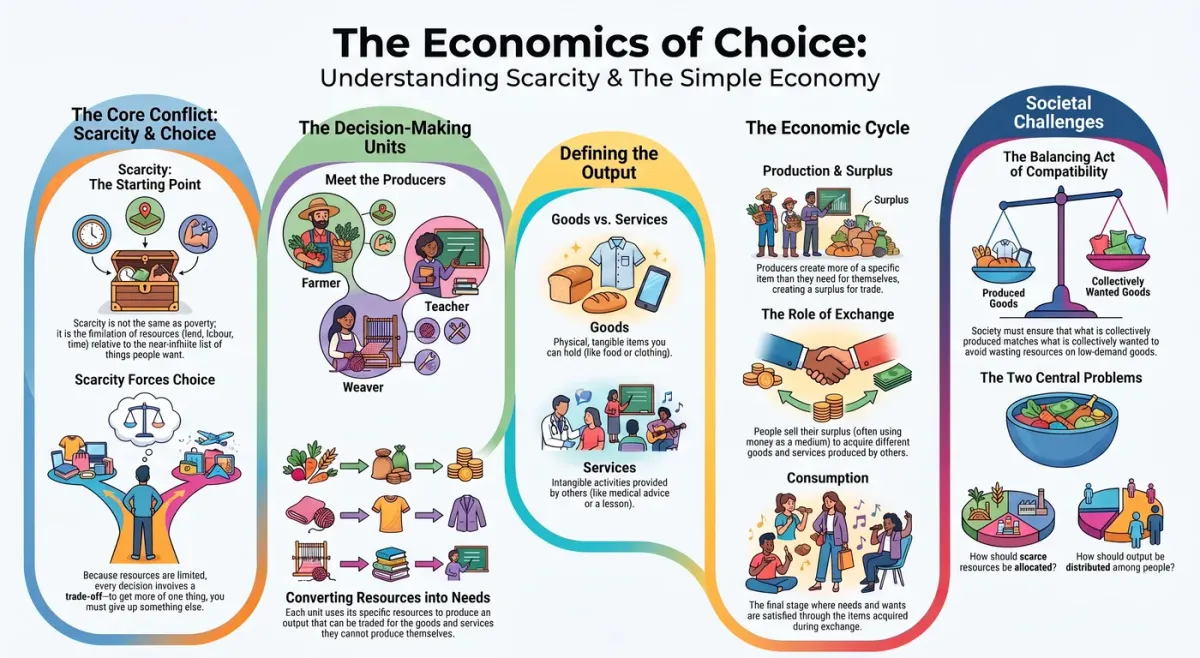
Picture a small society: a farmer who owns some land, a weaver who has yarn and cotton, a teacher with the skill to educate children, and a labourer who has nothing to offer except her own effort. None of them, on their own, has everything they need. The farmer needs cloth, the weaver needs food, the teacher needs both, and the labourer needs almost everything but has only her labour to trade.
This is what economists mean by a simple economy — a setting where different decision-making units each hold a small set of resources and must convert what they have into what they need.
Goods vs Services
Two terms are often used loosely in everyday conversation but have precise meanings in economics:
-
Goods are physical, tangible items that satisfy wants — food, clothing, machinery, books.
-
Services are intangible activities that satisfy wants — a doctor’s consultation, a teacher’s lesson, a lawyer’s advice.
They differ in whether you can hold them in your hand. This distinction matters because national output and employment data later in your course depend on separating “goods-producing” and “service-producing” sectors.
Resources and Individuals as Decision-Making Units
A resource, in economic terms, is anything used to produce other goods and services — land, labour, tools, and machinery are classic examples. Every decision-making unit — a person, household, firm, or organisation — owns some combination of resources and uses them to produce something it can trade for what it needs. The farmer uses land and labour to grow corn; the weaver uses yarn, cotton, and a loom to produce cloth. Each is solving the same problem differently: converting limited resources into the goods and services they actually want.
Why Every Individual Faces Scarcity
Here’s the catch: no individual, however resourceful, has unlimited means. The farmer can only grow as much corn as her land, seeds, and labour allow. This limitation is what economists call scarcity — and it’s scarcity, not poverty, that is the real starting point of economic thinking. Even a wealthy household faces scarcity, because its resources are still limited relative to the near-infinite list of things it might want.
Scarcity gives rise to choice. If a family wants a bigger house, it might have to give up buying more farmland. If it wants better education for its children, it might have to cut back on other comforts. This trade-off — gaining more of one thing only by giving up some of another — is a theme you will meet again when you study the production possibility frontier.
How Individuals Fulfil Their Needs Through Exchange
Since no one produces everything they need, exchange becomes essential. The farmer sells part of her corn harvest to buy cloth, housing, and services. The weaver does the same with cloth. The teacher converts her skill into money by teaching, then spends it on what she needs. Even the labourer, who owns no resource except her labour, participates by working for wages.
This constant cycle of producing, exchanging, and consuming keeps any economy — small or large — functioning. It also explains why money exists: a convenient way to facilitate exchange between people who produce different things.
Compatibility Between Production and Consumption in Society
Zoom out to society as a whole, and a new question appears: does what people collectively produce match what they collectively want to consume? If farmers produce far more corn than people want to eat, resources like land and labour are wasted on a good in low demand — they could have produced something society values more instead. If people want more corn than is being produced, resources from other goods need to be reallocated toward corn.
This balancing act — aligning what is produced with what is wanted — is one of the most persistent challenges any economy faces, from a small village to a modern nation with millions of producers and consumers.
From Individual Choices to the Economy as a Whole
What starts as a personal problem — “how do I use my limited resources to meet my needs?” — scales up into a societal problem the moment you consider an entire economy. Every society, like every individual, has scarce resources relative to what its people collectively want. This raises two fundamental questions every economic system must answer: how should scarce resources be allocated across different goods and services, and how should the resulting output be distributed among people?
These two questions — allocation and distribution — are what economists call the central problems of an economy, and they form the foundation for everything else you’ll study in this course.
Ready to Test What You’ve Learned?
Reading is only half the battle. On ChampionsPrep, resolve doubts on this topic instantly and practice topic-wise questions for just ₹10 per use. Head to app.championsprep.in and test these concepts before your next class test or board exam.
Introduction to Economics: Scarcity, Choice and a Simple Economy
Frequently Asked Questions
What is meant by a "simple economy" in economics? +
A simple economy refers to a setting where individuals or decision-making units, such as a farmer, weaver, or teacher, each own limited resources and must produce and exchange goods and services to meet their needs.
What is the difference between a good and a service? +
A good is a physical, tangible item like food or clothing, while a service is an intangible activity, such as teaching or medical treatment, that satisfies a want without being a physical object.
Why does scarcity exist even for wealthy individuals or households? +
Scarcity exists because resources — whether land, labour, income, or time — are always limited relative to the number of things people want, regardless of how much wealth an individual has.
How do individuals in a simple economy meet their needs if they don't produce everything themselves? +
They produce a good or service using the resources they own, consume part of it, and exchange the surplus for other goods and services they require, often using money as a medium of exchange.
Why is compatibility between production and consumption important for a society? +
If production doesn't match what society wants to consume, resources are wasted on goods in low demand while goods in high demand fall short — making it essential to align what is produced with what is actually needed.
Keep practising Economics
AI-powered feedback and structured revision for Economics — free to start, at your own pace.
AI-powered practice — free to start