
Production Possibility Frontier (PPF) and Opportunity Cost for Class 11 Economics
If there’s one diagram that captures the essence of economics in a single picture, it’s the Production Possibility Frontier (PPF). It shows, in the simplest possible way, how scarcity forces every economy to make trade-offs. This post breaks down the PPF and its closely linked concept, opportunity cost, using the same corn-and-cotton example that CBSE Class 11 students encounter in their textbook.
What Is a Production Possibility Set?
Every economy has a fixed amount of resources — land, labour, capital, and a certain level of technology — at any given time. Given these resources, there isn’t just one way to produce goods and services; there are many possible combinations. The collection of all the possible combinations of goods and services that an economy can produce, using its available resources and technology, is called the production possibility set.
This set represents every option on the table. An economy could choose to produce mostly one good, mostly another, or some balanced mix of both — and the production possibility set captures all of these options at once.
Understanding the PPF With a Corn and Cotton Example
To make this concrete, imagine an economy that can produce only two goods: corn and cotton. Depending on how it allocates its resources, it can end up with different combinations of the two.
Table of Production Possibilities
| Possibility | Corn | Cotton |
|---|---|---|
| A | 0 | 10 |
| B | 1 | 9 |
| C | 2 | 7 |
| D | 3 | 4 |
| E | 4 | 0 |
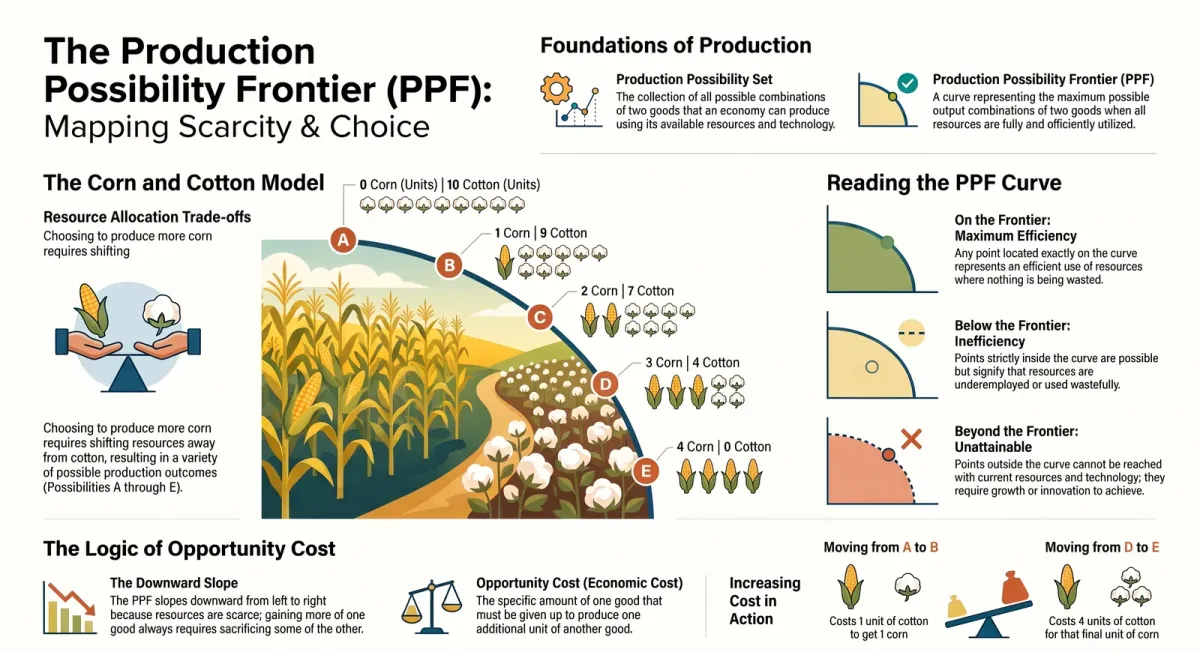
If all resources go into cotton production, the economy can produce 10 units of cotton and no corn (Possibility A). If all resources go into corn production, it can produce 4 units of corn and no cotton (Possibility E). In between, the economy can produce various combinations — 1 unit of corn with 9 of cotton, 2 units of corn with 7 of cotton, and so on.
Drawing and Reading the PPF Curve
If you plot these combinations on a graph, with cotton on the vertical axis and corn on the horizontal axis, and connect the points, you get a curve that slopes downward from left to right. This curve is the production possibility frontier — it shows the maximum amount of one good that can be produced for any given amount of the other, when all resources are fully and efficiently utilised.
Points On, Below, and Beyond the Frontier
Any point on the PPF represents an efficient combination — the economy is using all its resources fully. Any point strictly below the frontier represents a combination that’s possible but inefficient — it means resources are either underemployed or being used in a wasteful way. A point beyond the frontier, on the other hand, isn’t achievable at all with the economy’s current resources and technology — it would require either more resources or better technology to reach.
This is why the PPF is such a powerful tool: it draws a clear line between what’s efficient, what’s wasteful, and what’s simply impossible given current constraints.
What Is Opportunity Cost?
Look closely at the table again. As the economy produces more corn, it produces less cotton. Moving from Possibility A to B, corn rises from 0 to 1 unit, but cotton falls from 10 to 9 units — a cost of 1 unit of cotton for every additional unit of corn. Moving from D to E, corn rises from 3 to 4 units, but cotton falls all the way from 4 to 0.
This trade-off — the amount of one good that must be given up to produce one additional unit of another — is called opportunity cost. It’s also sometimes referred to as economic cost, and it applies just as much to individuals as it does to entire societies.
Why the PPF Slopes Downward
The PPF slopes downward precisely because of opportunity cost. Since resources used in corn production cannot simultaneously be used in cotton production, gaining more of one good always means sacrificing some amount of the other. If resources were unlimited, there would be no trade-off, and the PPF wouldn’t exist as a meaningful boundary at all.
Why the PPF Matters for Every Economy
The PPF isn’t just a textbook diagram — it’s a lens for understanding real economic decisions. Every economy has to choose a point on (or, ideally, on) its production possibility frontier, effectively deciding how to allocate scarce resources between competing uses. Should a country produce more consumer goods or more machinery? More agricultural output or more industrial products? Every such choice can be visualised as choosing a point along the PPF, and every choice comes with an opportunity cost attached.
Understanding the PPF also lays the groundwork for later topics in microeconomics, such as production functions, cost curves, and the efficient allocation of resources across markets — all of which build on this same core idea of scarcity forcing trade-offs.
Ready to Test What You’ve Learned?
PPF and opportunity cost questions are a favourite in Class 11 board exams. On ChampionsPrep, clear your doubts instantly and practice numerical and diagram-based questions on this topic for just ₹10 per use. Visit app.championsprep.in to sharpen your exam readiness.
Test Your Knowledge
Interactive Practice: Production Possibility Curve (PPC)
Production Possibility Frontier (PPF) & Opportunity Cost | Class 11 Economics
Frequently Asked Questions
What is the production possibility frontier (PPF)? +
The PPF is a curve showing the maximum combinations of two goods an economy can produce when its resources and technology are fully and efficiently utilised.
What does a point lying strictly below the PPF represent? +
It represents a combination of goods that is achievable but inefficient, meaning some resources are either underemployed or used in a wasteful manner.
What is opportunity cost in economics? +
Opportunity cost is the amount of one good that must be given up in order to produce one additional unit of another good, given a fixed amount of resources.
Why does the PPF slope downward from left to right? +
Because resources used to produce more of one good cannot be used to produce the other good at the same time, so gaining more of one always means giving up some of the other.
Can an economy produce at a point beyond its PPF? +
No, a point beyond the PPF is not achievable with current resources and technology; reaching it would require additional resources or improved technology.
AI-powered practice — free to start