
Centrally Planned Economy vs Market Economy: How Economies Organise Activities
Once you understand that every economy faces the central problems of what, how, and for whom to produce, a natural question follows: who actually makes these decisions? This post explores the two broad ways economic activities can be organised — through central planning or through the market — and explains why almost every real-world economy today is actually a blend of both.
Two Ways to Solve the Central Problems of an Economy
Broadly speaking, the basic problems of an economy can be solved in one of two ways: through the free interaction of individuals pursuing their own objectives, as happens in a market, or through a planned approach directed by a central authority, typically the government. These two approaches represent opposite ends of a spectrum, and most economies sit somewhere in between.
When Does the Government Step In?
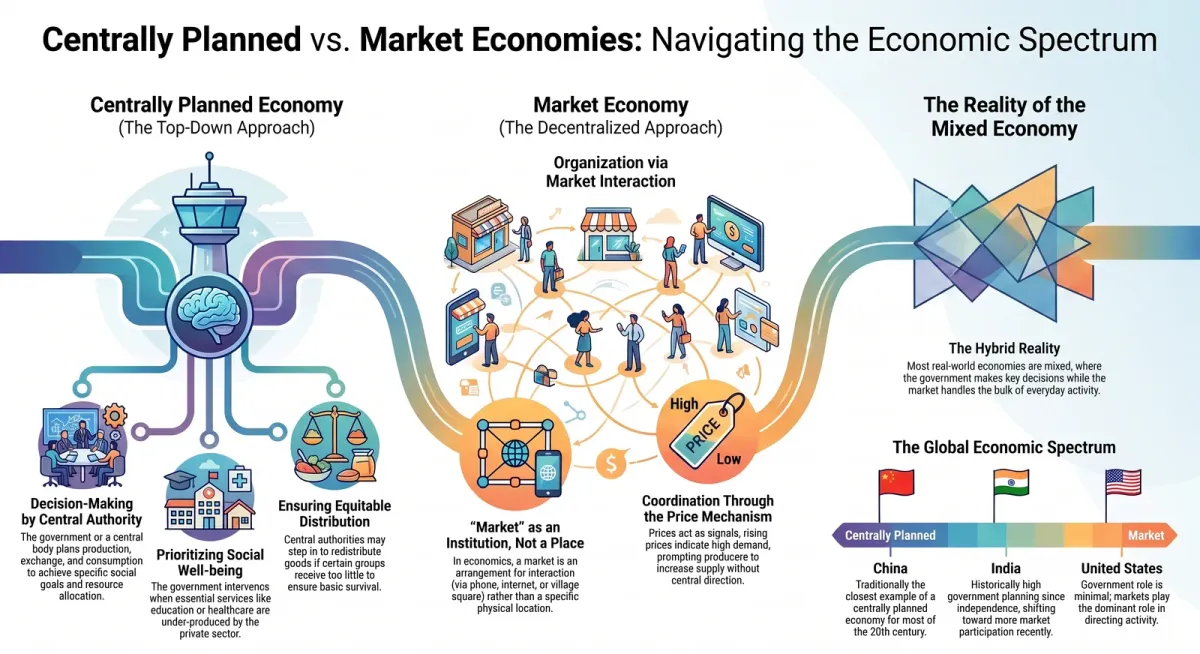
Central planning, or at least government intervention, often becomes especially important in specific situations. For example, if a good or service crucial to a society’s well-being — such as education or healthcare — isn’t being produced in adequate quantities by individuals acting on their own, the government might step in to encourage or directly undertake its production. Similarly, if certain groups in society receive such a small share of the final mix of goods and services that their basic survival is threatened, the central authority may intervene to achieve a more equitable distribution.
What Do Economists Mean by “Market”?
It’s worth pausing here because the economic meaning of “market” is quite different from the everyday sense of the word. A market, in economics, is an institution — essentially an arrangement with a purpose — that organises the free interaction of individuals engaged in their own economic activities. It has little to do with a physical marketplace. Buyers and sellers don’t need to meet face-to-face at all; they can interact through a village-chowk, a super bazaar, a telephone call, or the internet. What defines a market is the freedom to buy and sell, not the physical location where that exchange happens.
How Do Prices Coordinate a Market Economy?
A natural question arises: with millions of individuals making independent decisions, how does a market system avoid falling into chaos? The answer lies in prices. In a market system, every good or service comes with a price that both buyers and sellers agree upon, and this price reflects, on average, how much society values that good or service.
If buyers start demanding more of a good, its price rises. That rising price signals to producers that society wants more of that good than is currently being supplied, prompting them to increase production. Prices, in this way, carry information across the entire market and coordinate the decisions of countless individuals without any central authority directing them. This is often called the price mechanism, and it’s one of the most powerful ideas in all of economics.
Why Every Real-World Economy Is a Mixed Economy
In practice, no economy operates as a purely centrally planned system or a purely market-driven one. Every real economy is, to some extent, a mixed economy, where some important decisions are made by the government while the bulk of everyday economic activity is conducted through the market. What varies from country to country is simply the degree to which the government is involved.
The USA, China and India: Three Different Approaches
The United States is often cited as an economy where the government’s role in directing economic activity is comparatively minimal, with markets playing the dominant role. China, for much of the twentieth century, stood as the closest real-world example of a centrally planned economy, with the government controlling most major economic decisions. India presents a different trajectory altogether: since Independence, the government has historically played a significant role in planning economic activity, though this role has been reduced considerably over the last few decades as the economy has opened up to greater market participation.
These three examples illustrate that the choice between planning and markets isn’t binary — it’s a spectrum, and where a country sits on that spectrum can shift significantly over time as policy priorities change.
Ready to Test What You’ve Learned?
Comparing economic systems is a favourite exam topic. On ChampionsPrep, resolve your doubts on this topic instantly and practice application-based questions for just ₹10 per use. Visit https://app.championsprep.in to strengthen your understanding before your next test.
Test Your Knowledge
Market Equilibrium vs Price Controls Simulator
Drag the Demand Shift and Supply Shift sliders to see how competitive market forces automatically find equilibrium price and quantity without bureaucratic intervention.
Baseline market equilibrium. Move a slider to shift a curve.

Centrally Planned Economy vs Market Economy Explained | Class 11 Economics
Frequently Asked Questions
What is a centrally planned economy? +
A centrally planned economy is one where the government or a central authority makes the major decisions regarding production, exchange, and consumption of goods and services.
What is a market economy? +
A market economy is one where all economic activities are organised through the market, with individuals and firms freely deciding what and how much to produce, buy, and sell.
How does the price mechanism coordinate a market economy? +
Rising or falling prices signal to producers whether society wants more or less of a good, guiding them to adjust production without any central authority directing the process.
What is a mixed economy? +
A mixed economy is one where some important economic decisions are made by the government, while most economic activities are conducted through the market — a blend of planning and market forces.
Which country is considered closest to a centrally planned economy in the twentieth century? +
China is often cited as the closest example of a centrally planned economy for the major part of the twentieth century.
AI-powered practice — free to start