
Central Problems of an Economy Explained: What, How and For Whom to Produce
Every economy, no matter how big or small, rich or poor, must answer the same three basic questions. Whether it’s a family farm deciding what to grow or a national government deciding where to invest, the underlying challenge is identical: resources are scarce, but wants are not. This scarcity is the root cause of what economists call the central problems of an economy, and mastering them is essential for Class 11 Economics.
Why Every Economy Faces the Same Basic Problems
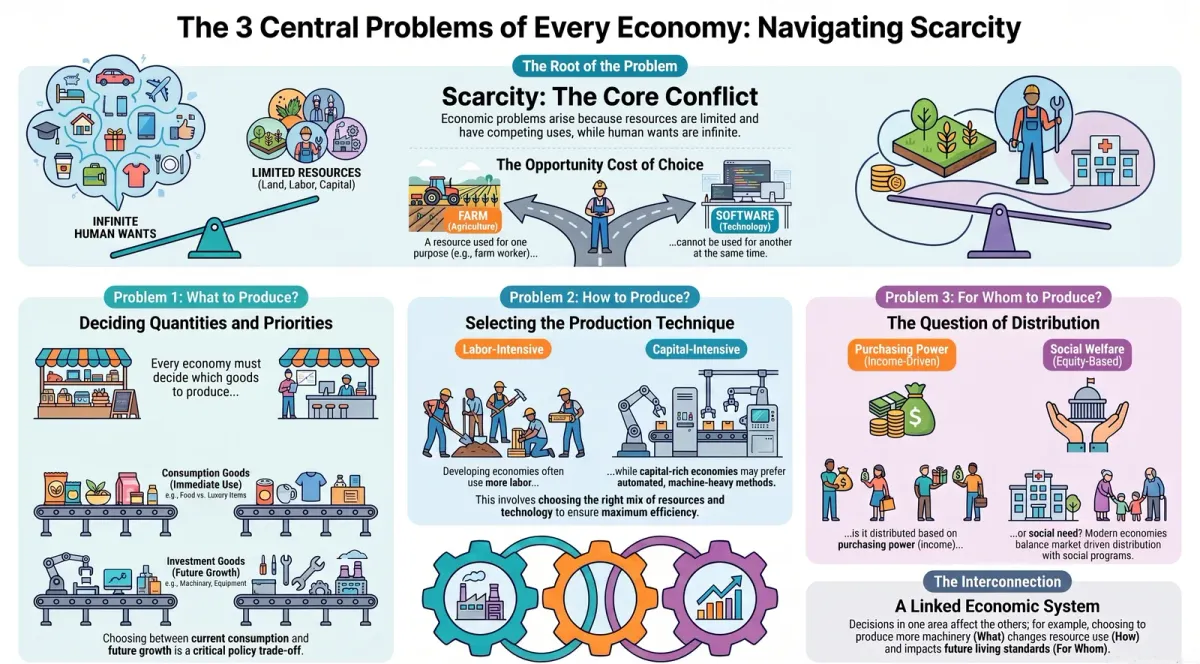
Production, exchange, and consumption are the basic economic activities of any society. But because resources — land, labour, capital, and raw materials — have competing uses, every society must decide how to allocate them. A resource used to build a hospital cannot simultaneously be used to build a factory. A worker employed in agriculture cannot, at the same time, work in a software company. This competition for scarce resources is what gives rise to the central problems of an economy: what to produce, how to produce, and for whom to produce.
Problem 1: What to Produce and in What Quantities
The first problem every economy faces is deciding which goods and services to produce, and in what amounts. Should the economy focus more on food, clothing, and housing, or on luxury goods? Should it prioritise agricultural output or industrial products? Should more resources go into education and healthcare, or into building military capacity?
Choosing Between Competing Goods
These aren’t abstract questions — they represent real trade-offs. A country that puts more resources into building highways has fewer resources left for building schools. A society that produces more basic goods for mass consumption has less capacity to produce premium or luxury items. Every choice about “what to produce” is really a choice about what to give up.
Consumption Goods vs Investment Goods
One particularly important version of this question is the choice between consumption goods (things people use directly, like food and clothing) and investment goods (machines and equipment that boost future production). An economy that invests more in machinery today may have less to consume now, but it builds the capacity to produce — and consume — more in the future. This trade-off between present and future consumption is a recurring theme in economic policy.
Problem 2: How to Produce
Once an economy has decided what to produce, it must decide how to produce it. This is fundamentally a question about the mix of resources and the technology used.
Choosing the Right Resource Mix
Should a good be produced using more labour or more machinery? A labour-intensive method might create more jobs but produce less output per worker, while a capital-intensive method might be more efficient but require significant upfront investment. Developing economies with abundant labour but scarce capital often lean toward labour-intensive techniques, while capital-rich economies may prefer automation.
Choosing the Right Technology
Beyond the labour-capital mix, producers must also choose which available technology to adopt. Newer technologies might increase output but require retraining workers or importing expensive equipment. The “how” question, therefore, isn’t just about resources — it’s also about efficiency, cost, and the practical realities of what an economy can access.
Problem 3: For Whom to Produce
The third central problem is about distribution: once goods and services are produced, who actually gets to consume them? This question goes beyond production and touches directly on fairness and equity within a society.
The Question of Distribution
Should the goods produced in an economy be distributed based purely on income and purchasing power, or should there be some redistribution to ensure fairness? Who gets more, and who gets less? These are not just economic questions but also deeply political and ethical ones, and different societies answer them differently based on their values and priorities.
Minimum Consumption and Basic Services
A related question is whether every individual in the economy should be guaranteed a minimum standard of living. Should elementary education and basic healthcare be freely available to everyone, regardless of income? Many modern economies grapple with exactly this question, balancing market-driven distribution with social welfare programmes designed to protect the most vulnerable.
How the Three Problems Are Connected
While it’s useful to study “what,” “how,” and “for whom” separately, in reality these three problems are deeply interconnected. A decision about what to produce affects how resources are used, which in turn affects who benefits from that production. For instance, a decision to prioritise investment goods over consumption goods might boost long-term growth but could reduce current living standards for some segments of society — directly affecting the “for whom” question.
Ultimately, every economic system — whether a centrally planned economy, a market economy, or a mix of both — is essentially a mechanism for answering these three central problems. How well an economy answers them determines how efficiently its resources are used and how fairly its output is shared.
Ready to Test What You’ve Learned?
Understanding the theory is just the start. On ChampionsPrep, resolve your doubts on central problems of an economy instantly and practice topic-wise MCQs and long-answer questions for just ₹10 per use. Visit https://app.championsprep.in to strengthen this topic before your next exam.
Test Your Knowledge
Interactive Practice: Production Possibility Curve (PPC)

Central Problems of an Economy Explained: What, How & For Whom
Frequently Asked Questions
What are the three central problems of an economy? +
The three central problems are: what to produce and in what quantities, how to produce it, and for whom it should be produced — covering resource allocation and distribution.
Why does every economy face the problem of "what to produce"? +
Because resources are scarce and have competing uses, every economy must choose which goods and services to produce, since producing more of one good means producing less of another.
What does the "how to produce" problem involve? +
It involves deciding the mix of resources — such as labour versus machinery — and which technology to adopt in producing each good or service.
What is meant by the "for whom to produce" problem? +
It refers to how the goods and services produced in an economy are distributed among individuals — who gets more and who gets less of the final output.
Are the three central problems of an economy independent of each other? +
No, they are closely interconnected — decisions about what and how to produce directly affect who ultimately benefits from that production.
AI-powered practice — free to start