
Positive Economics vs Normative Economics: Key Differences for CBSE Class 11
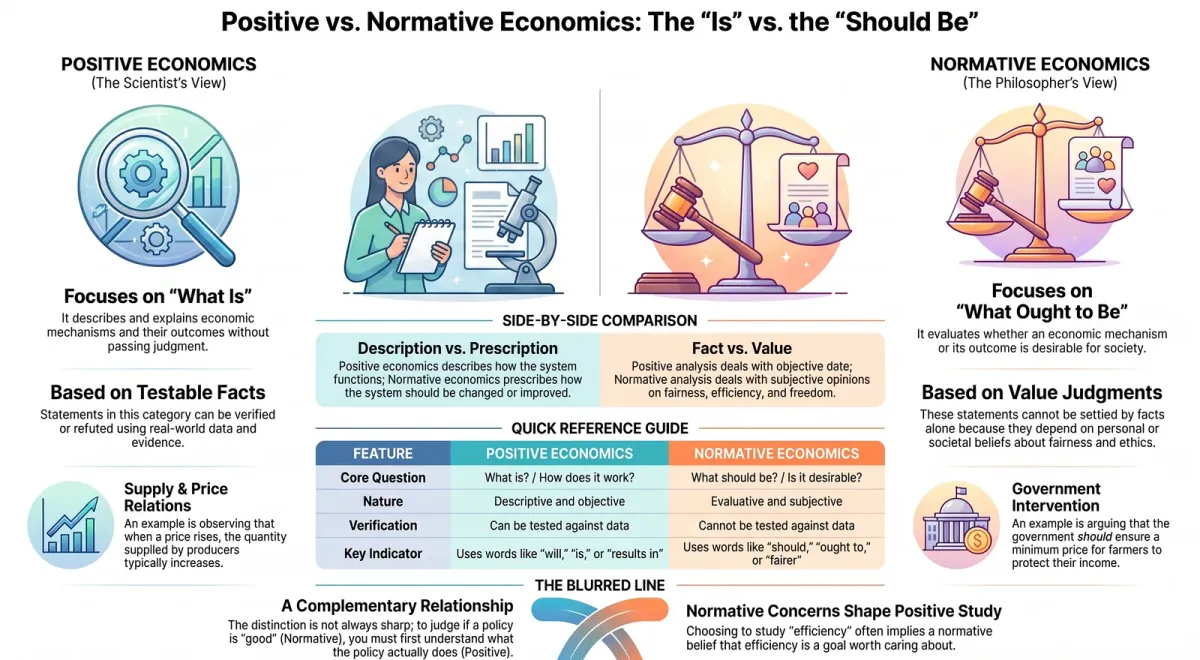
Economics isn’t just about describing how things work — it’s also about judging whether they should work that way. This dual nature of the subject is captured by a distinction every Class 11 student must understand: the difference between positive economics and normative economics. Let’s break down what each means and why the line between them isn’t always as clear as it first appears.
Why Economists Study Mechanisms in Two Different Ways
As you’ve seen in earlier topics, there’s more than one way to solve the central problems of an economy — through markets, through central planning, or through some mix of the two. Each of these mechanisms produces different outcomes: different allocations of resources and different distributions of goods and services. Naturally, this raises two separate but related questions: how does each mechanism actually function, and which of these mechanisms is more desirable for society? These two questions correspond directly to positive and normative economic analysis.
Examples of Positive Statements
Studying how the price mechanism coordinates supply and demand in a market economy, or analysing what happens to production when the government fixes prices, are both examples of positive economic analysis. The goal is to figure out the outcome that a given mechanism produces, not to evaluate whether that outcome is desirable.
Examples of Normative Statements
Should the government intervene to control prices? Is a market economy fairer than a centrally planned one? Should resources be redistributed to reduce inequality? These are normative questions because they involve value judgements — they can’t be settled by facts alone, since different people may weigh fairness, efficiency, and freedom differently.
Why the Line Between Positive and Normative Is Not Always Sharp
It might seem like positive and normative economics are two completely separate boxes, but in reality, the distinction is not very sharp. The two are closely intertwined, and a proper understanding of one is difficult without the other. Consider this: to make a normative judgement about whether a policy is “good,” you first need a positive understanding of what that policy actually does. Conversely, the way economists frame positive questions is often shaped, even subtly, by normative concerns about what outcomes matter.
For instance, deciding to study “how effectively a market allocates resources” already assumes that efficient resource allocation is something worth caring about — a value-laden starting point, even though the analysis itself remains fact-based. This is why economists generally treat positive and normative analysis as complementary tools rather than as a rigid divide.
Quick Examples to Tell Them Apart
A simple way to distinguish the two is to ask: is the statement describing what is, or prescribing what should be?
-
“When the price of a good rises, the quantity supplied by producers tends to increase.” — This is a positive statement. It describes an observable relationship and can be tested against real-world data.
-
“The government should ensure a minimum price for farmers to protect their income.” — This is a normative statement. It expresses a value judgement about what ought to happen, not a testable fact.
-
“A market economy allocates resources through the price mechanism.” — Positive, since it explains how the system functions.
-
“A market economy is a fairer system than a centrally planned economy.” — Normative, since “fairer” involves a value judgement.
Once you start applying this “is versus should be” test, distinguishing positive from normative statements becomes much more intuitive, even in unfamiliar exam questions.
Bringing It Together
Understanding positive and normative economics equips you to read economic arguments — whether in your textbook, in the news, or in policy debates — with a more critical eye. When someone claims that a particular economic policy will “work,” ask whether they mean it will produce a specific outcome (a positive claim) or that the outcome is desirable (a normative claim). Many disagreements in economics and public policy exist not because people disagree about the facts, but because they hold different normative views about what a good outcome looks like.
Ready to Test What You’ve Learned?
Positive vs normative economics is a classic conceptual question in board exams. On ChampionsPrep, resolve your doubts instantly and practice topic-wise questions for just ₹10 per use. Visit https://app.championsprep.in to build exam-ready clarity on this topic.
Test Your Knowledge

Positive vs Normative Economics: Key Differences
Frequently Asked Questions
What is positive economic analysis? +
Positive economic analysis studies how a particular economic mechanism functions, using fact-based, testable statements without making any value judgement about whether the outcome is desirable.
What is normative economic analysis? +
Normative economic analysis evaluates whether an economic mechanism or outcome is desirable, involving value judgements about what should happen rather than purely factual descriptions.
Why is the distinction between positive and normative economics not very sharp? +
Because the two are closely related — understanding whether an outcome is desirable (normative) requires first understanding how the mechanism actually works (positive), and vice versa.
How can you tell if a statement is positive or normative? +
Ask whether the statement describes what actually happens (positive) or expresses what ought to happen based on a value judgement (normative).
Can economics rely on positive analysis alone without normative analysis? +
Not effectively — a full understanding of economic mechanisms and their implications for society usually requires both positive analysis of function and normative evaluation of desirability.
AI-powered practice — free to start