
Microeconomics vs Macroeconomics: Complete Guide for Class 11 Commerce Students
If you’ve made it through the earlier topics in Chapter 1 — scarcity, central problems, the PPF, and positive versus normative analysis — you’re ready for one of the most important organising ideas in the entire subject: the split between microeconomics and macroeconomics. This distinction shapes how your entire Class 11 and 12 economics course is structured, so getting it right early makes everything that follows easier to place in context.
Two Broad Branches of Economics
Traditionally, economics has been studied under two broad branches. One branch zooms in on individual markets and individual decision-makers — this is microeconomics. The other zooms out to look at the economy as a single, aggregated system — this is macroeconomics. Both branches deal with the same underlying central problems of allocation and distribution, but they approach these problems from very different vantage points.
What Does Microeconomics Study?
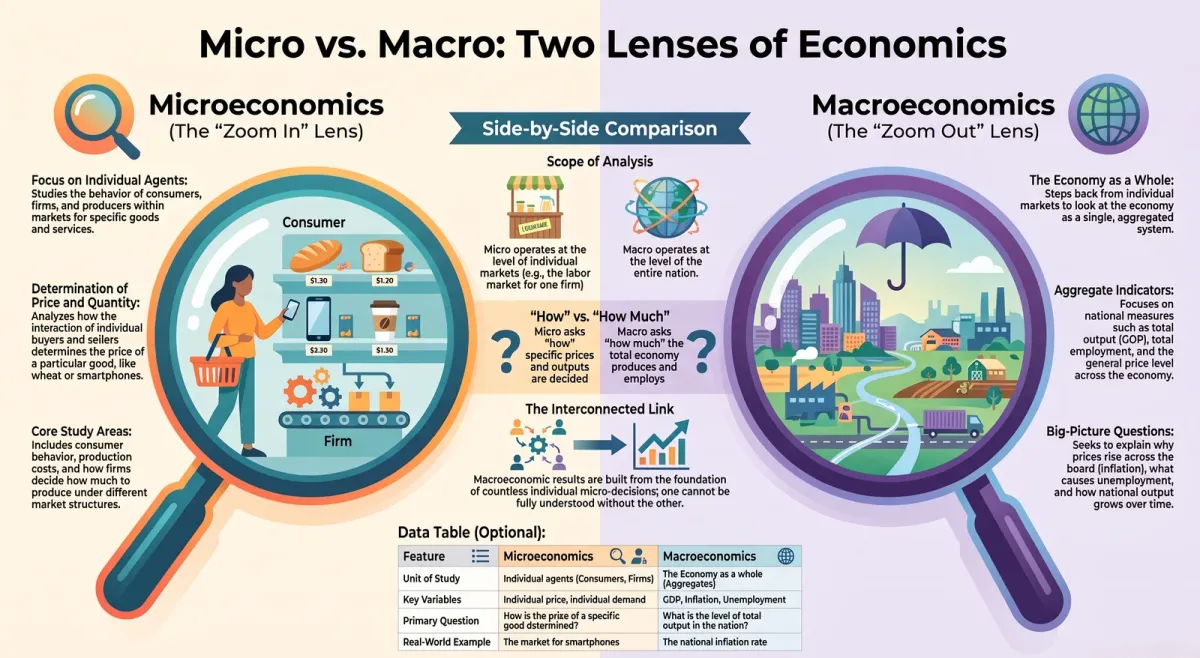
Microeconomics studies the behaviour of individual economic agents — consumers, firms, and producers — within the markets for specific goods and services. It tries to answer questions like: how is the price of a particular good determined? How much of a good will consumers buy at a given price? How does a firm decide how much to produce?
At its core, microeconomics is about understanding how prices and quantities are determined through the interaction of individual buyers and sellers in a market. This is the branch of economics that this entire textbook focuses on — you’ll spend the rest of your Class 11 course studying consumer behaviour, production and costs, producer behaviour, and how price and quantity are determined under different market structures, all from a microeconomic lens.
What Does Macroeconomics Study?
Macroeconomics, in contrast, steps back from individual markets and instead looks at the economy as a whole. Rather than asking how the price of a single commodity is determined, macroeconomics asks how aggregate measures — like total output, total employment, and the overall price level in the economy — are determined and how they change over time.
Key Questions Macroeconomics Tries to Answer
Macroeconomics tackles big-picture questions such as: What is the level of total output in the economy? How is that total output determined, and how does it grow over time? Are the economy’s resources, such as labour, fully employed, or is there unemployment? What causes unemployment when it happens? Why do prices rise across the economy — in other words, what causes inflation? These questions matter for entire nations, not just individual markets, which is why macroeconomics is often the branch you hear referenced in news reports about GDP growth, inflation rates, and unemployment figures.
Key Differences Between Microeconomics and Macroeconomics
The clearest way to separate the two branches is by their scope. Microeconomics operates at the level of individual markets — the market for wheat, the market for smartphones, the market for a particular firm’s labour. Macroeconomics operates at the level of the entire economy, aggregating across all these individual markets into single, economy-wide measures.
Another way to think about it: microeconomics asks “how” questions about specific goods and services — how is this particular price determined, how does this particular firm decide its output. Macroeconomics asks “how much, in total” questions — how much does the whole economy produce, how many people in total are employed, how fast do prices rise across the board.
It’s worth noting that microeconomics and macroeconomics aren’t disconnected from each other. Aggregate, economy-wide outcomes in macroeconomics are ultimately built up from the countless individual decisions studied in microeconomics. Understanding one branch well often makes the other easier to grasp, which is why most economics courses, including this one, introduce microeconomics first before moving on to macroeconomic analysis in later years.
What You’ll Study in This Microeconomics Course
Since this particular textbook focuses on microeconomics, it’s useful to know what lies ahead. The course builds up progressively: first, it examines the behaviour of individual consumers — how they decide what and how much to buy. Then it moves to the basic ideas of production and cost, followed by producer behaviour — how firms decide how much to produce and at what cost. Building on these foundations, the course examines how price and quantity are determined in a perfectly competitive market for a single commodity, and finally explores other market structures beyond perfect competition.
Each of these topics builds directly on the ideas introduced in this chapter — scarcity, choice, the central problems of an economy, and the production possibility frontier — so a solid grasp of these fundamentals will make every subsequent chapter significantly easier to follow.
Ready to Test What You’ve Learned?
Micro vs macro is a foundational distinction that shows up throughout your economics course. On ChampionsPrep, resolve your doubts instantly and practice topic-wise questions for just ₹10 per use. Visit https://app.championsprep.in to build a strong base before you move to the next chapter.
Test Your Knowledge
Microeconomics vs Macroeconomics: Complete Guide | Class 11 Commerce
Frequently Asked Questions
What is the main difference between microeconomics and macroeconomics? +
Microeconomics studies individual economic agents and specific markets, while macroeconomics studies the economy as a whole using aggregate measures like total output and employment.
What kinds of questions does microeconomics try to answer? +
Microeconomics asks how prices and quantities of specific goods and services are determined through the interaction of individual buyers and sellers in a market.
What kinds of questions does macroeconomics try to answer? +
Macroeconomics asks about the level and growth of total output, whether resources like labour are fully employed, and why prices rise across the economy as a whole.
Are microeconomics and macroeconomics related to each other? +
Yes, macroeconomic outcomes are ultimately built up from countless individual decisions studied in microeconomics, so the two branches are closely connected despite their different scope.
Does the Class 11 Introductory Microeconomics textbook cover macroeconomics as well? +
No, this textbook focuses specifically on microeconomics, covering consumer behaviour, production and cost, producer behaviour, and price determination in different market structures.
AI-powered practice — free to start