
The Last Lesson: Exam Tips, Important Questions and Revision Checklist
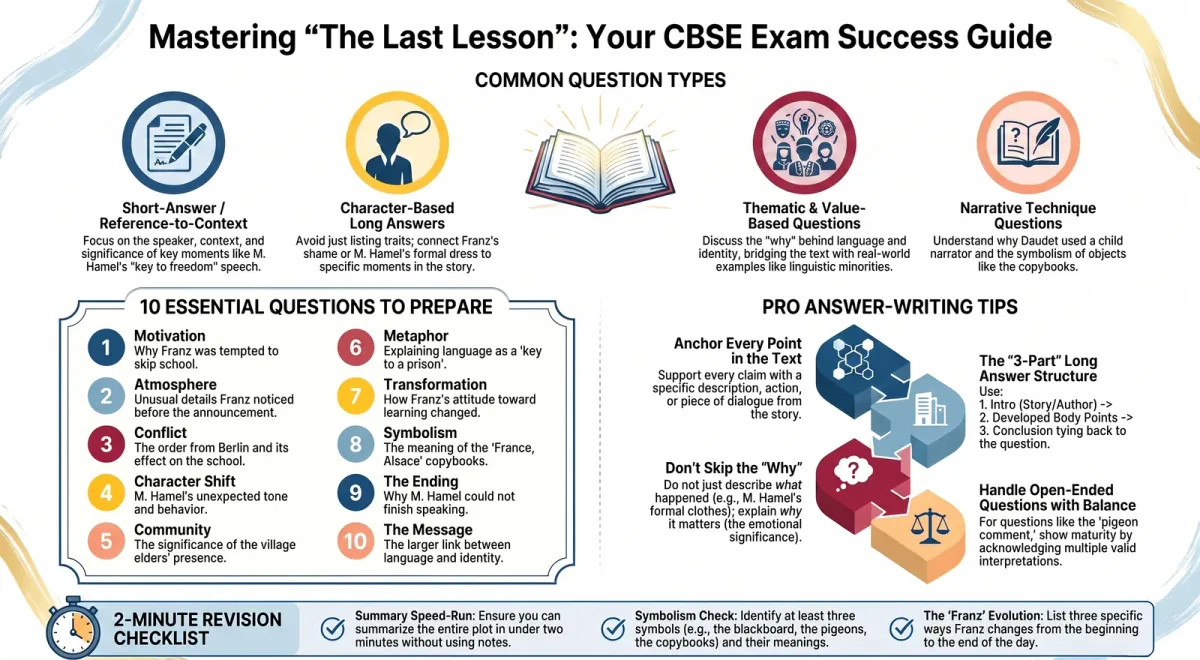
With the story, its characters, themes, and literary style covered across earlier posts in this series, this final piece pulls everything together into an exam-focused format. Here you will find the question types CBSE Class 12 papers most often draw from “The Last Lesson,” practical tips for structuring strong answers, and a quick checklist for last-minute revision.
Common Question Types on This Chapter
Short-Answer / Reference-to-Context Questions
These questions typically quote a line or short passage and ask students to identify the speaker, the context, and its significance. Frequent focus points include M. Hamel’s announcement about the last lesson, his reflection on the French language as a “key” to freedom, and the closing blackboard scene. For these, always identify who is speaking, when in the story the line occurs, and why it matters — a three-part structure that examiners look for even in brief answers.
Character-Based Long Answers
Long-answer questions often ask students to sketch Franz or M. Hamel, or to trace how a character changes across the story. Strong responses avoid listing personality traits in isolation and instead connect each trait to a specific moment: Franz’s shame at the recitation, M. Hamel’s formal dress and gentle tone that morning, his admission of shared blame for the students’ gaps in learning.
Thematic and Value-Based Questions
These ask students to discuss the story’s message about language, freedom, or the importance of education, sometimes extending into the “Talking About the Text” prompts about linguistic minorities or linguistic chauvinism. Answers here benefit from balancing the story’s specific details with a broader, real-world example, since board examiners reward the ability to generalise from a text without losing sight of it.
Narrative Technique Questions
Occasionally, students are asked to comment on how the story is told — for instance, why a child narrator is effective, or what the symbolism of the copybooks or the blackboard scene contributes to the story’s impact. These answers should name the specific technique and then explain its effect in context, rather than describing the technique in the abstract.
Ten Important Questions to Prepare
-
Why is Franz initially tempted to skip school on the day of the story?
-
What details make Franz realise something unusual is happening even before M. Hamel’s announcement?
-
What order has come from Berlin, and what effect does it have on the school?
-
How does M. Hamel’s tone and behaviour toward Franz differ from what Franz expects that morning?
-
Why do the village elders attend the last lesson, and what does their presence suggest?
-
What does M. Hamel mean when he compares language to a key to a prison?
-
How does Franz’s attitude toward his lessons and his teacher change over the course of the day?
-
What is the significance of the copybooks reading “France, Alsace”?
-
Describe the final scene of the story and explain why M. Hamel cannot finish speaking.
-
What larger message about language and identity does the story convey?
Answer-Writing Tips for This Chapter
Anchor Every Point in the Text
Whether the question is about theme, character, or style, always support your point with a specific detail or moment from the story — a description, an action, or a piece of dialogue — rather than relying on general statements alone.
Structure Long Answers Clearly
For long-answer questions, use a brief introduction that identifies the story and author, two or three well-developed body points, and a short concluding line that ties back to the question. This structure helps examiners quickly locate the marks-worthy content in your response.
Don’t Skip the “Why,” Only the “What”
Many students describe what happens in the story accurately but lose marks by failing to explain why it matters — for instance, describing M. Hamel’s formal clothing without explaining what it reveals about his emotional state and the significance of the occasion.
Handle Open-Ended Questions With Balance
For questions like the interpretation of Franz’s pigeon comment or the discussion of linguistic pride versus linguistic chauvinism, present a clear position while acknowledging that more than one reasonable reading exists — this shows examiners a mature, balanced understanding rather than a rigid, memorised answer.
Quick Revision Checklist
-
Can you summarise the plot of “The Last Lesson” in under two minutes without notes?
-
Can you name three ways Franz changes from the beginning to the end of the story?
-
Can you explain, in your own words, why M. Hamel compares language to a “key to a prison”?
-
Can you list at least three symbolic details from the story and explain what each represents?
-
Can you connect the story’s theme of linguistic identity to at least one real-world example?
-
Can you describe the story’s closing scene and explain its emotional and symbolic weight?
-
Have you revisited the “Talking About the Text” discussion points on linguistic minorities and linguistic chauvinism?
Working through this checklist a day or two before your exam is a fast way to spot any gaps before they cost you marks.
Related Reading
-
The Last Lesson Summary and Analysis (CBSE Class 12 English, Flamingo Chapter 1)
-
The Last Lesson Character Sketch: Franz and M. Hamel (CBSE Class 12 English Flamingo)
-
The Last Lesson Themes: Language, Identity and Freedom (CBSE Class 12 English Flamingo)
Turn This Checklist into a Study Habit with ChampionsPrep
Revision works best when it’s active, not passive. ChampionsPrep’s AI-powered platform gives CBSE and State Board Class 11-12 students chapter-wise practice questions and instant feedback to build genuine exam readiness. It is free to register & pay as you use. Start practising on ChampionsPrep today .
Test Your Knowledge

The Last Lesson: Exam Tips, Important Questions and Revision Checklist (CBSE Class 12 English Flamingo)
Frequently Asked Questions
What is the most commonly asked type of question on "The Last Lesson" in CBSE exams? +
Reference-to-context questions based on key lines, along with character-based and theme-based long-answer questions, are the most frequent question types drawn from this chapter.
How should I structure a long answer on M. Hamel's character? +
Begin with a brief introduction naming the story and character, develop two or three points supported by specific moments from the text, and close with a line connecting his character to the story's broader message.
Is there a single correct answer for open-ended questions like Franz's pigeon comment? +
No, several of the chapter's discussion questions accept more than one reasonable interpretation, and a mature answer presents a clear position while acknowledging that other readings are valid.
What is the biggest mistake students make when answering questions on this chapter? +
The most common mistake is describing what happens in the story without explaining why it matters, which loses marks even when the factual description itself is accurate.
How can I revise this chapter quickly before an exam? +
Use a checklist approach: test yourself on the plot summary, character changes, key symbols, and the story's central theme without referring to notes, then revisit any point you cannot recall confidently.
AI-powered practice — free to start