
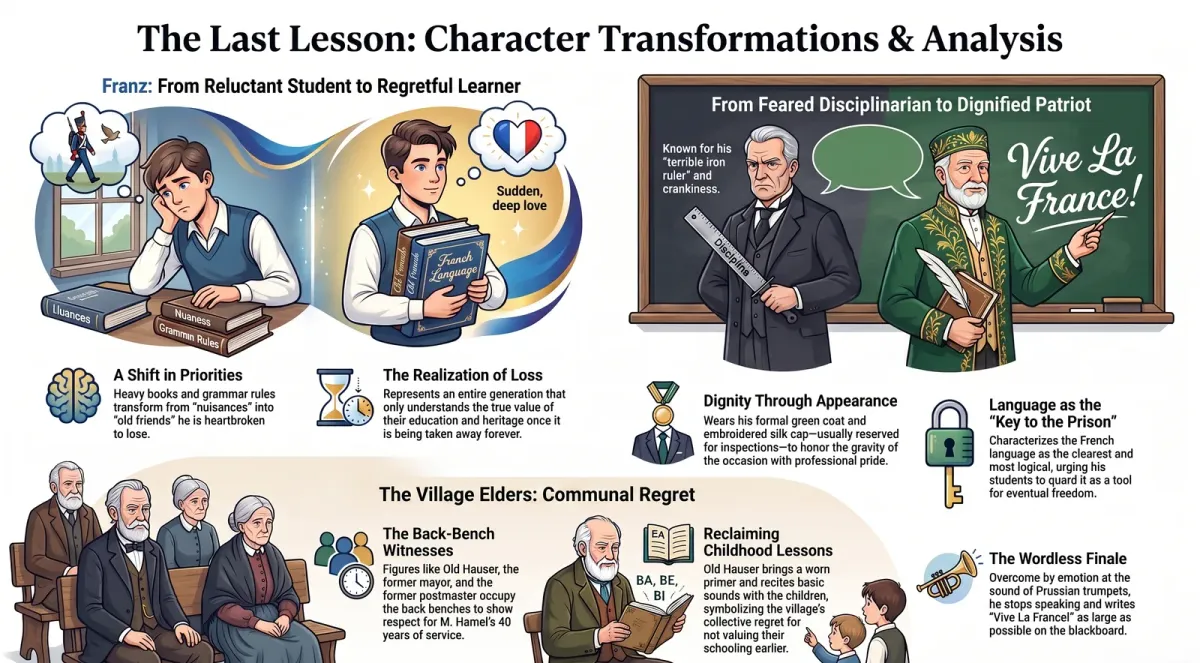
The Last Lesson Character Sketch: Franz and M. Hamel
Alphonse Daudet’s “The Last Lesson” works so well as short fiction because its two central characters are drawn with such economy. Franz, the young narrator, and M. Hamel, his teacher, each undergo an emotional shift within a single school day, and understanding that shift is essential for CBSE Class 12 students answering character-based questions on this chapter. This post examines both figures, along with the quietly important village elders in the back of the classroom.
Franz: The Narrator and Reluctant Student
Franz at the Start of the Story
When the story opens, Franz is a fairly ordinary boy with an ordinary boy’s priorities. He is late for school, has not learned his lesson on participles, and briefly considers skipping school altogether to enjoy the warm weather outdoors. He is more drawn to the birds chirping and the Prussian soldiers drilling near the sawmill than to grammar rules waiting for him in the classroom. This opening portrait matters because it establishes Franz as an entirely relatable, imperfect student — not a model pupil, but someone many readers will recognise in themselves.
Franz’s Transformation
The heart of Franz’s character arc is how quickly and completely his priorities reverse once M. Hamel announces that this is the last French lesson the class will ever receive. Suddenly, the very things Franz resented — his heavy books, his grammar exercises, even M. Hamel’s feared iron ruler — become precious to him, because he now understands he is about to lose access to them forever. He is ashamed that he cannot recite the rule for participles when called upon, and for the first time he listens with complete attention as M. Hamel explains the day’s grammar lesson, later admitting he is amazed at how easily he understands it.
What Franz Represents
Franz is not simply an individual character; he stands in for an entire generation of students who take education for granted until it is threatened. His guilt about procrastination, and his sudden appreciation for the language and lessons he is losing, is what gives the story its emotional universality. Through Franz, Daudet suggests that real understanding often arrives only through loss.
M. Hamel: The Devoted Teacher
A Familiar, Even Feared, Figure
For most of his forty years at the village school, M. Hamel has been a strict and somewhat intimidating presence, associated in Franz’s mind with his “terrible iron ruler” and a reputation for crankiness. This everyday severity makes his behaviour on the day of the last lesson all the more striking by contrast.
Dignity in the Face of Loss
On this final day, M. Hamel appears in his formal green coat, frilled shirt, and embroidered black silk cap — clothing usually reserved for inspection or prize days. This deliberate act of dressing up in the face of an enormous personal and professional loss reveals a man determined to meet a painful moment with dignity rather than despair. Rather than scolding Franz for arriving late, he speaks to him with unusual gentleness, a small but telling sign of how the occasion has softened him.
Patience, Patriotism, and Self-Reflection
Throughout the last lesson, M. Hamel displays remarkable patience, working carefully through grammar, writing, and history so that he can, in his own words, put everything he knows into his students’ heads at once before he goes. He is also strikingly self-critical, admitting that he too is partly to blame for the students’ gaps in learning, having sometimes given them a holiday to go fishing instead of teaching. His long reflection on the French language — describing it as the clearest and most logical in the world, and calling it the “key” to a prison for an enslaved people — reveals a man whose patriotism is inseparable from his professional devotion.
The Final, Wordless Moment
M. Hamel’s character reaches its most powerful point at the very end of the story. Overcome with emotion as Prussian trumpets sound outside, he cannot finish the sentence he begins. Instead, he turns to the blackboard and writes as large as he can, then dismisses the class with only a gesture. This inability to speak, followed by an act of silent, determined writing, captures a lifetime of devotion condensed into a single wordless image.
The Village Elders: Old Hauser and Others
Although they have no dialogue, the elderly villagers who occupy the back benches — old Hauser with his three-cornered hat, the former mayor, and the former postmaster — add real emotional weight to the story. Hauser even brings along his own old, worn primer, holding it open with his spectacles resting on the pages, and joins the youngest children in reciting basic sounds. Their presence signals communal regret at not having valued their own schooling and language while they could, and their quiet dignity mirrors M. Hamel’s own.
Why This Matters for Exam Answers
CBSE Class 12 papers frequently ask students to sketch Franz or M. Hamel individually, or to compare how each character changes over the story. Strong answers go beyond simply describing personality traits and instead trace the specific moments — Franz’s shame at the recitation, M. Hamel’s formal dress, the closing blackboard scene — that reveal character through action rather than direct description.
Related Reading
-
The Last Lesson Summary and Analysis (CBSE Class 12 English, Flamingo Chapter 1)
-
The Last Lesson Themes: Language, Identity and Freedom (CBSE Class 12 English Flamingo)
-
The Last Lesson: Literary Devices and Narrative Style (CBSE Class 12 English Flamingo)
-
The Last Lesson: Exam Tips, Important Questions and Revision Checklist (CBSE Class 12 English Flamingo)
Build Stronger Answers with ChampionsPrep
Character-based questions reward specific, well-organised detail, not vague description. ChampionsPrep’s AI-powered platform helps CBSE and State Board students practise exactly this kind of exam-style answer writing, chapter by chapter. It is free to register & pay as you use. Start practising on ChampionsPrep today .
Test Your Knowledge

The Last Lesson Character Sketch: Franz and M. Hamel (CBSE Class 12 English Flamingo)
Frequently Asked Questions
What kind of student is Franz at the beginning of the story? +
Franz is a distracted, somewhat reluctant student who is late for school, unprepared for his lesson, and tempted to skip class altogether to enjoy the outdoors.
How does Franz change by the end of the story? +
He develops a sudden, deep appreciation for his lessons, his teacher, and his language once he learns this is the last French class he will ever attend, listening with unusual attention and regretting his earlier carelessness.
Why does M. Hamel wear his formal clothes on the last day? +
He wears his green coat and embroidered cap, normally reserved for special occasions, to honour his final French lesson with dignity after forty years of teaching in the same school.
What does M. Hamel's speech about the French language reveal about him? +
It reveals his deep patriotism and his belief that language is central to a people's freedom and identity, since he describes it as a "key" that an enslaved people must hold onto.
Why do the village elders attend the last lesson? +
They attend to show respect for M. Hamel's decades of service and to express quiet regret at not valuing their own education and language while they had the freedom to do so.
AI-powered practice — free to start