
The Last Lesson Themes: Language, Identity and Freedom
Alphonse Daudet’s “The Last Lesson” is a short story, but it carries several interlocking themes that CBSE Class 12 students are regularly asked to discuss in both short and long-answer formats. Beneath its simple classroom setting lie ideas about language, colonial loss, procrastination, and the quiet dignity of ordinary people facing forces beyond their control. This post breaks down each major theme with supporting detail from the story.
Language as the Foundation of Identity
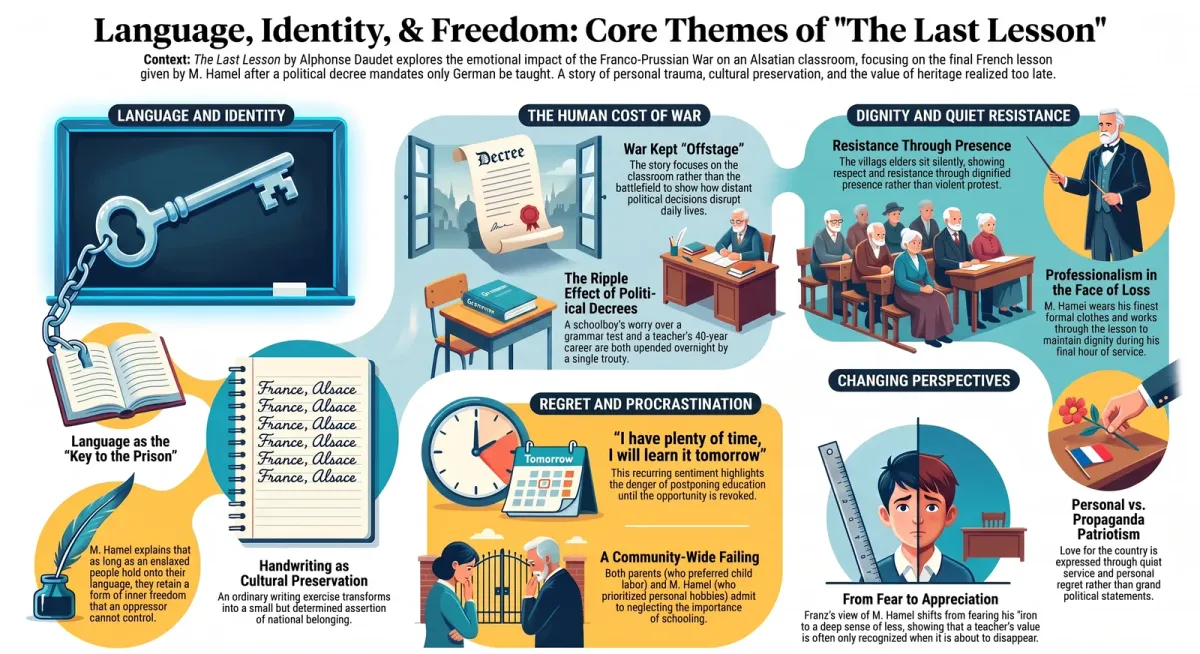
The most central theme of “The Last Lesson” is the idea that a people’s language is inseparable from their sense of who they are. When M. Hamel tells his students that French is the clearest and most logical language in the world, and that they must guard it carefully, he is not simply expressing pride — he is warning them that losing their language means losing a part of themselves. His statement that a language held onto by an enslaved people is like a key to their prison captures this theme precisely: as long as people can still speak and think in their own language, an occupying power cannot fully control them.
This theme becomes especially vivid through the writing exercise where students copy out “France, Alsace” in their new copybooks. An ordinary handwriting lesson becomes an act of preserving identity, a small but determined assertion of belonging to a nation and a culture that political decisions elsewhere are trying to erase.
The Trauma of Political Decisions on Ordinary Lives
Daudet deliberately keeps the war itself offstage. There are no battle scenes, no soldiers charging, no depiction of Bismarck or the treaty negotiations. Instead, the story shows how a decision made far away, in Berlin, reaches all the way down into a single village classroom and changes the lives of a teacher and his students overnight. This is one of the story’s most effective techniques: it demonstrates that the human cost of political and military decisions is often felt most sharply not by soldiers or statesmen, but by ordinary people going about their daily routines — a schoolboy worried about a grammar test, a teacher who has spent forty years in the same room.
Regret and the Danger of Procrastination
Franz’s arc through the story is built almost entirely around regret. He is ashamed that he has not learned his lessons, wishing desperately that he could recite the rule for participles without a single mistake, precisely because he now understands he will never have another chance to prove himself in French class. M. Hamel extends this theme to the whole community, admitting that parents often preferred sending children to work on farms or at the mills over sending them to school, and confessing that he himself sometimes let lessons slide in favour of a fishing trip. The recurring idea — that people say “I have plenty of time, I will learn it tomorrow” until tomorrow no longer exists — gives the story a message that extends well beyond its historical setting.
Respect and Renewed Appreciation for Teachers
Franz’s feelings about M. Hamel shift dramatically over the course of the story. At the start, M. Hamel is associated with sternness and his feared iron ruler; by the end, Franz cannot bear the thought of losing him and forgets all about his crankiness. This shift reflects a broader theme about how the true value of a teacher’s guidance is often recognised only when it is at risk of disappearing. The presence of the village elders, sitting respectfully in the back benches to honour M. Hamel’s forty years of service, reinforces this same idea on a community-wide scale.
Dignity in the Face of Loss
Rather than despair or protest, the characters in “The Last Lesson” respond to an enormous loss with quiet dignity. M. Hamel dresses in his formal clothes, works patiently through every subject on the timetable, and channels his emotion into writing “Vive La France!” on the blackboard when words fail him. The village elders sit silently, showing their respect through presence rather than speech. This restrained, dignified response to occupation is itself a form of resistance — one that does not require violence or open defiance to make its point.
Patriotism Without Propaganda
While the story is unmistakably patriotic, it expresses this patriotism through personal, specific detail rather than grand political statements. The love for France and the French language is shown through a teacher’s forty years of quiet service, a boy’s sudden regret, and a roomful of villagers giving up an ordinary morning to sit in a schoolroom. This grounded, human-scale patriotism is part of why the story has remained widely taught and translated for over a century.
Why These Themes Matter for CBSE Exams
Questions on “The Last Lesson” frequently ask students to connect the story’s themes to real-world examples of linguistic minorities or to discuss whether pride in one’s language can go too far. Being able to move fluently between the story’s specific details and these larger thematic ideas is exactly what board examiners reward in high-scoring answers.
Related Reading
-
The Last Lesson Summary and Analysis (CBSE Class 12 English, Flamingo Chapter 1)
-
The Last Lesson Character Sketch: Franz and M. Hamel (CBSE Class 12 English Flamingo)
-
The Last Lesson: Exam Tips, Important Questions and Revision Checklist (CBSE Class 12 English Flamingo)
Master These Themes with ChampionsPrep
Thematic questions ask you to connect a story’s specific details to bigger ideas, which takes practice to do well under exam conditions. ChampionsPrep’s AI-powered platform gives CBSE and State Board students structured chapter-wise practice to build exactly this skill. It is free to register & pay as you use. Start practising on ChampionsPrep today .
Test Your Knowledge

The Last Lesson Themes: Language, Identity and Freedom (CBSE Class 12 English Flamingo)
Frequently Asked Questions
What is the central theme of "The Last Lesson"? +
The central theme is that language is deeply tied to identity and freedom, and that people often recognise its true value only when they are about to lose the right to use it.
How does the story show the effect of war without depicting battles? +
Daudet keeps the war offstage entirely, instead showing its impact through an ordinary classroom, a teacher's final lesson, and a boy's regret, demonstrating how political decisions affect everyday lives.
What does M. Hamel mean by calling language "the key to their prison"? +
He means that as long as an occupied or enslaved people continue to speak and think in their own language, they retain a form of inner freedom that cannot be taken away by force.
How does the theme of regret appear in the story? +
It appears through Franz's shame at not having learned his lessons and through M. Hamel's admission that he and the parents share blame for repeatedly postponing the value they placed on education.
Why is the villagers' dignified silence considered a form of resistance? +
Their quiet, respectful presence in the classroom, without protest or violence, asserts the value of what is being taken from them and honours their culture and teacher in the face of forces they cannot change.
AI-powered practice — free to start