
Exponential Growth Models: How Mathematics Predicts Population Growth
How does a government agency estimate how many people will live in a country ten years from now? The CBSE Class 11 NCERT Appendix on Mathematical Modelling answers this with a population growth model built from birth rates, death rates, and one of the most important functions in mathematics — the exponential function. This post derives the model step by step and closes out the appendix by summarising the full modelling cycle.
Step 1: Formulating the Problem
Suppose a population control unit wants to find out how many people will be in a certain country after 10 years. The population clearly changes with time: it increases through births and decreases through deaths.
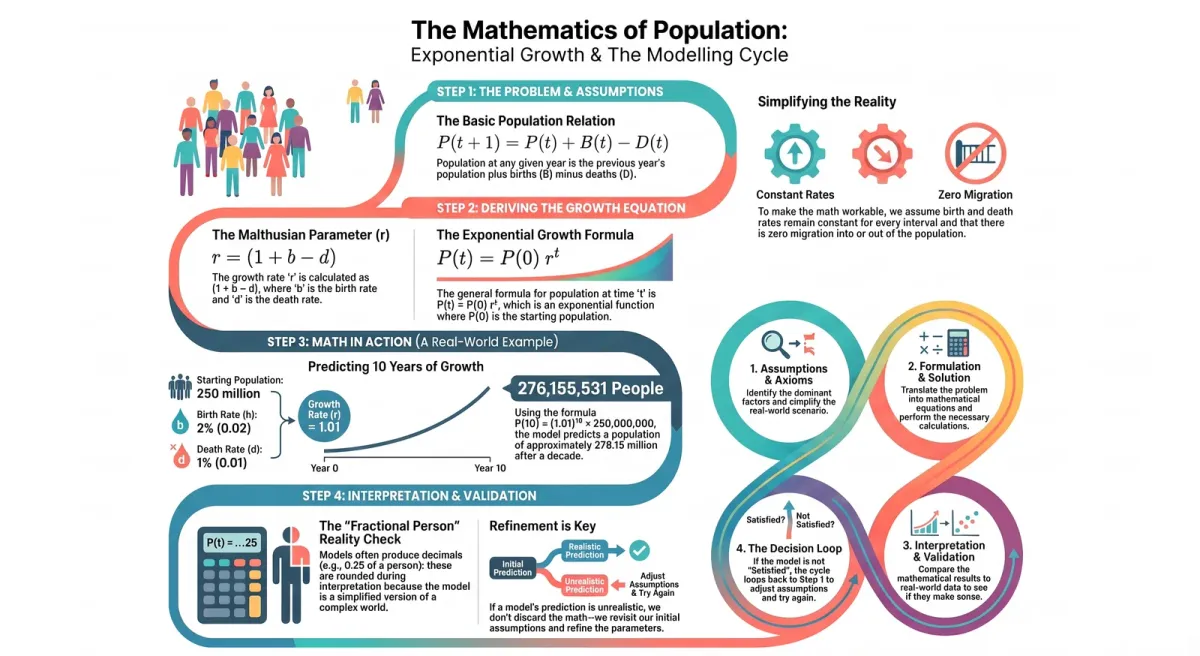
Let t denote time in years, where t = 0 is the present time, t = 1 is the next year, and so on. Let P(t) denote the population at time t. If B(t) is the number of births between year t and t + 1, and D(t) is the number of deaths in that same interval, then the population one year later is:
P(t + 1) = P(t) + B(t) − D(t)
Defining Birth Rate and Death Rate
Two useful ratios are defined from this relation:
-
B(t) / P(t) is called the birth rate for the interval t to t + 1
-
D(t) / P(t) is called the death rate for the same interval
Two Simplifying Assumptions
To turn this into a workable model, two assumptions are made:
-
The birth rate is the same for every interval, and so is the death rate. This means there exist constants b (birth rate) and d (death rate) such that b = B(t)/P(t) and d = D(t)/P(t) for all t ≥ 0.
-
There is no migration into or out of the population — the only sources of population change are births and deaths.
Step 2: Deriving the Growth Equation
Using these two assumptions, the population relation becomes:
P(t + 1) = P(t) + B(t) − D(t) = P(t) + bP(t) − dP(t) = (1 + b − d) P(t)
Setting t = 0 gives P(1) = (1 + b − d) P(0). Setting t = 1 gives P(2) = (1 + b − d) P(1) = (1 + b − d)² P(0), since P(1) can be substituted from the previous step. Continuing this pattern for every value of t produces the general formula:
P(t) = (1 + b − d)ᵗ P(0)
The constant (1 + b − d) is commonly abbreviated as r and called the growth rate, or the Malthusian parameter, named after Robert Malthus, who first popularised this style of population model. In terms of r, the formula becomes:
P(t) = P(0) rᵗ, for t = 0, 1, 2, …
This is an example of an exponential function — any function of the form c·rᵗ, where c and r are constants, is exponential. This equation is the complete mathematical formulation of the population problem.
Step 3: Solving with Real Numbers
Suppose the current population is 250,000,000, with a birth rate b = 0.02 and a death rate d = 0.01. This gives a growth rate r = 1 + 0.02 − 0.01 = 1.01. To find the population after 10 years, calculate P(10):
P(10) = (1.01)¹⁰ × 250,000,000 = 1.104622125 × 250,000,000 = 276,155,531.25
Step 4: Interpretation and Validation
This result is immediately flagged as slightly unrealistic — no country can have 0.25 of a person. This is a normal and expected feature of mathematical models: the underlying assumptions (constant birth and death rates, zero migration) are simplifications of a far more complex reality, so the model’s output needs sensible rounding and interpretation. After rounding, the population is approximated as 276,155,531. The small mismatch between the model’s precision and reality is not a flaw to panic over — it is simply the cost of simplifying the real world enough to make it mathematically tractable.
The Complete Mathematical Modelling Cycle
Having worked through the tower-height, Konigsberg bridge, pendulum, food-mix, and population examples, the NCERT appendix closes by summarising the entire process as a repeating cycle:
Assumptions/Axioms → Formulation → Solution → Interpretation → Validation → Satisfied?
If the answer to “Satisfied?” is yes, the process stops — the model is accepted as a good enough representation of reality. If the answer is no, the cycle loops back to the assumptions stage: perhaps an essential parameter was left out, an assumption was too simplistic, or the formulation needs adjustment. A new formulation, new mathematical manipulation, and a fresh evaluation follow, and the loop repeats until the model’s predictions are close enough to observed facts.
This is the central lesson of the entire appendix: the real world is far too complex to describe completely. Modelling works by deliberately picking out just one or two dominant factors, building a simplified model around them, and refining that model repeatedly as better data or sharper reasoning becomes available. Every equation covered in this appendix — from h = d tan θ to P(t) = P(0)rᵗ — is a snapshot of this ongoing refinement process, not a final, perfect truth.
Keep Learning
-
Linear Programming as a Mathematical Model: The Farm Food-Mix Problem
-
The Four Steps of Mathematical Modelling Explained with the Simple Pendulum
-
What Is Mathematical Modelling? Meaning, Need & Real-Life Examples
Start Practising with ChampionsPrep
Exponential growth, formulation, and validation are recurring themes across CBSE Maths and Commerce entrance exams alike. Register free on ChampionsPrep for AI-powered practice questions, detailed explanations, and mock tests designed for CBSE and Maharashtra Board Class 11–12 Commerce students — with simple pay-as-you-use pricing.
Test Your Knowledge

Exponential Growth Models: How Mathematics Predicts Population Growth (Class 11 Maths)
Frequently Asked Questions
What is the formula for population growth in this model? +
The formula is P(t) = P(0) rᵗ, where P(0) is the initial population, r = 1 + b − d is the growth rate, b is the birth rate, d is the death rate, and t is time in years.
What is the Malthusian parameter? +
The Malthusian parameter, denoted r, is the growth rate of a population, equal to 1 + b − d, where b is the birth rate and d is the death rate. It is named after Robert Malthus.
What assumptions does the population growth model make? +
The model assumes that the birth rate and death rate remain constant over every time interval, and that there is no migration into or out of the population.
Why does the population model give a non-whole-number answer? +
The exponential formula treats population as a continuously growing mathematical quantity, so calculations can produce fractional results; these are rounded to the nearest whole number when interpreting the real-world answer.
What are the six stages of the mathematical modelling cycle? +
The cycle moves through assumptions/axioms, formulation, solution, interpretation, and validation, followed by a check on whether the model is satisfactory — if not, the cycle repeats from the assumptions stage.
AI-powered practice — free to start