
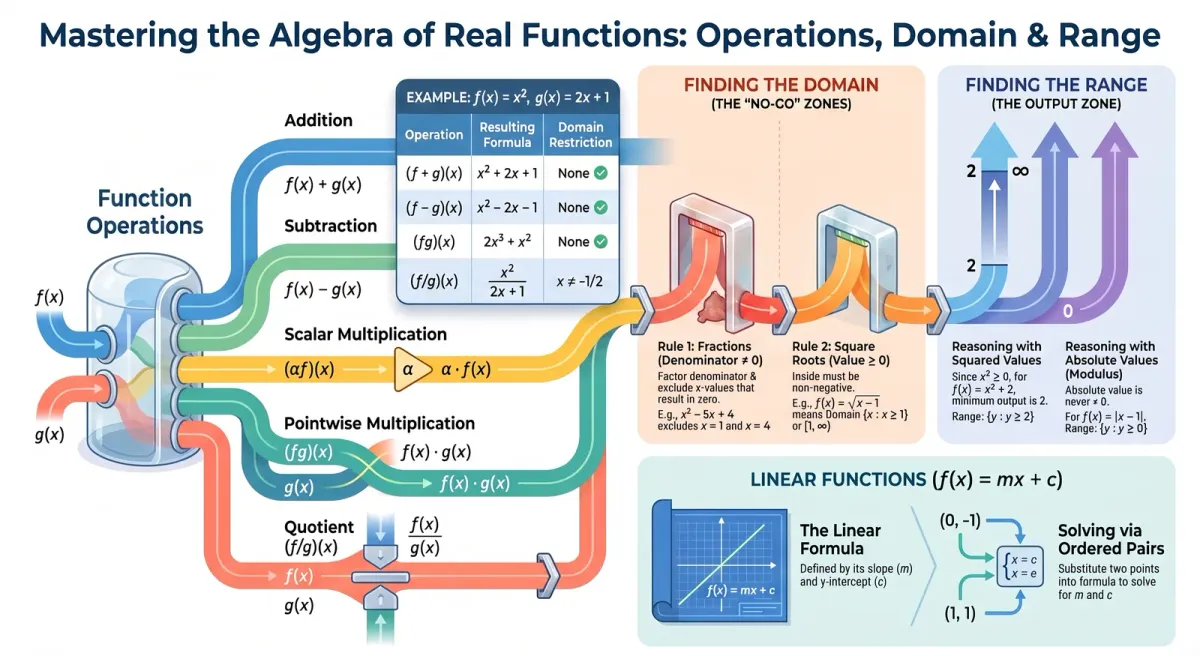
Just like numbers can be added, subtracted, multiplied, and divided, so can functions — and this chapter’s final topic, the algebra of real functions, brings together everything covered earlier: Cartesian products , relations , and types of functions . This post covers all five operations on real functions, plus an exam-critical skill: finding a function’s domain algebraically.
The Five Operations on Real Functions
Let f: X → R and g: X → R be two real functions, where X ⊆ R. These operations combine them into new functions.
Addition and Subtraction
The sum function (f + g): X → R is defined by (f + g)(x) = f(x) + g(x). Similarly, (f - g)(x) = f(x) - g(x), for every x in X.
Multiplication by a Scalar
If α is a real number, the function αf is defined by (αf)(x) = α · f(x) for every x in X — scaling every output of f by α.
Multiplication of Two Real Functions
The product function fg: X → R is defined by (fg)(x) = f(x) · g(x), for every x in X — also called pointwise multiplication.
Quotient of Two Real Functions
The quotient (f/g): X → R is defined by (f/g)(x) = f(x) / g(x), provided g(x) ≠ 0. As with any division, the quotient is undefined wherever the denominator equals zero.
Worked Example: Combining Two Functions
Let f(x) = x² and g(x) = 2x + 1 be two real functions. Applying each operation:
-
(f + g)(x) = x² + 2x + 1
-
(f - g)(x) = x² - 2x - 1
-
(fg)(x) = x²(2x + 1) = 2x³ + x²
-
(f/g)(x) = x² / (2x + 1), valid for all x except x = -1/2, where the denominator becomes zero
Notice how the quotient carries an extra restriction that the other three operations do not — this exclusion is the direct result of the “g(x) ≠ 0” condition built into the definition.
Finding the Domain of a Function
One of the most frequently tested skills in this chapter is determining the domain of a real function directly from its formula, without being told the domain explicitly. Two situations account for almost every domain question at this level.
Domain Restrictions From Denominators
Whenever a function contains a fraction, any value of x that makes the denominator zero must be excluded from the domain. For example, to find the domain of f(x) = (x² + 3x + 5) / (x² - 5x + 4), factor the denominator: x² - 5x + 4 = (x - 4)(x - 1). The function is undefined at x = 4 and x = 1, since both make the denominator zero. The domain is therefore R - {1, 4} — every real number except 1 and 4.
Domain Restrictions From Square Roots
Whenever a function contains a square root, the expression inside the root must be greater than or equal to zero, since square roots of negative numbers are not defined within the real number system. For instance, for f(x) = √(x - 1), the domain requires x - 1 ≥ 0, meaning x ≥ 1. The domain is therefore {x : x ≥ 1}, or equivalently, the interval [1, ∞).
Finding the Range of a Function
Range questions typically ask you to reason about what output values a given rule can actually produce. Consider f(x) = x² + 2 for real x. Since x² can never be negative, the smallest possible value of x² is 0, which occurs at x = 0, giving f(0) = 2 as the minimum output. As x moves further from zero in either direction, x² grows without bound, so the range is {y : y ≥ 2}.
For a modulus-based function like f(x) = |x - 1|, the same logic applies: since an absolute value can never be negative, the minimum output is 0 (achieved when x = 1), and the range is {y : y ≥ 0}.
Linear Functions and Their Formula
A linear function takes the general form f(x) = mx + c, where m and c are constants. If you are given a handful of ordered pairs known to belong to a linear function, you can determine m and c by substitution. For example, suppose f = {(1,1), (2,3), (0,-1), (-1,-3)} is known to be linear. Using (0, -1): f(0) = c = -1. Using (1, 1): f(1) = m + c = 1, so m + (-1) = 1, giving m = 2. The function is therefore f(x) = 2x - 1 — and you can verify this matches every remaining pair in the set.
Quick Recap
-
(f + g)(x) = f(x) + g(x); (f - g)(x) = f(x) - g(x); (fg)(x) = f(x)·g(x); (f/g)(x) = f(x)/g(x), g(x) ≠ 0.
-
For fractions, exclude x-values that make the denominator zero.
-
For square roots, require the expression inside to be ≥ 0.
-
A linear function f(x) = mx + c can be pinned down using any two known ordered pairs.
Related Reading
Practice What You’ve Learned
Domain-finding questions, in particular, show up in nearly every CBSE board paper and entrance exam like CUET and IPMAT, making this one of the highest-return topics to master in the chapter. ChampionsPrep offers chapter-wise practice, step-by-step solutions, and mock tests built for Class 11–12 Commerce students and competitive exam aspirants. Registration is free, and you only pay as you use the platform.
Test Your Knowledge
Algebra of Real Functions: Domain, Range & Solved Examples
Frequently Asked Questions
What is the domain restriction for the quotient of two functions? +
The quotient (f/g)(x) is defined only where g(x) ≠ 0. Any x-value that makes the denominator function zero must be excluded from the domain.
How do you find the domain of a function with a square root? +
Set the expression under the square root to be greater than or equal to zero, then solve the resulting inequality for x. The solution set is the domain.
Is multiplication of functions the same as composition of functions? +
No. Multiplying functions means multiplying their outputs pointwise, (fg)(x) = f(x)·g(x). Composition, covered in later classes, means feeding the output of one function into another.
What is the range of f(x) = x² + 2? +
Since x² is always greater than or equal to 0, adding 2 gives a minimum value of 2 at x = 0. The range is {y : y ≥ 2}.
How do you find m and c in a linear function f(x) = mx + c from given pairs? +
Substitute two known ordered pairs into the formula to form two equations, then solve them simultaneously for m and c.
AI-powered practice — free to start