

Functions of Management: Planning, Organising, Staffing, Directing and Controlling Explained
If management is a process, then planning, organising, staffing, directing, and controlling are the five functions that make up that process. NCERT Class 11 Business Studies Chapter 1 introduces all five — often remembered by the acronym POSDC — as the practical machinery through which managers actually get things done. This post walks through each function with a running small-business example, so you can see how these abstract functions show up in real, everyday decisions.
Why These Five Functions Matter
Earlier in the chapter, management is defined as the process of getting things done effectively and efficiently. That "process" specifically refers to these five functions. They are usually taught in this order — planning, then organising, staffing, directing, and finally controlling — because that mirrors a logical sequence. But in real organisational life, managers rarely perform these functions in strict isolation; they are interrelated, and it is often hard to say where one function ends and the next begins.
1. Planning
Planning is the function of determining in advance what is to be done and who is to do it. It means setting goals ahead of time and developing a way to achieve them efficiently and effectively.
Imagine a small candle-making business whose objective is production and sale of candles. Before anything else happens, the owner has to decide on quantities, variety, and colours for a given festive season, and then figure out how to allocate resources to purchase raw materials from different suppliers. Planning cannot eliminate every problem that might arise, but it can anticipate likely ones and prepare contingency responses in advance.
2. Organising
Once a plan exists, organising is the function that turns it into an actionable structure — assigning duties, grouping tasks, establishing authority, and allocating the resources needed to carry it out.
Organising answers a set of very concrete questions: what activities and resources does this plan require? Who will do a particular task? Where will it be done, and when? It also involves grouping related tasks into manageable departments or work units, and establishing clear authority and reporting relationships within the organisational hierarchy. Different kinds of businesses need different organisational structures depending on the nature of their work — a topic you will study in more depth in a later chapter.
3. Staffing
Staffing, put simply, is finding the right people for the right job. It is also called the human resource function, and it covers recruitment, selection, placement, and training of personnel.
A software company, for instance, needs systems analysts and programmers with very specific skills — staffing is the function responsible for making sure the right people, with the right qualifications, are available at the right places and times to accomplish organisational goals.
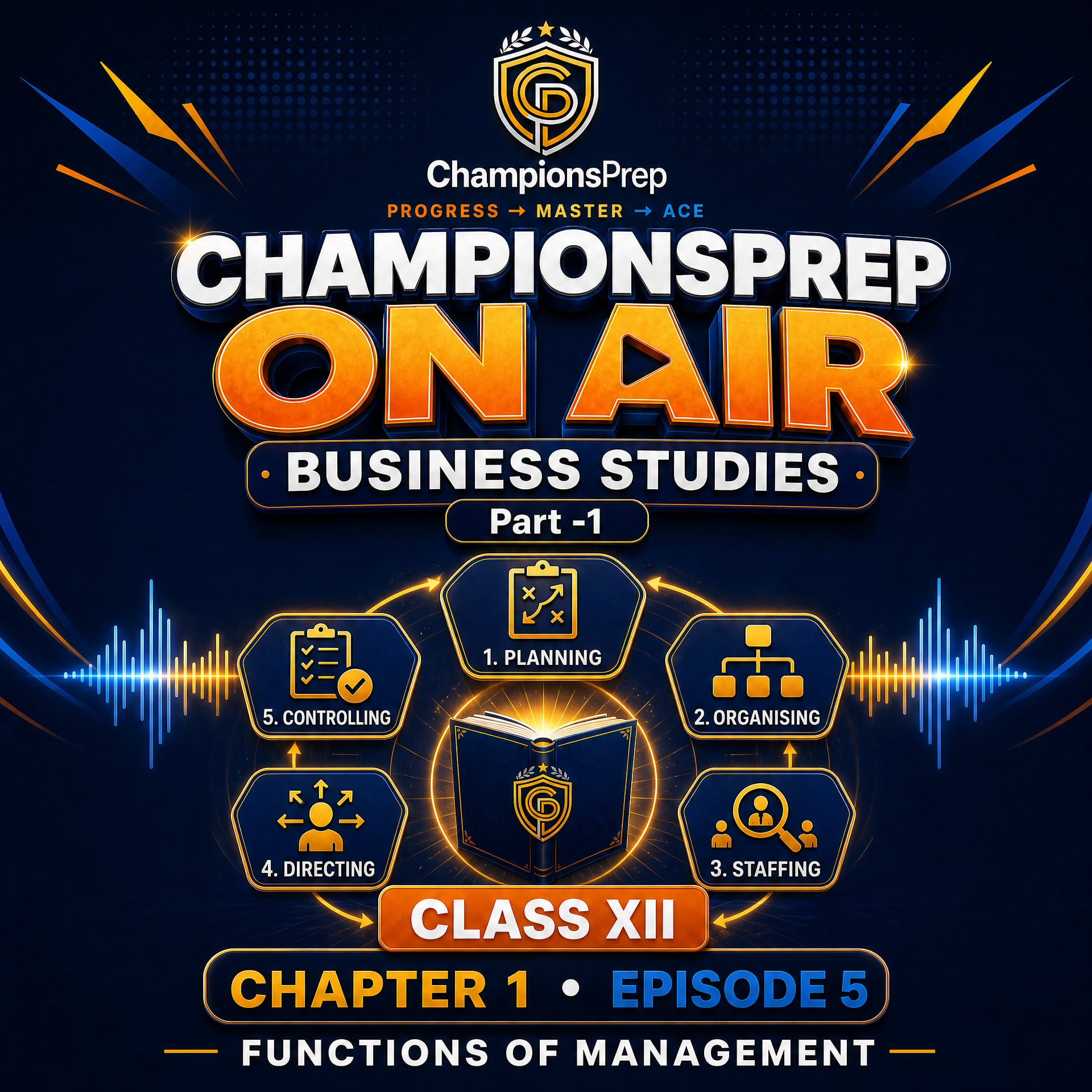
Functions of Management: Planning, Organising, Staffing, Directing and Controlling Explained
4. Directing
Directing involves leading, influencing, and motivating employees to actually perform the tasks assigned to them. It requires building an atmosphere that encourages people to do their best work, and it rests on two key components:
- Motivation — creating an environment that makes employees genuinely want to work.
- Leadership — influencing others to do what the leader wants them to do.
Directing also includes effective communication and active supervision at work. A good manager directs through a thoughtful combination of praise and constructive criticism, aiming to bring out the best in each employee rather than simply issuing instructions.
5. Controlling
Controlling is the function of monitoring organisational performance against the goals that were set during planning. It involves:
- Establishing performance standards
- Measuring actual current performance
- Comparing that performance against the established standards
- Taking corrective action wherever a deviation is found
To do this well, management has to determine which activities and outputs are actually critical to success, how and where they can be reliably measured, and who has the authority to take corrective action when something goes wrong.
The Functions Are Interrelated, Not Sequential
It is tempting to think of these five functions as a neat checklist — plan, then organise, then staff, then direct, then control. In reality, managers rarely perform them in isolation. A business owner might spend part of one day planning a future festive collection and part of another day resolving an employee's personal issue, a directing task, often within the same working week, sometimes the same day. The five functions overlap constantly, and skilled managers move fluidly between them as circumstances demand.
How This Connects to the Rest of the Chapter
These five functions are what tie together everything else in Chapter 1 — they are the concrete process through which the objectives covered earlier get pursued, and they are performed differently in emphasis at each level of management, since top managers spend more time planning and organising while supervisors spend more time directing and controlling day-to-day work. They also set up the next major concept in the chapter: coordination, often described as the force that binds all five functions together.
Related Reading on ChampionsPrep
- Link to "Levels of Management" to see how the emphasis on each function shifts between top, middle, and supervisory management.
- Link to "Coordination: The Essence of Management" as the natural next topic, since coordination binds all five functions together.
- Link to "What Is Management? Meaning, Definition and Characteristics" for readers who need the foundational definition first.
- Link to "Objectives and Importance of Management" to connect these functions back to the goals they are designed to achieve.
Build Exam-Ready Fluency
Functions of management is one of the highest-weightage topics in this chapter, and it appears repeatedly across both short-answer and case-based board questions. ChampionsPrep's AI-powered platform gives CBSE and Maharashtra Board Class 11 and 12 Commerce students focused practice for ₹10 a session, along with dedicated prep for CUET, IPMAT, JIPMAT, NPAT, and SET. Visit https://app.championsprep.in to sharpen your grip on POSDC before your next test.
Test Your Knowledge
Frequently Asked Questions
What are the five functions of management, and what does the acronym POSDC stand for? +
Planning, Organising, Staffing, Directing, and Controlling — the five interrelated functions that together make up the process of management.
Is planning the same as organising? +
No. Planning determines what needs to be done and sets goals in advance; organising takes that plan and assigns the actual duties, resources, and authority needed to execute it.
Why is staffing sometimes called the "human resource function"? +
Because it covers all the activities related to people — recruitment, selection, placement, and training — that ensure the right personnel are available to carry out the organisation's plans.
What are the two key components of directing? +
Motivation, which creates an environment that makes employees want to work, and leadership, which is influencing others to do what the leader wants.
Do managers perform these five functions one after another, in strict order? +
No. Although they are typically taught in the sequence plan-organise-staff-direct-control, in practice these functions are interrelated and overlapping, and managers move between them continuously rather than completing one before starting the next.
Keep practising Business Studies
AI-powered feedback and structured revision for Business Studies — free to start, at your own pace.
AI-powered practice — free to start