

The official CBSE Class 12 Business Studies Sample Paper 2026-27 contains a 6-mark case study on the Stock Exchange. It is a strong example of how CBSE now tests Financial Markets: the chapter name is hidden inside a realistic situation and students must identify the institution from the clues before they can even start answering.
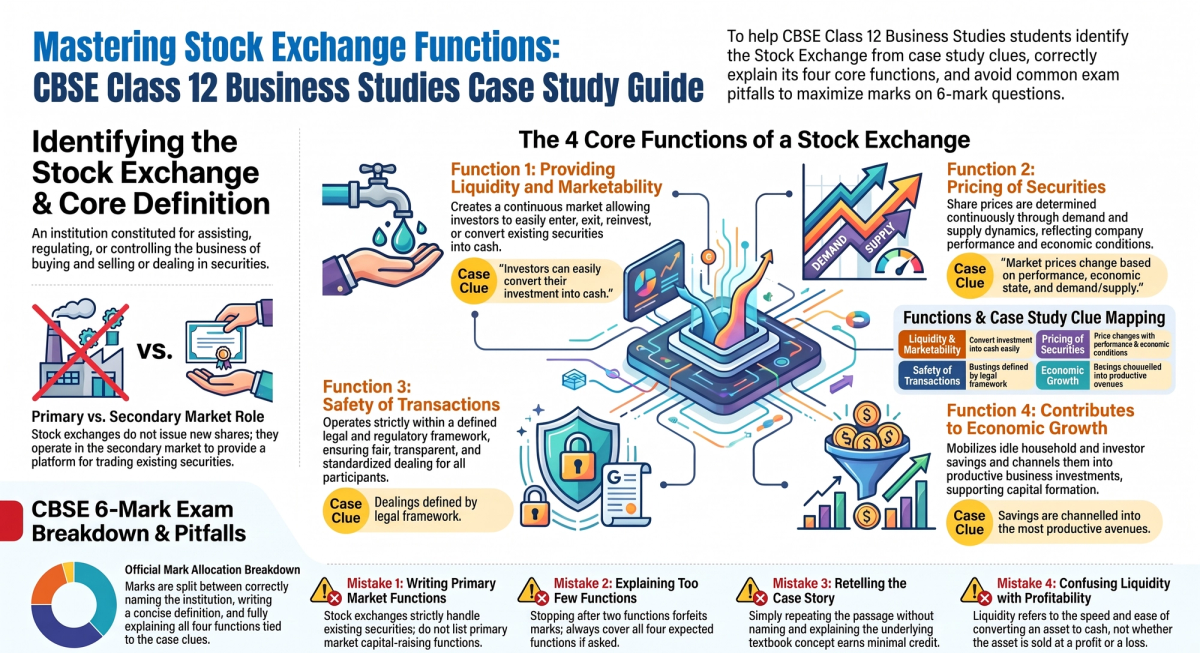
Q32: Stock Exchange Functions (Case Study)
A company raises money by issuing shares to the public. After the issue, its shares trade in a market where existing securities are bought and sold.
The case also says: share prices change with company performance, economic conditions and demand and supply; dealings follow a legal framework; investors can convert investments into cash; savings are channelled into productive investment opportunities.
The institution is the Stock Exchange.
Definition
The marking scheme describes a Stock Exchange as an institution constituted for assisting, regulating or controlling the business of buying and selling or dealing in securities.
For a Board answer, keep the definition concise and then move quickly to the functions demonstrated by the case, because most of the marks sit with the functions, not the definition.
Function 1: Providing Liquidity and Marketability to Existing ...
A stock exchange creates a continuous market for existing securities.
This allows investors to: sell when they need cash; reinvest in other securities; enter or exit investments more easily.
Case clue: The passage says investors can easily convert their investment into cash.
Function 2: Pricing of Securities
Share prices on a stock exchange are determined through demand and supply.
Continuous trading provides ongoing valuation and price information to buyers and sellers, which is why daily share prices are published and widely tracked.
Case clue: The passage says the market price changes with performance reports, economic conditions and demand and supply.
Function 3: Safety of Transactions
Stock-exchange dealings operate within a defined legal and regulatory framework.
This gives the investing public a safer and fairer market, since all members and transactions are expected to follow the same set rules rather than informal, unregulated dealing.
Case clue: The passage says dealings are well defined according to the existing legal framework.
Function 4: Contributes to Economic Growth
A stock exchange enables savings to move from investors into productive investment opportunities.
This contributes to capital formation and economic growth, because funds that would otherwise sit idle are channelled into businesses that can use them productively.
Case clue: The passage says investors' savings can be channelled into the most productive avenues.
How the 6 Marks Are Structured
The supplied marking scheme allocates marks for: naming the institution; defining it; explaining the relevant functions.
This is why simply writing "Stock Exchange" is not enough — a large share of the marks is earned only once the named functions are explained and tied back to the case.
Stock Exchange — Definition
- Liquidity and Marketability
Explanation + one line connecting to the case.
- Pricing of Securities
Explanation + case clue.
- Safety of Transactions
Explanation + case clue.
- Contribution to Economic Growth
Explanation + case clue.
Common Mistakes
Mistake 1
Writing functions of the primary market.
The case refers to trading in existing securities, so the relevant institution is the Stock Exchange/secondary market, not the mechanism by which the company first raised capital.
Mistake 2
Explaining only two functions.
Read the mark allocation and cover the functions asked; stopping after two functions when four are expected leaves marks on the table even if those two are explained well.
Mistake 3
Retelling the company story.
Use the case only as evidence for the textbook concept — restating the passage in your own words without naming and explaining the function it illustrates earns little credit.
Mistake 4
Confusing liquidity with profitability.
Liquidity means ease of converting the investment into cash; it does not guarantee profit, and treating the two as the same idea weakens the explanation of Function 1.
Practice It Yourself
Practice Question 1
A retail investor wants to sell shares she bought two years ago because she needs cash urgently for a family expense. She is able to sell them within minutes on the stock exchange, though at a small loss compared to her purchase price. Which function of the Stock Exchange does this illustrate, and does the small loss change your answer?
Approach & Solution: This illustrates Liquidity and Marketability — the ability to convert an investment into cash quickly. The small loss does not change the answer, because liquidity is about the ease and speed of converting an investment into cash, not about guaranteeing a profitable exit; profitability depends on separate market and company factors.
Practice Question 2
A regulator requires every stock exchange member to follow standard trading rules, disclosure norms and settlement timelines before a trade is finalised. Identify the function of the Stock Exchange this supports, and explain why it matters to ordinary investors.
Approach & Solution: This supports the Safety of Transactions function. It matters to ordinary investors because a defined legal and regulatory framework reduces the risk of fraud or unfair dealing, giving smaller, less-informed investors the confidence to participate in a market dominated by larger institutional players.
Mini Practice
A company’s shares are already listed. Investors can buy and sell them daily. Prices change based on market expectations, and transactions follow exchange rules.
Question: Identify any three functions of the Stock Exchange visible in the situation.
Expected approach: liquidity and marketability; pricing of securities; safety of transactions.
ChampionsPrep Next Step
Practise case clues rather than memorising one story. Registration on ChampionsPrep is free and you only pay as you use it, so once you can recognise "existing securities + liquidity + demand/supply pricing + legal framework" in any case, you can keep testing that recognition on fresh company scenarios at no upfront cost.
Frequently Asked Questions
Is Stock Exchange part of Financial Markets? +
Yes. It is central to the secondary market for existing securities, within the broader Financial Markets chapter.
Does the Stock Exchange issue new shares? +
No. New securities are issued in the primary market. The Stock Exchange provides a platform for trading existing securities.
Why does the Stock Exchange contribute to economic growth? +
It supports capital formation by enabling household and investor savings to move towards productive investment opportunities.
Does liquidity on a stock exchange guarantee profit to an investor? +
No. Liquidity means an investor can convert an investment into cash relatively easily; it says nothing about whether that sale will be at a profit or a loss.
How does a stock exchange facilitate capital formation in the economy? +
By providing a continuous and liquid market for securities, stock exchanges encourage household savings to flow into productive industrial investments.
Keep practising Business Studies
AI-powered feedback and structured revision for Business Studies — free to start, at your own pace.
AI-powered practice — free to start