

Marketing Management appears as a full 6-mark question in the official CBSE Class 12 Business Studies Sample Paper 2026-27.
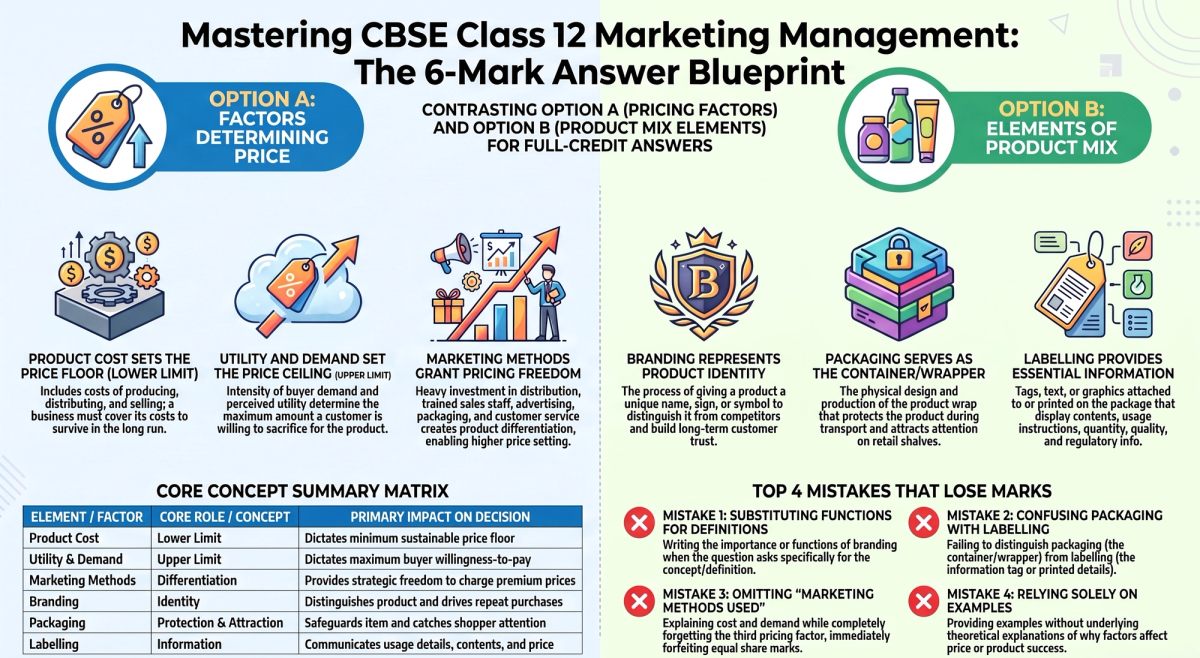
Q31: Factors Determining Price OR Product Mix Elements
A. Explain Product Cost, Utility and Demand, and Marketing Methods Used as factors determining price.
OR
B. Explain Branding, Packaging and Labelling as elements of product mix.
This is a direct long-answer question, so the scoring opportunity is high if your structure is clean, and low if the three (or two) required points blur into one another.
Quick Reference: Which Option to Pick
Choose Option A if you can clearly separate a cost-based explanation from a demand-based one and add a third point on marketing strategy. Choose Option B if you can distinguish "identity" (branding) from "container" (packaging) from "information" (labelling) without hesitation. Whichever you choose, plan your three subheadings before writing a single sentence.
Option A: Factors Determining Price
- Product Cost
The marking scheme explains that product cost includes the cost of producing, distributing and selling the product.
Cost generally sets the lower limit or floor price in the long run because a business must at least cover its costs to survive.
Exam phrase to remember: Cost sets the lower limit of price.
- Utility and Demand
Utility and the intensity of demand affect the upper limit that buyers are willing to pay.
A buyer compares the benefit received with the sacrifice made through price.
Exam phrase: Utility and demand influence the upper limit of price.
- Marketing Methods Used
Price is also affected by: distribution system; quality of salespeople; advertising; sales promotion; packaging; product differentiation; credit facilities; customer service.
If a company creates strong differentiation through these elements, it may have more freedom in fixing price, because buyers are paying partly for the surrounding service and experience, not only for the physical product.
How to Write the 6-mark Answer
Use three subheadings.
For each: define or state the factor; explain how it influences price; add one supporting sentence connecting it back to the pricing decision.
Do not mix all three factors into one paragraph — examiners scanning for three distinct points will not credit an answer where they are merged.
Option B: Branding, Packaging and Labelling
Branding
Branding is the process of giving a product a name, sign, symbol or other identity that helps distinguish it from competing products.
Why it matters: It supports identification and differentiation, and over time it can build customer trust and repeat purchase without the seller repeating the full sales pitch every time.
Packaging
Packaging refers to designing and producing the container or wrapper of a product.
The marking scheme highlights the role packaging can play in the success of consumer products, both in protecting the product and in attracting attention on a crowded shelf.
Labelling
Labelling involves designing the label placed on the package.
A label may range from a simple information tag to detailed graphics and can provide: product information; contents; usage details; price/quality information.
How Students Lose Marks
Mistake 1
Writing functions of branding when the question asks for the concept.
Answer exactly what is asked — a definition question and a "state the importance" question are scored differently, even on the same topic.
Mistake 2
Treating packaging and labelling as the same thing.
Packaging is the container/wrapper; labelling is information attached to or printed on it. Confusing the two usually costs marks on both points at once.
Mistake 3
Forgetting Marketing Methods Used in pricing.
Students often remember cost and demand but omit the third factor, which is usually worth an equal share of the marks.
Mistake 4
Writing only examples.
A 6-mark answer needs explanations. An example can support a point, but it cannot replace the underlying explanation of why the factor affects price or product success.
Quick Comparison
Branding = identity
Packaging = container/wrapper
Labelling = information
Product Cost = lower price limit
Utility and Demand = upper price influence
Marketing Methods = strategic freedom in price
Practice It Yourself
Practice Question 1
A company reduces spending on advertising, salespeople and after-sales service and competes mainly through very low pricing. A rival firm invests heavily in distribution reach, trained salespeople and strong customer service. Using the concept of "Marketing Methods Used" as a factor determining price, explain which firm is likely to have more freedom in fixing a higher price, and why.
Approach & Solution: State the concept — marketing methods such as distribution, salesmanship, advertising and service influence how much freedom a firm has in pricing. Apply it: the rival firm, by investing in these methods, differentiates its offering, so buyers may accept a higher price for the added service and reliability. The low-price competitor has less pricing freedom because it is competing mainly on cost, not differentiation.
Practice Question 2
A skincare brand’s packet displays only the brand name and a picture, with no information on ingredients, net quantity or usage instructions. Identify which marketing element is missing here, and briefly explain two purposes it should have served.
Approach & Solution: The missing element is labelling. Two purposes it should serve: providing essential product information (ingredients, quantity, usage) that helps a buyer make an informed decision, and building consumer confidence and legal compliance by disclosing details a buyer is entitled to know before purchase.
Possible Practice Questions
- Explain how packaging can influence marketing success.
- Why can product differentiation give a firm greater pricing freedom?
- Distinguish branding from labelling.
- Explain why price cannot generally remain below total cost in the long run.
- How does demand affect the upper limit of price?
ChampionsPrep Next Step
Practise both options so that in the exam, internal choice actually helps you rather than costing time you don’t have. Registration on ChampionsPrep is free and you only pay as you use it, so you can attempt both option A and option B under timed conditions and see which one you write faster and more accurately, at no upfront cost.
Frequently Asked Questions
Is Marketing a high-priority chapter for the 2027 Boards? +
It appears as a 6-mark question in the official SQP, so it deserves strong preparation on both option A (pricing factors) and option B (branding, packaging, labelling).
Should I memorise the exact textbook paragraph? +
No. Memorise the headings and the underlying logic, then explain each point in your own clear, syllabus-aligned language.
How long should a 6-mark Marketing answer be? +
The official paper guidance suggests around 200 words for a 6-mark answer, split roughly evenly across the points required.
What sets the lower and upper limits of price? +
Product cost generally sets the lower limit, while utility and the intensity of demand influence the upper limit buyers are willing to pay.
What are the three levels of packaging tested in CBSE Business Studies? +
Primary packaging (immediate container), secondary packaging (additional protective layer), and transportation packaging (bulk corrugated boxes for shipping).
Keep practising Business Studies
AI-powered feedback and structured revision for Business Studies — free to start, at your own pace.
AI-powered practice — free to start