
On a November evening in 2016, millions of Indians learned that the currency notes in their wallets would soon be worthless. This single policy decision — demonetisation — reshaped conversations about cash, corruption, and digital payments in India, and remains a regularly tested topic in CBSE Class 12 Money and Banking.
What Was Demonetisation?
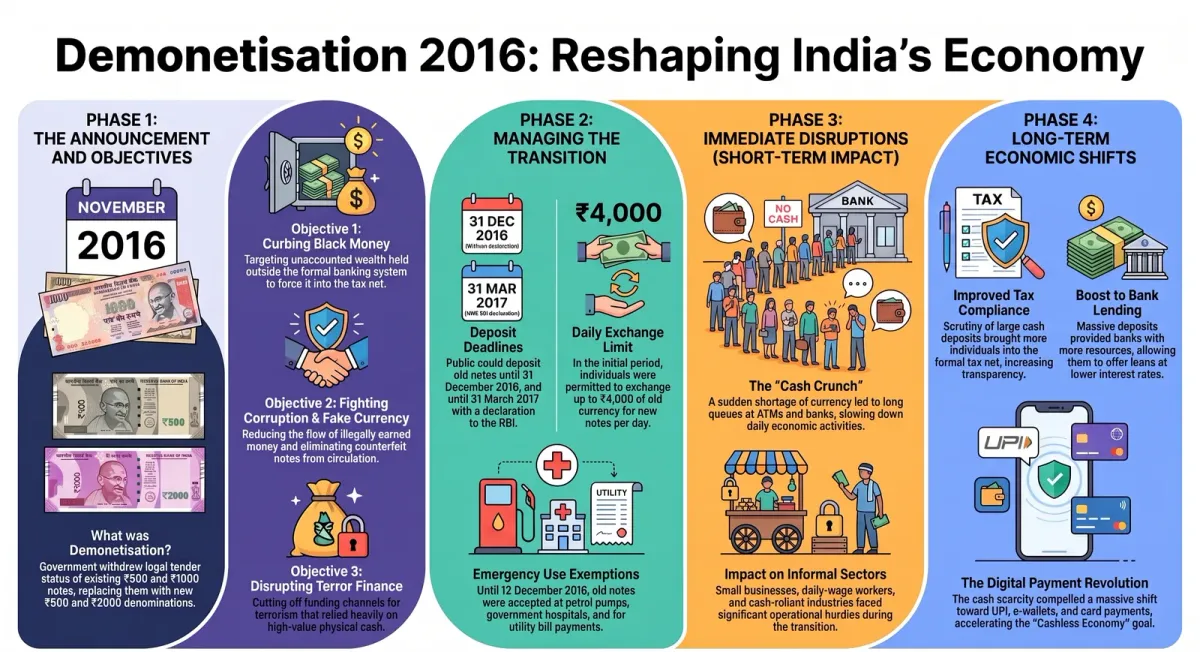
Demonetisation refers to the Government of India’s decision, announced in November 2016, to withdraw the legal tender status of the existing Rs 500 and Rs 1000 currency notes. Overnight, these notes could no longer be used for everyday transactions. In their place, the government introduced new currency notes of Rs 500 and Rs 2000 denominations.
Why Was Demonetisation Introduced? The Core Objectives
According to the government, demonetisation aimed at tackling four major problems:
-
Corruption — reducing the flow of illegally earned money
-
Black money — targeting unaccounted wealth outside the formal banking system
-
Terrorism financing — disrupting funding channels reliant on high-value cash
-
Fake currency — curbing circulation of counterfeit notes
The logic was simple: if unaccounted cash suddenly became worthless unless deposited (and explained) through the banking system, holders of black money would have to declare it — paying taxes and penalties — or lose its value entirely.
How the Transition Was Managed
The government put several transitional measures in place to manage the shock:
-
The public was allowed to deposit old currency notes into their bank accounts until 31 December 2016 without any declaration, and up to 31 March 2017 with a declaration to the RBI.
-
To prevent a complete breakdown in daily transactions, the government permitted an exchange of up to Rs 4,000 in old currency for new currency, per person, per day, in the initial period.
-
Until 12 December 2016, old notes remained usable at specific locations such as petrol pumps, government hospitals, and for payment of government dues like taxes and utility bills.
The Immediate Impact: Criticism and Disruption
Demonetisation was met with both appreciation and criticism. In the short term, its effects were highly visible and disruptive:
-
Long queues formed outside banks and ATM booths as people rushed to exchange or deposit old notes.
-
A shortage of currency in circulation created a cash crunch that affected day-to-day economic activities, particularly in sectors heavily reliant on cash transactions.
-
Small businesses, daily-wage workers, and informal-sector participants — who depended heavily on physical cash — were disproportionately affected during the transition period.
Over time, however, the situation stabilized and normal economic activity gradually resumed.
The Longer-Term Positive Effects
Beyond the initial disruption, demonetisation is credited with several lasting structural changes to the Indian economy:
1. Improved Tax Compliance
A large number of previously unaccounted individuals were brought into the formal tax net, as unexplained cash deposits triggered scrutiny, encouraging greater transparency in financial dealings going forward.
2. Channelling Savings into the Formal Financial System
Money that had previously been held outside the banking system — as physical cash “under the mattress” — was forced into bank accounts, channelling household savings into the formal financial system.
3. More Resources for Bank Lending at Lower Rates
As deposits surged following demonetisation, banks found themselves with greater resources at their disposal, which could then be used to extend more loans at comparatively lower interest rates.
4. A Signal Against Tax Evasion
Demonetisation served as a strong demonstration of the government’s resolve to curb black money, signalling that tax evasion would face both financial penalties and social condemnation going forward, with expected long-term improvements in tax compliance and reductions in corruption.
5. Accelerating the Shift to Digital Payments
Perhaps demonetisation’s most visible long-term legacy is the push toward electronic payment technologies. With physical cash suddenly scarce, households and businesses that had never used digital payments were compelled to adopt UPI apps, e-wallets, and card payments — shifting transactions out of the cash economy and into the formal, traceable payment system.
Demonetisation and the Broader Push for a Cashless Economy
Demonetisation didn’t happen in isolation — it aligned with India’s broader financial inclusion agenda, which also included Jan Dhan accounts, Aadhaar-enabled payment systems, e-Wallets, and the National Financial Switch (NFS). Together, these initiatives have made a genuinely cashless, digitally inclusive economy a far more realistic goal than it was a decade ago, supported by rising mobile and smartphone penetration across the country.
How This Topic Is Tested in Exams
Demonetisation questions typically appear as:
-
Short factual recall questions (denominations banned, dates, deposit deadlines)
-
Explain-based long-answer questions on objectives and impact (4-6 marks)
-
Case-study or assertion-reason questions linking demonetisation to money supply concepts (like M1 and M3)
-
Comparative or evaluative questions weighing the pros and cons of the policy
Since this topic blends factual recall with conceptual reasoning, it rewards students who can connect demonetisation to broader ideas like money supply, tax compliance, and financial inclusion covered elsewhere in the chapter.
Test Your Knowledge
Interactive Simulation: Cash Reserves & Net Banking Liquidity
Explore how alterations in the Cash Reserve Ratio (CRR) and demonetisation cash returns affect lendable bank reserves and the money multiplier using this interactive model:
Demonetisation, CRR & Credit Expansion Simulator
Adjust initial bank deposits, the reserve requirement ratio (CRR), and incremental reserve adjustments to view overall bank credit creation capacity.
CRR channel
Open Market Operations
Simple money-multiplier model
More banking-system liquidity can support additional lending and aggregate demand.
Illustrative upper bound only: the simple multiplier assumes every lendable rupee is redeposited. Actual lending depends on banks, borrowers and policy conditions.
Conclusion
Demonetisation stands as one of the most significant real-world applications of monetary economics in recent Indian history — combining objectives around corruption and black money with tangible effects on tax compliance, banking, and digital payments. For exams, focus on remembering the key facts (dates, denominations, deadlines) while also being ready to explain and evaluate its broader economic impact.
Want to revise demonetisation and money supply topics together? Practice topic-wise MCQs and long-answer questions for just ₹10 per use on ChampionsPrep — built for CBSE and Maharashtra Board Commerce students preparing for boards, CUET, IPMAT, JIPMAT, NPAT, and SET.

Demonetisation in India 2016: Objectives, Impact and Key Facts for Class 12 Students
Frequently Asked Questions
When was demonetisation implemented in India? +
Demonetisation was implemented in November 2016, when the Government of India withdrew the legal tender status of Rs 500 and Rs 1000 currency notes.
What were the main objectives of demonetisation? +
The main objectives of demonetisation were to tackle corruption, curb black money, disrupt terrorism financing, and reduce the circulation of fake currency in the Indian economy.
What were the immediate negative effects of demonetisation? +
The immediate negative effects included long queues outside banks and ATMs, a severe cash crunch, and disruption to economic activities that were heavily dependent on physical cash transactions.
What positive long-term effects did demonetisation have on the economy? +
Demonetisation improved tax compliance, channelled savings into the formal financial system, gave banks more resources to lend at lower interest rates, and accelerated the shift from cash to digital payment technologies.
How much old currency could be exchanged per person during demonetisation? +
The government allowed an exchange of up to Rs 4,000 in old currency notes for new currency, per person, per day, during the initial transition period.
AI-powered practice — free to start