
If you ask an economist what economics actually studies, chances are they will mention three words almost immediately: consumption, production, and distribution. Class 11 Statistics for Economics organises the entire study of economic activity around these three conventional divisions. Understanding what each one means — and how they connect to one another — gives you a mental map for the rest of the syllabus. This post walks through all three, and also looks at how modern economics has expanded beyond them to study issues like poverty and income inequality.
Why Economics Needs These Three Divisions
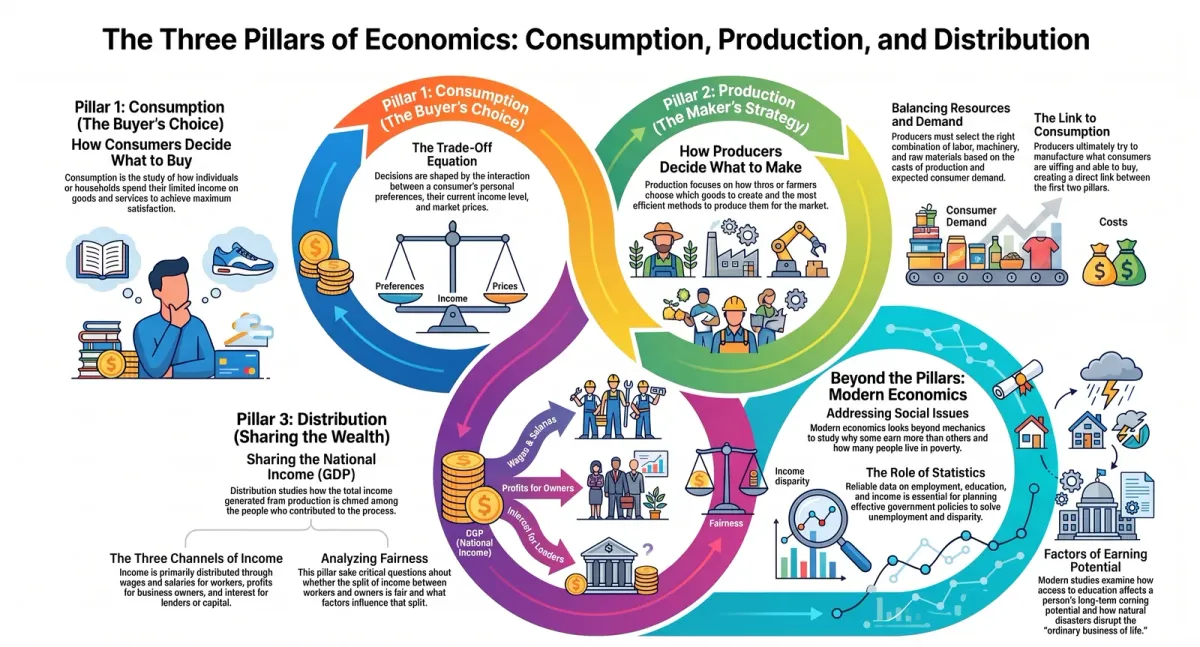
Economic activity in any society is enormous and varied — farmers growing crops, factories manufacturing goods, families buying groceries, companies paying salaries, and governments collecting taxes, all happening simultaneously. To study this complexity in an organised way, economists traditionally break it down into three connected questions: how do people decide what to buy, how do producers decide what to make, and how is the income earned from all this activity shared out among people? These three questions correspond to consumption, production, and distribution.
What Is Consumption?
Consumption is the study of how a consumer decides what to buy. Given a certain income and a range of goods available at known prices, a consumer must decide how to spend that income to get the maximum satisfaction. Should you spend more on books this month or save for a new pair of shoes? Should a household prioritise groceries or a family outing? These everyday trade-offs are exactly what the study of consumption tries to explain and predict.
Economists studying consumption look at how income levels, prices, and personal preferences interact to shape buying decisions — both for individuals and for entire households or communities.
What Is Production?
Production looks at the flip side of the same coin: how producers decide what to make and how to make it for the market. A farmer must choose which crop to grow on a given piece of land; a company must decide which products to manufacture, how much to produce, and which combination of labour, machinery, and raw material to use.
Production decisions are shaped by the resources available, the cost of using them, and the expected demand from consumers. This is why the study of production connects closely back to consumption — producers ultimately try to make what consumers are willing and able to buy.
What Is Distribution?
Once goods and services have been produced and sold, the income generated from that activity — commonly measured as the country’s total income or Gross Domestic Product (GDP) — has to be shared among the people who contributed to producing it. This sharing happens mainly through wages and salaries (paid to workers), profits (earned by business owners), and interest (earned by those who lend capital).
Distribution asks questions such as: how much of the total income goes to workers compared to business owners? Is the split fair, and what factors influence it? While the syllabus at this stage sets aside more complex elements like income from international trade and investment, the core idea of distribution remains central to understanding how the fruits of economic activity are actually shared out in society.
Beyond the Three Pillars: Modern Economics and Social Issues
The three conventional divisions cover the essential mechanics of an economy, but modern economics has grown to ask deeper questions too. Why do some households earn far more than others? How many people in a country live in poverty, and how many belong to the middle class or are relatively well-off? How does access to education affect a person’s earning potential over their lifetime? How do events like natural disasters affect the ordinary business of life for entire regions?
These questions require detailed, reliable facts — not guesswork — before any meaningful policy can be designed to address them. This is precisely where the subject of Statistics enters modern economics: without organised data on incomes, employment, education, and disparity, it becomes impossible to plan effective solutions to problems like poverty or unemployment.
Why These Three Divisions Matter for Your Exam
Examiners frequently test whether students can correctly classify a given economic scenario under consumption, production, or distribution, or explain how the three interact. Being able to define each term precisely, and give a fresh, real-life example for each, is one of the simplest ways to secure full marks on short-answer questions built around this section of the chapter.
Quick Recap for Class 11 Exam Prep
-
Consumption studies how consumers choose what to buy, given their income and market prices.
-
Production studies how producers decide what and how much to produce for the market.
-
Distribution studies how the income generated (GDP) is shared as wages, profits, and interest.
-
Modern economics also studies poverty, income disparity, and education using detailed data — which is why Statistics is essential to the subject.
Related Reading on ChampionsPrep
-
Why Study Economics? Meaning and Basic Concepts for Class 11 Students
-
Role and Importance of Statistics in Economics (Class 11)
-
Statistics for Economics Chapter 1: Exercise Solutions & Exam Tips
Start Learning Smarter with ChampionsPrep
Mixing up consumption, production, and distribution is one of the most common mistakes students make in Class 11 board exams. ChampionsPrep’s AI-powered practice sets help you drill exactly these distinctions with instant feedback, chapter by chapter. Registration is free, and you only pay-as-you-use. Start practising with ChampionsPrep and turn confusion into clarity before your next test.
Test Your Knowledge
Consumption, Production and Distribution — The Three Pillars of Economics
Frequently Asked Questions
What are the three conventional divisions of economics? +
The three conventional divisions are consumption (how consumers choose what to buy), production (how producers decide what to make), and distribution (how the income earned is shared as wages, profits, and interest).
What is the difference between production and distribution? +
Production is about creating goods and services for the market, while distribution is about how the income generated from that production is shared among workers, business owners, and lenders of capital.
What is GDP and how does it relate to distribution? +
GDP, or Gross Domestic Product, refers to the total income arising from everything produced in a country. Distribution studies how this total income is divided among people mainly through wages, profits, and interest.
Why does modern economics study poverty and income disparity? +
Beyond the three conventional divisions, modern economics also examines social issues like poverty, unemployment, and unequal incomes, because understanding these problems with reliable data is necessary to design effective government policies.
How should I remember consumption, production, and distribution for exams? +
Think of them as three connected questions: what do people buy (consumption), what do producers make (production), and how is the income from that activity shared out (distribution). Real-life examples for each help secure full marks.
AI-powered practice — free to start