
Budget Line and Budget Set in Economics Explained
You might want five ice creams, a new phone, and a weekend trip — but your pocket money says otherwise. This is exactly the problem economists study through the concepts of the budget set and budget line: what a consumer can actually afford, given her income and market prices. This post explains both concepts clearly, along with how they shift when income or prices change — a favourite topic in Class 11 Economics exams.
What Is the Consumer’s Budget Problem?
A consumer typically has a fixed income to spend on multiple goods, and each good has a fixed market price. She cannot buy every combination of goods she might desire — only those combinations she can actually afford. This affordability constraint is what economists formalize through the budget set and budget line.
The Budget Constraint
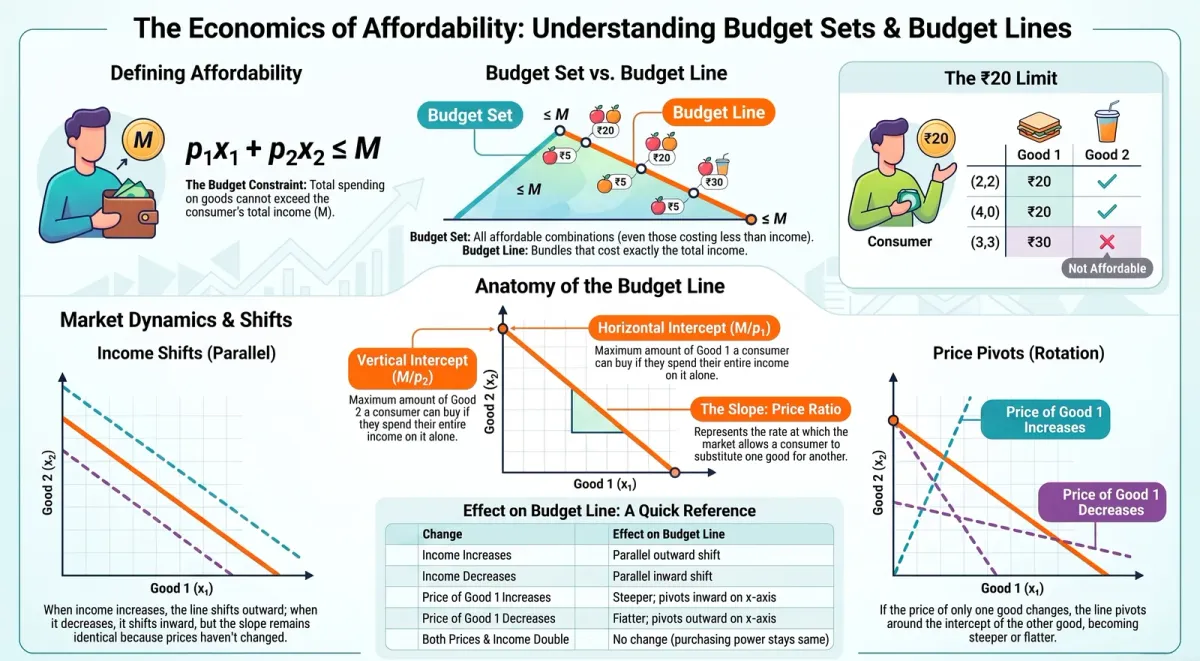
Suppose a consumer has income M, and she buys two goods — bananas (x₁) at price p₁, and mangoes (x₂) at price p₂. The total amount she spends on a bundle (x₁, x₂) is p₁x₁ + p₂x₂. She can afford this bundle only if her total spending doesn’t exceed her income:
p₁x₁ + p₂x₂ ≤ M
This inequality is called the consumer’s budget constraint.
What Is the Budget Set?
The budget set is the collection of all bundles that satisfy the budget constraint — essentially, every combination of goods the consumer can afford at the given prices and income, including bundles that cost less than her full income.
Example
Suppose a consumer has ₹20, and both bananas and mangoes are priced at ₹5 each (available only in whole units). The bundles she can afford include (0,0), (1,1), (2,2), (3,1), (4,0), and several others — as long as total cost doesn’t exceed ₹20. She simply cannot afford bundles like (3,3), since that would cost ₹30.
What Is the Budget Line?
While the budget set includes everything affordable, the budget line specifically represents bundles that cost exactly equal to the consumer’s income — i.e., where she spends her entire budget:
p₁x₁ + p₂x₂ = M
This equation can be rearranged into the familiar straight-line form:
x₂ = (M/p₂) − (p₁/p₂)x₁
This looks just like the equation of a line you studied in school math (y = c + mx), where:
-
The vertical intercept (M/p₂) is the amount of the good on the y-axis the consumer could buy if she spent her entire income on it alone.
-
The horizontal intercept (M/p₁) is the amount of the good on the x-axis she could buy if she spent everything on it alone.
-
The slope is −p₁/p₂.
Why Is the Budget Line Downward Sloping?
The negative slope reflects a real trade-off. If the consumer wants one more unit of bananas, she must reduce her spending on mangoes by exactly p₁ (the price of one banana). Since each unit of mangoes costs p₂, giving up p₁ worth of spending means giving up p₁/p₂ units of mangoes.
In other words, the price ratio (p₁/p₂) tells you exactly how many mangoes the consumer must sacrifice in the market to get one more banana, while spending her full budget. This absolute value of the slope is the rate at which the market allows substitution between the two goods.
How Does the Budget Line Change When Income Changes?
If the consumer’s income increases (M′ > M), while prices stay the same, both intercepts (M′/p₁ and M′/p₂) increase. Since the slope (−p₁/p₂) doesn’t change, this produces a parallel outward shift of the budget line — she can now afford more of both goods.
If income decreases (M′ < M), both intercepts shrink, causing a parallel inward shift — fewer bundles are now within reach.
How Does the Budget Line Change When Price Changes?
Now suppose only the price of bananas changes, while income and the price of mangoes stay fixed.
-
If the price of bananas increases, the horizontal intercept (M/p₁′) falls, but the vertical intercept (M/p₂) stays exactly the same. The budget line pivots inward and becomes steeper around the vertical intercept.
-
If the price of bananas decreases, the horizontal intercept rises, and the budget line pivots outward and becomes flatter.
A similar logic applies if the price of mangoes changes instead — except this time, it’s the vertical intercept that moves while the horizontal intercept stays fixed.
Quick Recap Table
| Change | Effect on Budget Line |
|---|---|
| Income increases (prices constant) | Parallel outward shift |
| Income decreases (prices constant) | Parallel inward shift |
| Price of good 1 increases | Steeper; pivots inward on x-axis |
| Price of good 1 decreases | Flatter; pivots outward on x-axis |
Why the Budget Line Matters
The budget line isn’t just an abstract diagram — it’s the boundary of what’s actually possible for a consumer. Combined with indifference curves (covered in our previous post), it helps determine the consumer’s optimum bundle — the single best combination of goods she can both afford and prefer the most. We explore this tangency condition in detail in the next post.
Practice Budget Line Numericals the Smart Way
Budget line questions often involve calculations — intercepts, slopes, and shifts — that need practice, not just theory. On ChampionsPrep, solve topic-wise numerical questions on the Budget Line and get instant doubt resolution for just ₹10 per use. Visit https://app.championsprep.in to build exam-ready confidence.
Test Your Knowledge

Budget Line and Budget Set in Economics Explained (Class 11)
Frequently Asked Questions
What is the difference between the budget set and the budget line? +
The budget set includes all bundles a consumer can afford, including those costing less than her income, while the budget line includes only those bundles that cost exactly equal to her income.
Why is the budget line negatively sloped? +
Because to buy more of one good while spending her entire fixed income, the consumer must necessarily buy less of the other good, creating an inverse relationship between the two quantities.
What does the slope of the budget line represent? +
The slope, −p₁/p₂, represents the rate at which the consumer can substitute one good for the other in the market while spending her entire budget, based on the ratio of their prices.
What happens to the budget line if both prices and income double? +
Nothing changes — the budget line and budget set remain exactly the same, since the ratio of prices to income stays constant, so purchasing power is unaffected.
Does a price change always cause a parallel shift in the budget line? +
No. A change in income causes a parallel shift, but a change in the price of just one good causes the budget line to pivot (become steeper or flatter) around one of its intercepts.
AI-powered practice — free to start