
Introduction: The Vocabulary of Financial Language
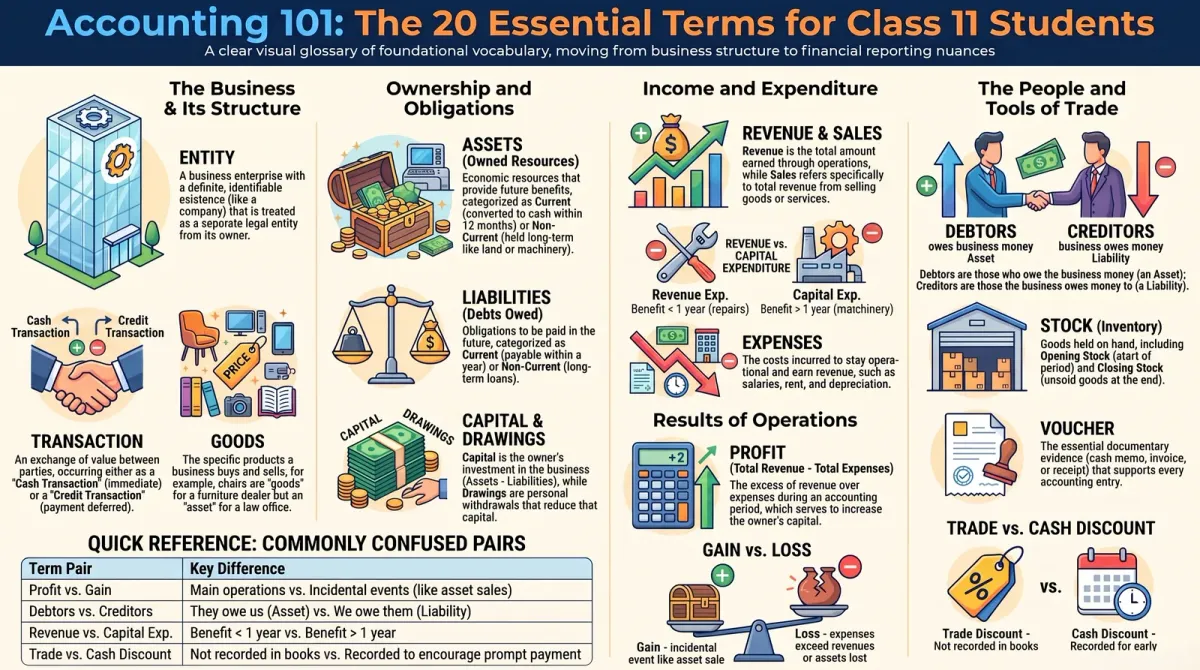
You cannot understand accounting without mastering its basic terminology. Class 11 CBSE Accountancy Chapter 1 introduces 20 essential terms that form the foundation of everything ahead — from journal entries to Balance Sheets. This blog defines all 20 clearly, with examples, so you can use them confidently in exams and beyond.
Group 1: The Business and Its Structure
1. Entity
An entity is a business enterprise with a definite, identifiable existence — such as a sole proprietorship, partnership, or company. Every accounting system is designed for a specific accounting entity. Importantly, the business and its owner are treated as separate entities.
2. Transaction
A transaction is any event involving an exchange of value between two or more parties. It can be a cash transaction (immediate payment) or a credit transaction (payment deferred). Examples: purchasing goods, paying salary, receiving money from customers.
3. Goods
Goods refer to the products the business buys and sells. The same item can be “goods” for one business and an “asset” for another. For example, chairs are goods for a furniture dealer but a fixed asset for a law office.
Group 2: What a Business Owns and Owes
4. Assets
Assets are economic resources owned by a business, expressed in monetary terms. They provide future economic benefits.
-
Current Assets — converted to cash within 12 months: inventory, trade receivables, cash
-
Non-Current Assets — held long-term: land, machinery, goodwill, patents
5. Liabilities
Liabilities are obligations or debts the business must pay in the future. They represent creditors’ claims on assets.
-
Current Liabilities — payable within 12 months: trade payables, short-term loans
-
Non-Current Liabilities — payable beyond 12 months: long-term bank loans, debentures
6. Capital
Capital is the amount invested by the owner in the business — in cash or other assets. It appears on the liabilities side of the Balance Sheet because the business owes this amount back to the owner.
Capital = Assets − Liabilities
7. Drawings
Drawings are withdrawals of money or goods by the owner for personal use. Drawings reduce capital.
Group 3: Income and Expenditure
8. Revenue
Revenue (also called income) is the total amount earned by the business through its main operations — selling products or providing services. It also includes commission received, interest, dividends, royalties, and rent received.
9. Sales
Sales are the total revenues earned from selling goods or services. Sales may be cash sales (immediate) or credit sales (collected later).
10. Expenses
Expenses are costs incurred while earning revenue — what the business spends to stay operational. Common examples include salaries, rent, depreciation, and interest payments.
11. Expenditure
Expenditure is spending money or incurring a liability to obtain a benefit.
-
If the benefit lasts less than one year → Revenue Expenditure (treated as expense, e.g., repairs)
-
If the benefit lasts more than one year → Capital Expenditure (treated as asset, e.g., buying machinery)
Group 4: Results of Business Operations
12. Profit
Profit is the excess of revenues over expenses in an accounting period.
Profit = Total Revenue − Total Expenses
Profit increases the owner’s capital. Example: Revenue ₹6,00,000 − Expenses ₹5,40,000 = Profit ₹60,000.
13. Gain
A gain is a profit from transactions incidental to the main business — not from regular operations. Examples: profit on sale of a fixed asset, winning a court case, appreciation in asset value.
14. Loss
Loss is the excess of expenses over revenues. It decreases the owner’s equity. It also includes money lost without any return — such as goods destroyed by fire or cash stolen.
Group 5: Supporting Concepts
15. Stock (Inventory)
Stock refers to goods held in hand by a business.
-
Opening Stock — goods at the start of the accounting period
-
Closing Stock — unsold goods at the end of the period
In manufacturing, closing stock includes raw materials, work-in-progress, and finished goods.
16. Purchases
Purchases are the total goods procured by a business for resale or use — on cash or credit. In trading firms, purchases are merchandise for resale; in manufacturing firms, purchases are raw materials.
17. Discount
Discount is a deduction from the price of goods. Two types:
-
Trade Discount — deducted at the time of sale from the list price; offered by manufacturers to wholesalers; NOT recorded in books.
-
Cash Discount — given to debtors who pay early; IS recorded in books; encourages prompt payment.
18. Voucher
A voucher is the documentary evidence supporting a transaction. It is the original source document for every accounting entry. Examples: cash memo (cash purchase), invoice (credit purchase), receipt (payment made).
Group 6: People the Business Deals With
19. Debtors
Debtors are persons or entities who owe money to the business for goods or services received on credit. They appear on the asset side of the Balance Sheet as Sundry Debtors or Trade Receivables.
20. Creditors
Creditors are persons or entities to whom the business owes money for goods or services provided on credit. They appear on the liabilities side of the Balance Sheet as Sundry Creditors or Trade Payables.
Key Distinctions to Remember for Exams
| Pair | Distinction |
|---|---|
| Profit vs Gain | Profit from main operations; Gain from incidental events |
| Debtors vs Creditors | Debtors owe us money (asset); Creditors we owe money (liability) |
| Revenue vs Capital Expenditure | Benefit within 1 year vs. benefit beyond 1 year |
| Trade vs Cash Discount | At time of sale (not recorded) vs. for early payment (recorded) |
Test Your Knowledge
Interactive Classifier: Capital vs Revenue Expenditure
Practice These Terms with ChampionsPrep
Knowing definitions is step one — applying them under exam pressure is what scores marks. ChampionsPrep provides chapter-wise MCQs and long-answer questions for all 20 terms, designed for CBSE Class 11 board exams and competitive entrance tests like CUET and IPMAT.
👉 Start practising at https://app.championsprep.in — AI-powered learning, pay only for what you use.
20 Basic Accounting Terms Every Class 11 Commerce Student Must Know – CBSE Accountancy
Frequently Asked Questions
What is the difference between profit and gain in accounting? +
Profit results from the main business operations (e.g., selling traded goods), while gain arises from incidental transactions such as selling a fixed asset above its book value.
What is the difference between debtors and creditors? +
Debtors owe money to the business and are recorded as an asset. Creditors are owed money by the business and are recorded as a liability.
What is the difference between revenue expenditure and capital expenditure? +
Revenue expenditure benefits only the current accounting period and is treated as an expense. Capital expenditure provides benefits for more than one year and is treated as an asset.
Why are drawings treated as a reduction in capital? +
Drawings represent the owner using business funds for personal purposes, which reduces the net amount the owner has invested in the business.
What is the difference between goods and assets? +
Goods are items that the business buys and sells in the normal course of trade. Assets are items purchased for use in the business, not for resale.
AI-powered practice — free to start