
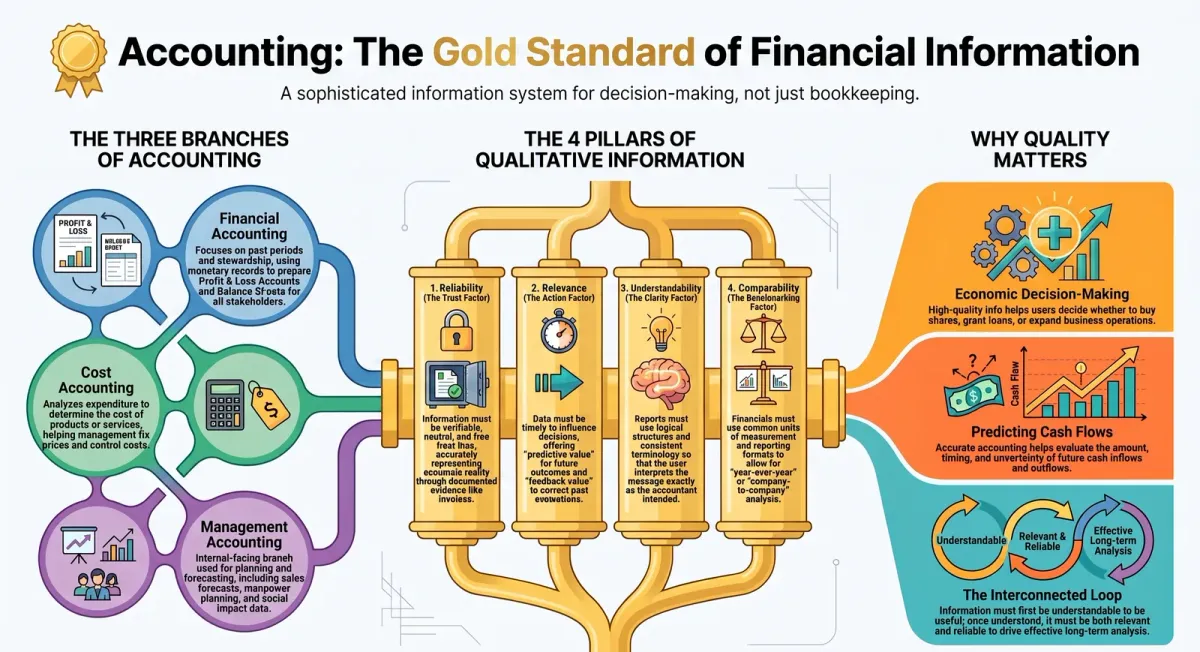
Introduction: Information is the Heart of Accounting
We live in an age where information drives every major decision — whether it is a business deciding to launch a new product or an investor deciding where to put their money. Accounting is the engine that generates this financial information and ensures it reaches the right people in a useful form.
In Class 11 CBSE Accountancy (Chapter 1), this topic is crucial — not just for exams, but for understanding the real-world relevance of everything you will study in Commerce. In this blog, we explore how accounting functions as a source of information and what makes that information truly useful.
Accounting as a Definite Information System
Accounting is a set of interlinked activities that begins with identifying transactions and ends with preparing financial statements. Every single step in this process generates information. However, generating information is not an end in itself — it is a means to an end.
The real purpose is to disseminate (distribute) this information to different user groups — investors, management, creditors, government agencies, and others — so they can make appropriate decisions. Therefore, dissemination of information is an essential function of accounting.
What Should Useful Accounting Information Do?
For accounting to serve its purpose as an information source, it must ensure the following:
-
Provide information for economic decision-making — Should the business take a loan? Should an investor buy shares?
-
Serve users who rely on financial statements — Many external users, like shareholders, have no other source of detailed financial data.
-
Help predict and evaluate cash flows — Assessing the amount, timing, and uncertainty of future cash inflows and outflows.
-
Judge management’s resource utilisation — Is management meeting its goals efficiently?
-
Disclose underlying assumptions — Information must be transparent about estimates, interpretations, and predictions.
-
Cover social impact — Modern accounting increasingly covers an organisation’s impact on society and the environment.
Three Sub-Disciplines of Accounting as an Information Source
Because different users need different types of information, accounting has developed three distinct branches:
1. Financial Accounting
Financial accounting focuses on maintaining systematic records of financial transactions and preparing financial statements — the Profit & Loss Account and the Balance Sheet. It:
-
Relates to past periods
-
Serves the stewardship function (accountability to owners)
-
Is monetary in nature
-
Provides information to all stakeholders
2. Cost Accounting
Cost accounting analyses expenditure to determine the cost of products manufactured or services rendered. It:
-
Helps in fixing prices
-
Assists in controlling costs
-
Provides management with costing data for decisions
3. Management Accounting
Management accounting provides information to people inside the organisation — primarily management — for planning, decision-making, and control. It draws from both financial and cost accounting and goes further to include:
-
Sales forecasts
-
Cash flow analysis
-
Purchase requirements
-
Manpower planning
-
Environmental and social impact data
Qualitative Characteristics of Accounting Information
Not all information is equally useful. For accounting information to be decision-useful, it must possess four key qualitative characteristics:
1. Reliability
Reliability means that users can depend on the information. A reliable piece of accounting information:
-
Accurately represents what it claims to represent
-
Is free from error and bias
-
Is verifiable — independent parties using the same method should arrive at the same figure
-
Is neutral — it does not favour one user group over another
-
Is faithful — it represents economic reality, not a distorted picture
Example: If a company’s Balance Sheet shows total assets of ₹10,00,000, a reliable system ensures that this figure has been independently verified, is based on documented evidence (vouchers, invoices), and is not inflated to impress investors.
Sub-characteristics of Reliability:
-
Verifiability
-
Faithfulness
-
Neutrality
2. Relevance
Relevance means that the information must be available in time and must actually influence the decisions of users. Information is relevant if it:
-
Has predictive value — helps users form expectations about future outcomes
-
Has feedback value — helps confirm or correct past evaluations
-
Is timely — outdated information loses its relevance
Example: A manufacturer deciding whether to expand production needs current cost data, not data from three years ago. Information about last year’s raw material prices is irrelevant if current market conditions have changed significantly.
Sub-characteristics of Relevance:
-
Predictive (Dedicative) Value
-
Feedback Value
-
Timeliness
3. Understandability
Understandability means that decision-makers must be able to interpret accounting information in the same sense as it was prepared and intended to communicate.
Accounting communication is effective only when the receiver understands the message in the same way the sender intended. This requires:
-
Clear presentation of data
-
Logical structure in reports
-
Consistent use of terminology
Accountants must present information in the most intelligible (easy to understand) manner without sacrificing relevance or reliability.
Example: A Balance Sheet with clearly labelled sections for Current Assets, Non-Current Assets, Current Liabilities, and Non-Current Liabilities is far more understandable than one with jumbled, unlabelled rows of figures.
4. Comparability
Comparability means that financial information should allow users to compare one period with another and compare one entity with another.
For information to be comparable:
-
Accounting reports must belong to a common period
-
They must use a common unit of measurement
-
They must follow a common format of reporting
Example: If Company A follows one method of calculating depreciation and Company B follows another, their profit figures cannot be compared meaningfully. Standardised accounting practices — like those set by the Institute of Chartered Accountants of India (ICAI) — ensure comparability.
How the Four Characteristics Relate to Each Other
The four qualitative characteristics are interconnected:
-
Information must first be understandable before it can be useful.
-
To be useful for decisions, it must be both relevant and reliable.
-
For longer-term analysis across time and entities, comparability is essential.
A good accountant balances all four — presenting information that is easy to understand, trustworthy, timely, and consistent.
Test Your Knowledge
Build Your Commerce Foundation with ChampionsPrep
Understanding qualitative characteristics is a favourite exam topic — and it requires clear conceptual understanding, not just rote learning. ChampionsPrep helps Class 11 and 12 Commerce students master such concepts through AI-powered doubt resolution, topic-wise question banks, and personalised learning — available on a pay-per-use model.
👉 Start learning at app.championsprep.in — your smart study partner for board exams and beyond.

Accounting as a Source of Information: Qualitative Characteristics Explained – Class 11
Frequently Asked Questions
What are the four qualitative characteristics of accounting information? +
The four qualitative characteristics are Reliability, Relevance, Understandability, and Comparability. These ensure that accounting information is useful for decision-making.
What is reliability in accounting? +
Reliability means the information is free from error and bias, verifiable by independent parties, and faithfully represents the financial transactions it describes.
What does relevance mean in accounting? +
Information is relevant if it is available on time and can influence the decisions of users, either by helping them predict future outcomes or by confirming/correcting past evaluations.
Why is comparability important in accounting? +
Comparability allows users to evaluate trends over time and compare one organisation with another, which is essential for investment and lending decisions.
What are the three branches of accounting? +
The three main branches are Financial Accounting, Cost Accounting, and Management Accounting, each serving different information needs.
AI-powered practice — free to start