
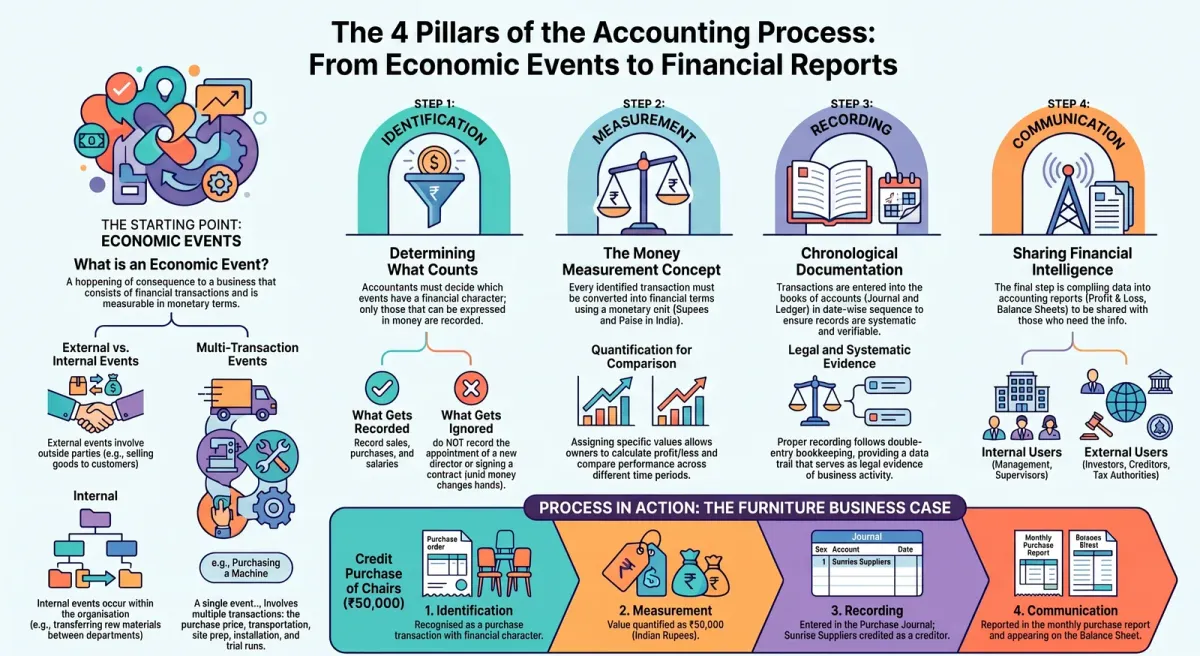
Introduction: The Four Pillars of the Accounting Process
Accounting is not a single action — it is a four-step process that transforms raw financial events into meaningful information. These four steps are Identification, Measurement, Recording, and Communication. Together, they form the backbone of every accounting system, from a small grocery store to a multinational corporation.
In Class 11 Accountancy (CBSE Chapter 1), understanding this process deeply will help you grasp not just what accounting does, but why it does it. Let’s break down each step with examples, and also understand the concept of economic events that triggers the entire process.
What Are Economic Events?
Before accounting can begin, something must happen in a business. That “something” is an economic event — a happening that has financial consequences for an organisation and can be measured in monetary terms.
Characteristics of an Economic Event
-
It must be a happening of consequence to the business.
-
It must consist of one or more financial transactions.
-
It must be measurable in monetary terms.
Example: Purchasing a Machine
Buying a machine is an economic event. But it is not one transaction — it involves:
-
Buying the machine
-
Paying transportation costs
-
Preparing the installation site
-
Paying for installation
-
Running trial operations
Accounting identifies all these individual transactions as part of one economic event.
Types of Economic Events
External Events
These involve transactions between the business and an outside party. Examples include:
-
Sale of goods to customers
-
Purchasing raw materials from suppliers
-
Paying monthly rent to a landlord
-
A company providing services to clients
Internal Events
These occur entirely within the organisation, between different departments. Examples include:
-
The stores department supplying raw material to the manufacturing department
-
Payment of wages to factory workers
The Four Steps of the Accounting Process
Step 1: Identification
Identification means deciding which events or transactions need to be recorded in the books of accounts. Not every event that happens in a business qualifies. The key criterion is: does the event have a financial character that can be expressed in monetary terms?
What Gets Recorded:
-
Cash and credit sales
-
Purchases of goods and services
-
Payment of salaries
-
Receipts and payments
What Does NOT Get Recorded:
-
Appointment of a new managing director
-
Signing of a contract (until money changes hands)
-
Changes in managerial policy
-
Value of human resources
The reason: events like hiring a manager are important, but they cannot be reliably quantified in monetary terms at the time of the event. Accounting is grounded in objectivity and monetary measurement.
Step 2: Measurement
Measurement means converting identified transactions into financial terms using a monetary unit — in India, this is rupees and paise.
If an event cannot be quantified in money, it is not recorded in the financial accounts. This is known as the Money Measurement Concept — one of the fundamental principles of accounting.
Why Measurement Matters:
-
Assigning ₹2,00,000 to a purchase of stationery tells the owner exactly how much was spent.
-
It allows comparison across time periods.
-
It enables profit and loss calculation.
What This Means in Practice:
The appointment of a new marketing director might transform the company’s future — but it doesn’t appear in the books until a salary is actually paid. The moment salary is paid, it becomes measurable and recordable.
Step 3: Recording
Once events are identified and measured, they are entered into the books of accounts in monetary terms and in chronological order (date-wise sequence).
Recording follows well-established accounting practices so that:
-
Financial information is systematically summarised
-
Data is available as and when required
-
The records are verifiable and serve as legal evidence
Recording in chronological order means that if goods were purchased on 1st March and sold on 5th March, they are recorded in that sequence, not reversed or grouped randomly.
The primary books of original entry include the Journal, followed by posting to the Ledger. This is the foundation of the double-entry bookkeeping system introduced by Luca Pacioli.
Step 4: Communication
The final and arguably most important step is Communication — conveying the processed financial information to the people who need it.
The economic events, once identified, measured, and recorded, are compiled into accounting reports. These reports are regularly communicated to:
-
Internal users — management teams, business unit heads, store managers, line supervisors
-
External users — investors, creditors, tax authorities, regulatory agencies, customers
Forms of Communication:
-
Profit and Loss Account
-
Balance Sheet
-
Cash Flow Statements
-
Management Reports
Frequency of Reports:
Reports may be prepared and communicated daily, weekly, monthly, or quarterly — depending on the needs of the users.
An important element of effective communication is the accountant’s ability and efficiency in presenting information clearly and accurately. Information that is hard to read, incomplete, or biased defeats the entire purpose of accounting.
How the Four Steps Work Together: A Complete Example
Situation: A furniture business purchases chairs worth ₹50,000 on credit from Sunrise Suppliers on 10th March.
| Step | Action |
|---|---|
| Identification | This is a purchase transaction — it has a financial character and relates to the business |
| Measurement | The value is ₹50,000, expressed in Indian rupees |
| Recording | Entry in the Purchase Journal on 10th March; Sunrise Suppliers credited as a creditor |
| Communication | Appears in the monthly purchase report and on the Balance Sheet as a current liability |
Test Your Knowledge
Interactive Practice: Identify the Economic Event
Ace Your Accountancy Exams with ChampionsPrep
The four-step accounting process forms the core of your Class 11 Accountancy exam. With ChampionsPrep, you can practise chapter-specific MCQs and long-answer questions, resolve doubts instantly using our AI engine, and track your exam readiness — all at a pay-per-use price that fits your budget.
👉 Try ChampionsPrep at https://app.championsprep.in — India’s smartest doubt-resolution platform for Commerce students.

Identification, Measurement, Recording & Communication in Accounting – Class 11 CBSE
Frequently Asked Questions
What is identification in accounting? +
Identification means determining which business transactions or economic events have a financial character and need to be recorded in the books of accounts.
Why are some events not recorded in accounting? +
Events that cannot be measured in monetary terms — such as employee appointments or changes in company policy — are not recorded, as accounting requires all entries to be expressed in money.
What does "recording in chronological order" mean? +
It means transactions are entered date-wise, in the order in which they occur, ensuring a clear and accurate trail of financial activity.
What is the difference between internal and external economic events? +
External events involve transactions with parties outside the organisation (customers, suppliers), while internal events occur within the organisation (e.g., raw materials transferred between departments).
Who are the internal and external users of accounting information? +
Internal users include managers, executives, and supervisors. External users include investors, creditors, tax authorities, regulatory agencies, and customers.
AI-powered practice — free to start