
Introduction: Accounting — A Means to an End
Accounting is not an end in itself. It is a means to an end — the end being the decisions that are made possible by the availability of accurate financial information. Whether it is a business owner checking profitability, a bank officer evaluating a loan application, or a government agency verifying tax compliance, accounting information underpins every significant financial decision.
In Class 11 CBSE Accountancy, Chapter 1, understanding the objectives and role of accounting gives you the “why” behind everything you will study — from journal entries to financial statements. This blog breaks down both topics comprehensively.
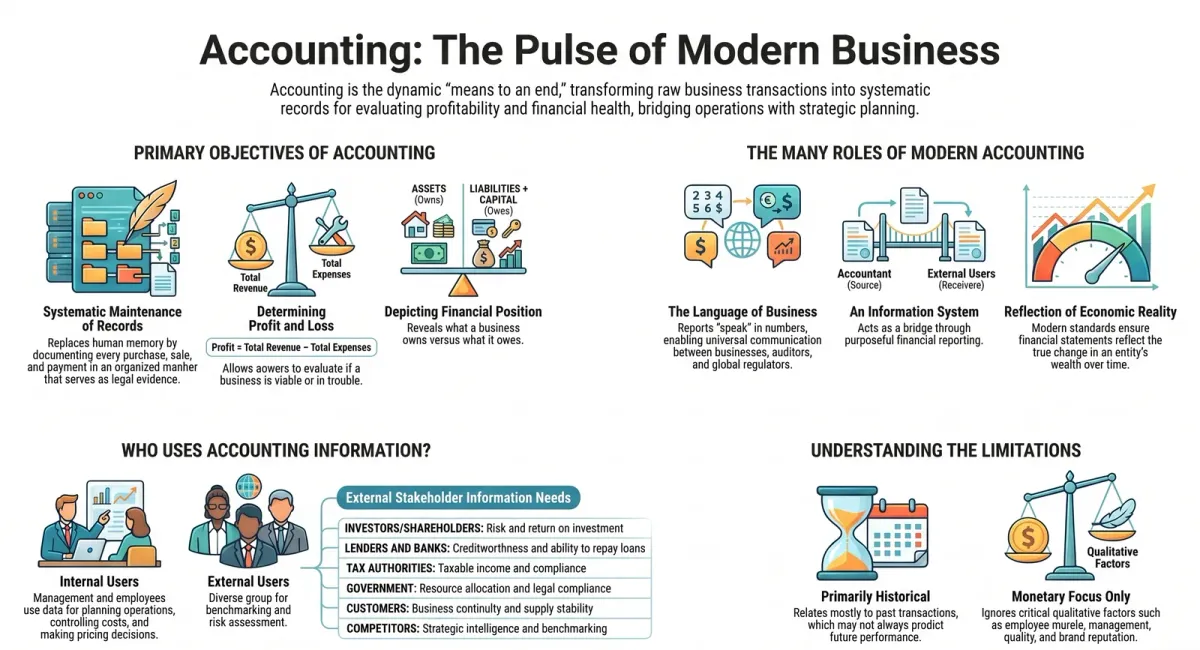
Primary Objectives of Accounting
Accounting as an information system serves several primary objectives. Let us examine each one.
Objective 1: Maintenance of Records of Business Transactions
The most fundamental objective of accounting is to maintain a systematic record of all financial transactions in the books of accounts.
No business owner — however experienced — can accurately remember every purchase, sale, payment, and receipt that takes place in the course of daily business. The volume and variety of transactions make memory unreliable.
Systematic accounting records ensure:
-
Every transaction is documented in an organised manner
-
Records can be retrieved at any time for reference or verification
-
The information acts as legal evidence in disputes
-
It enables verifiability of financial claims
Example: A retail shop that buys goods from ten different suppliers, pays rent, salaries, utility bills, and collects cash and credit sales daily — without systematic records, it would be impossible to track what is owed and what is owned.
Objective 2: Calculation of Profit and Loss
Business owners need to know, periodically, whether their business is earning profits or incurring losses. This is achieved by preparing a Profit and Loss Account (also called the Income Statement) for a specific accounting period.
How Profit is Calculated:
-
Profit = Total Revenue – Total Expenses (when revenue exceeds expenses)
-
Loss = Total Expenses – Total Revenue (when expenses exceed revenue)
Example:
-
Total Revenue for the year: ₹6,00,000
-
Total Expenses for the year: ₹5,40,000
-
Profit = ₹60,000
This simple calculation helps owners evaluate whether the business is viable, growing, or in trouble — and take corrective action.
Objective 3: Depiction of Financial Position
Beyond profit and loss, stakeholders need to know the overall financial health of a business — what it owns and what it owes. This is depicted through the Balance Sheet (also called the Position Statement).
The Balance Sheet records:
-
Assets — Economic resources owned by the business (land, machinery, inventory, cash)
-
Liabilities — Obligations or debts owed by the business (loans, creditors, outstanding expenses)
-
Capital — The owner’s investment in the business
A properly maintained Balance Sheet helps creditors decide whether to extend credit, investors decide whether to invest, and management decide how to allocate resources.
Objective 4: Providing Accounting Information to Users
Accounting information is generated so that it can be communicated to those who need it, in a form that is easy to understand and act upon. This information is shared through reports, statements, graphs, and charts.
There are two main user groups:
Internal Users
Management and employees who use accounting data for:
-
Planning future operations
-
Controlling current activities
-
Making pricing and cost decisions
-
Evaluating departmental performance
External Users and Their Needs
| External User | Information Needed |
|---|---|
| Investors/Shareholders | Risk and return on investment |
| Lenders and Banks | Creditworthiness and ability to repay loans |
| Suppliers and Creditors | Whether amounts owed will be repaid on time |
| Tax Authorities | Taxable income and compliance with tax laws |
| Government and Regulators | Resource allocation and legal compliance |
| Customers | Business continuity and continued product/service supply |
| Employees and Trade Unions | Stability, profitability, and wealth distribution |
| Competitors | Benchmarking and strategic intelligence |
| Social Responsibility Groups | Environmental impact and ethical conduct |
The Role of Accounting in Modern Business
The role of accounting has evolved dramatically over centuries, driven by economic development and increasing societal demands. Today, accounting plays multiple roles simultaneously.
Role 1: Language of Business
Just as language enables communication between people, accounting enables communication between businesses and their stakeholders. Financial statements “speak” in numbers, conveying the story of an organisation’s financial performance.
Accounting reports are universally understood by auditors, investors, analysts, and regulators — making accounting a truly global language of commerce.
Role 2: Historical Record
Accounting maintains a chronological record of financial transactions at their actual amounts. This historical record:
-
Provides a trail of past decisions
-
Supports legal and regulatory compliance
-
Enables trend analysis over time
Role 3: Current Economic Reality
Beyond history, accounting aims to reflect the true income and financial condition of an entity — the change in wealth over time. Modern accounting standards (like Ind AS in India) push for financial statements that reflect economic reality, not just historical cost.
Role 4: Information System
As an information system, accounting links the accountant (information source) with external users (receivers) through a channel of communication — financial reports. This systems view positions accounting as an active, purposeful discipline, not passive record-keeping.
Role 5: Service Function
Accounting performs a service activity by providing quantitative financial information that helps users in a variety of ways. Specialised accounting knowledge — forensic accounting, tax accounting, environmental accounting — is in demand across industries, with accountants serving as trusted advisors.
Limitations of Accounting
No discussion of accounting’s role is complete without acknowledging its limitations:
-
Accounting relates primarily to past transactions — it is largely historical.
-
It is quantitative and monetary — it does not capture qualitative factors like employee morale, brand reputation, or management quality.
-
It does not provide non-financial information such as customer satisfaction scores or market positioning.
These limitations must be kept in mind when using accounting information for decision-making.
Test Your Knowledge
Master Accountancy with ChampionsPrep
The objectives and role of accounting are high-frequency exam topics that require both conceptual clarity and the ability to apply concepts to practical scenarios. ChampionsPrep provides chapter-wise question banks, AI-driven doubt resolution, and targeted practice to help Class 11 and 12 Commerce students excel in board exams and entrance tests like CUET and IPMAT.
👉 Join thousands of Commerce students at https://app.championsprep.in — pay-per-use, no subscriptions.

Objectives and Role of Accounting in Modern Business – Class 11 CBSE Accountancy
Frequently Asked Questions
What are the main objectives of accounting? +
The main objectives are: maintaining records of business transactions, calculating profit and loss, depicting the financial position, and providing accounting information to various users.
What is the role of accounting in modern business? +
Accounting serves as the language of business, a historical record, a reflection of current economic reality, an information system, and a service function for society.
Who are the external users of accounting information? +
External users include investors, creditors, tax authorities, government and regulatory agencies, customers, employees, trade unions, and social responsibility groups.
What does the Balance Sheet depict? +
The Balance Sheet depicts the financial position of a business at a specific date, showing its assets, liabilities, and capital.
What are the limitations of accounting? +
Accounting is largely historical, monetary, and quantitative in nature. It does not capture qualitative information or non-financial data, which limits its usefulness as a standalone decision-making tool.
AI-powered practice — free to start