
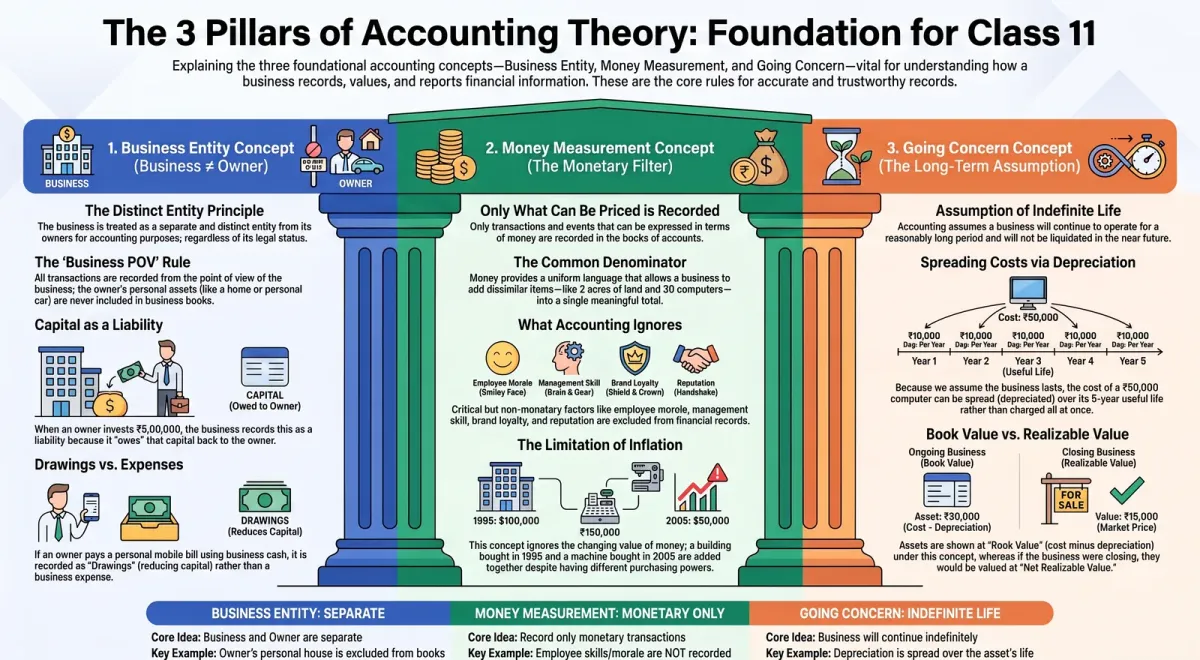
Understanding the basic accounting concepts is like learning the grammar of a new language. Just as grammar rules make communication clear and consistent, accounting concepts make financial records accurate, comparable, and trustworthy. In this guide, we explore three foundational concepts from CBSE Class 11 Accountancy Chapter 2: the Business Entity Concept, the Money Measurement Concept, and the Going Concern Concept.
These three concepts form the first pillar of accounting theory and appear regularly in board exams and competitive tests like CUET, IPMAT, and CA Foundation.
1. Business Entity Concept
What Does It Mean?
The Business Entity Concept states that a business is treated as a distinct and separate entity from its owners for the purpose of accounting. This might seem obvious, but it carries major practical implications.
When a sole proprietor named Rahul starts his grocery store, Rahul and his store are considered two separate entities in the books of accounts — even though in legal terms, Rahul bears personal responsibility for all business debts.
How It Works in Practice
Example 1: When Rahul invests ₹5,00,000 as capital into his business, this is recorded as a liability of the business to its owner — not as Rahul’s personal wealth. The business effectively “owes” this money to Rahul.
Example 2: If Rahul takes ₹10,000 from the business cash to pay his personal mobile bill, this is recorded as drawings — a reduction in his capital — and NOT as a business expense.
All accounting records are maintained from the point of view of the business, not the owner. Personal assets (Rahul’s house, car, savings account) and personal liabilities are entirely excluded from the business books. Similarly, personal transactions of the owner are not recorded in the business books unless they involve an inflow or outflow of business funds.
Why This Concept Matters
Without the Business Entity Concept, it would be impossible to assess the true performance of a business. Mixing personal and business finances distorts profits, misleads creditors, and creates complications for tax authorities. It is also the concept that makes sole proprietorship accounting meaningful despite the legal reality that the owner and business are one person.
2. Money Measurement Concept
What Does It State?
The Money Measurement Concept states that only those transactions and happenings in an organisation that can be expressed in terms of money are recorded in the books of accounts.
Events that cannot be assigned a monetary value — such as the morale of employees, the skill of management, customer loyalty, or the reputation of the brand — do not find a place in accounting records, no matter how significant they may be to business success.
Why Monetary Units?
Consider a business that owns the following on a single day:
-
2 acres of factory land
-
10 office rooms in a building
-
30 personal computers
-
20 tonnes of raw material
-
100 cartons of finished goods
These assets are measured in completely different units — acres, rooms, numbers, tonnes, cartons. It is impossible to add them together and arrive at a meaningful total. By converting everything into rupees (the common monetary unit), accounting creates a uniform language that makes aggregation and comparison possible.
Limitation of This Concept
The money measurement concept carries one significant limitation: it ignores the changing value of money over time.
If a building was purchased in 1995 for ₹2 crore and a machine was bought in 2005 for ₹1 crore, the balance sheet shows these as ₹3 crore in assets — but the rupee of 1995 and the rupee of 2005 represent very different purchasing powers. Inflation erodes the real value of money, which means we are sometimes adding heterogeneous values that cannot truly be compared. This is a recognised limitation of the historical cost approach to accounting.
3. Going Concern Concept
What Does It Assume?
The Going Concern Concept assumes that a business will continue to operate indefinitely — for a reasonably long period of time — and will NOT be wound up or liquidated in the near future.
This is a foundational assumption in accounting and has far-reaching consequences for how assets are valued and how expenses are allocated.
Practical Implication: Depreciation
Here is a concrete example. A computer is purchased for ₹50,000 with an expected useful life of 5 years. Instead of charging the entire ₹50,000 as an expense in Year 1, accounting spreads this cost over 5 years — charging ₹10,000 per year as depreciation.
This treatment is only logical if the business is expected to continue for the next 5 years. If there were no going concern assumption, the entire ₹50,000 would need to be written off immediately in the year of purchase.
The Going Concern Concept enables accountants to:
-
Capitalise expenditures that will benefit future periods (record as assets)
-
Defer expenses over the useful life of long-term assets
-
Show assets at their book value (cost minus accumulated depreciation) rather than at liquidation value
When This Concept Does Not Apply
If a business is known to be closing down soon, the going concern assumption no longer holds. In such cases, assets are re-valued at their net realisable value — what they could actually fetch if sold immediately — which is typically lower than book value.
Quick Summary
| Concept | Core Idea | Key Example |
|---|---|---|
| Business Entity | Business ≠ Owner | Owner's house excluded from business books |
| Money Measurement | Record only monetary transactions | Employee skills are not recorded |
| Going Concern | Business will continue indefinitely | Depreciation is spread over asset life |
Related Reading on ChampionsPrep
-
Next: Accounting Period, Cost Concept & Dual Aspect — Class 11 Guide
-
Related: Full Disclosure, Consistency & Conservatism Concepts
🎯 Clear Your Doubts Instantly
Have questions about any accounting concept? ChampionsPrep provides AI-powered instant doubt resolution for Class 11 and Class 12 Commerce students — available anytime you need it.
👉 Ask your doubt now at https://app.championsprep.in
Test Your Knowledge

Business Entity, Money Measurement & Going Concern Concepts | Class 11 Accountancy
Frequently Asked Questions
What is the Business Entity Concept in simple terms? +
The Business Entity Concept means that for accounting purposes, a business and its owner are treated as two separate entities, even if the owner is a sole proprietor who is personally liable for all business debts.
Why cannot non-monetary items be recorded in accounts? +
Non-monetary items like employee morale, brand loyalty, and management skill cannot be objectively measured in monetary terms. Without a common monetary value, they cannot be recorded consistently or compared meaningfully in financial statements.
How does the Going Concern Concept affect depreciation? +
The Going Concern Concept allows the cost of an asset to be spread over its useful life through depreciation. This treatment is only valid because the business is assumed to continue long enough to use the asset over its full life.
What happens to asset valuation when the Going Concern assumption fails? +
If a business is winding up or facing liquidation, assets must be re-valued at their net realisable value rather than book value, since the assumption of indefinite continuity no longer holds.
Can the owner's personal transactions ever appear in the business books? +
Only if they involve an inflow or outflow of business funds. For instance, if an owner draws cash from the business for personal use, this is recorded as drawings — a reduction in capital.
AI-powered practice — free to start