
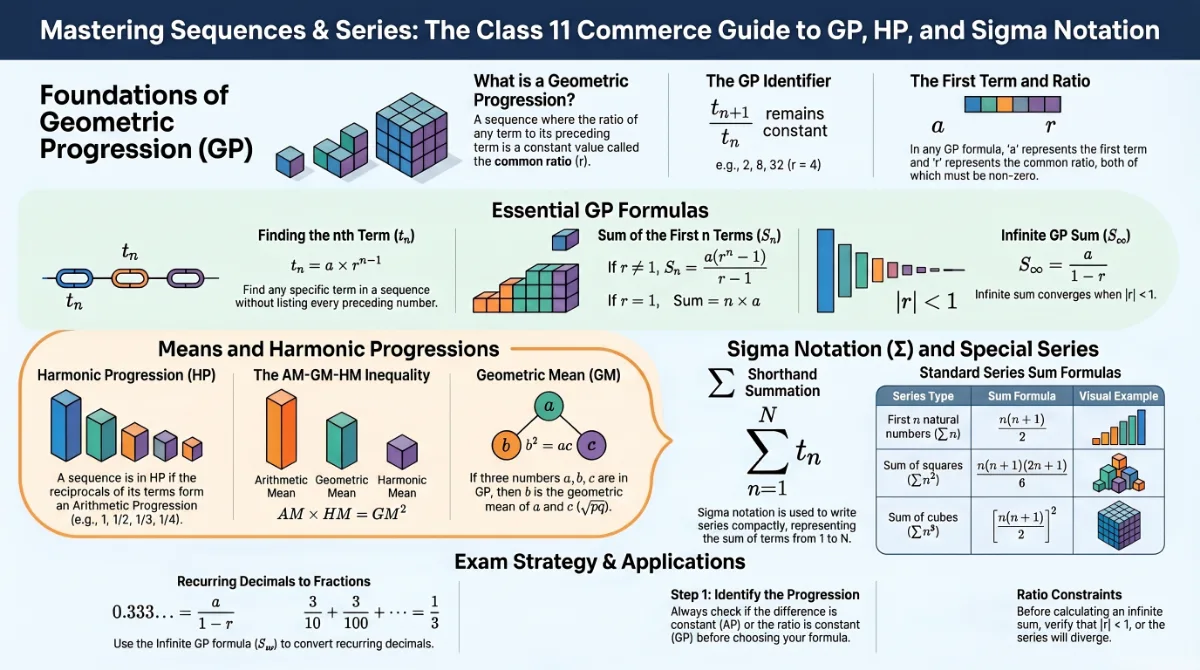
When you double your savings each month, that’s a geometric progression at work. When a bouncing ball reaches half its previous height on each bounce, that’s an infinite GP. Chapter 4 of your Class 11 Commerce Maths textbook — Sequences and Series — models these real-world patterns of growth, decay, and accumulation. For commerce students, these concepts connect directly to compound interest, depreciation, and financial series in economics.
📊 Interactive Practice: Simulate GP terms and test infinite convergence conditions with our Infinite GP Convergence Simulator in the middle of this guide!
What Is a Sequence?
A sequence is an ordered list of numbers following a specific rule. Each number is called a term, denoted tₙ.
-
Finite sequence: Fixed, countable terms. Example: [2, 4, 6, 8, 10]
-
Infinite sequence: Continues indefinitely. Example: [1, 3, 5, 7, 9, …]
Sequences following a specific rule are called progressions. You know Arithmetic Progression (AP) from Class 10, where the difference between terms is constant. Chapter 4 focuses on Geometric Progression (GP), where the ratio between consecutive terms is constant.
Geometric Progression — Definition and Recognition
A sequence {tₙ} is a Geometric Progression (GP) if the ratio of any term to its preceding term is constant:
This constant r is called the common ratio (r ≠ 0). The first term is denoted a (a ≠ 0).
Examples:
-
2, 8, 32, 128 → a = 2, r = 4 ✓
-
25, 5, 1, 1/5 → a = 25, r = 1/5 ✓
-
4, −8, 16, −32 → a = 4, r = −2 ✓ (negative ratio gives alternating signs)
-
4, 8, 16, 24 → NOT a GP (differences are constant, not ratios — this is AP)
Quick check: Divide any term by its predecessor. If the ratio is always the same, it’s a GP.
nth Term (General Term) of a GP
This formula lets you find any specific term without listing all preceding terms.
Example 1: Find the 6th term of 3, 6, 12, 24, …
-
a = 3, r = 2
-
t₆ = 3 × 2⁵ = 3 × 32 = 96
Example 2: In a GP, if the 3rd term is 24 and the 6th term is 192, find the first term (a) and common ratio (r).
-
$t_3 = a r^2 = 24$
-
$t_6 = a r^5 = 192$
-
Dividing $t_6$ by $t_3$: $\frac{a r^5}{a r^2} = r^3 = \frac{192}{24} = 8 \implies r = 2$.
-
Substituting $r = 2$ in $a r^2 = 24 \implies a(4) = 24 \implies a = 6$.
-
Thus, the first term $a = 6$ and common ratio $r = 2$.
Finding n when a term is given: If tₙ = 192 in Example 1, solve 3 × 2ⁿ⁻¹ = 192 → 2ⁿ⁻¹ = 64 = 2⁶ → n − 1 = 6 → n = 7.
Key Property — Geometric Mean
If a, b, c are in GP, then b² = ac. This means b is the geometric mean of a and c. To insert a geometric mean between two numbers p and q: GM = √(pq).
Sum of the First n Terms of a GP
When r ≠ 1:
Equivalently: Sₙ = a(1 − rⁿ) / (1 − r) — use whichever avoids a negative denominator.
When r = 1: Every term equals a, so:
Example: Find S₅ for 2, 6, 18, 54, 162, …
-
a = 2, r = 3
-
S₅ = 2(3⁵ − 1) / (3 − 1) = 2(243 − 1) / 2 = 242
Always verify: 2 + 6 + 18 + 54 + 162 = 242 ✓
Sum of Infinite Terms of a GP
When |r| < 1, terms shrink progressively toward zero and the infinite sum converges to a finite value:
If |r| ≥ 1, the sum diverges — it has no finite value.
Example: Sum of 1 + 1/2 + 1/4 + 1/8 + … (a = 1, r = 1/2) S∞ = 1 / (1 − 1/2) = 1 / (1/2) = 2
Practical application: Converting recurring decimals to fractions uses this formula. 0.333… = 3/10 + 3/100 + 3/1000 + … → a = 3/10, r = 1/10 S∞ = (3/10) / (1 − 1/10) = (3/10) / (9/10) = 1/3 ✓
Infinite GP Convergence Simulator
Change the first term (a) and common ratio (r) to see terms list and check if the sum to infinity converges.
Series Terms List
Sum to Infinity
Since |r| = 0.5 < 1, the terms shrink to 0. The sum stabilizes at 20.
Syllabus Checkpoints & Exam Watch-Outs
- Exam Trap: The formula S_∞ = a / (1 - r) ONLY applies when |r| < 1. If |r| ≥ 1, the series diverges and the sum to infinity is undefined!
- If r is negative, the terms will alternate sign (+, -, +, -, ...). Make sure to include the negative sign in your r-value when using formulas.
Harmonic Progression (HP)
A sequence is in Harmonic Progression if the reciprocals of its terms form an AP. Example: 1, 1/2, 1/3, 1/4, … — the reciprocals 1, 2, 3, 4 are in AP.
Harmonic Mean (HM) of two numbers a and b: HM = 2ab / (a + b)
The AM-GM-HM inequality for positive numbers is one of the most tested relationships. Specifically, for any two positive numbers $a$ and $b$, the relationship is:
This elegant result connects all three means and appears in optimisation problems and entrance exam questions.
Sigma Notation — Writing Series Compactly
Sigma (Σ) notation is shorthand for summing series. Σₙ₌₁ᴺ tₙ means “sum of tₙ for n from 1 to N.”
Three Standard Formulas — Memorise These
| Series | Sum Formula |
|---|---|
| Σn = 1 + 2 + 3 + ... + n | n(n+1)/2 |
| Σn² = 1² + 2² + 3² + ... + n² | n(n+1)(2n+1)/6 |
| Σn³ = 1³ + 2³ + 3³ + ... + n³ | [n(n+1)/2]² |
Properties:
-
Σ(aₙ + bₙ) = Σaₙ + Σbₙ
-
Σ(k × aₙ) = k × Σaₙ (constants factor out)
-
Σk = nk when k is a constant
These Sigma formulas are the key to solving board exam questions involving sums like 1×2 + 2×3 + 3×4 + … to n terms. Express the nth term as n(n+1) = n² + n, then split using Sigma properties: Σ(n² + n) = Σn² + Σn.
Common Exam Applications
Recurring decimal to fraction: Always use infinite GP. 0.6̄ = 6/10 + 6/100 + … = (6/10)/(9/10) = 2/3.
Sum of series like 1 + 11 + 111 + …: Multiply and divide by 9, convert to 9 + 99 + 999 + … = (10 + 100 + 1000 + …) − n, then apply GP sum formula.
Finding number of terms: Use the nth term formula tₙ = arⁿ⁻¹ and solve for n using logarithms if needed.
Exam Tips
-
Identify AP vs GP first — check difference then ratio.
-
Always confirm r ≠ 1 before using the GP sum formula.
-
For infinite GP, verify |r| < 1 before computing S∞.
-
Use AM-GM-HM inequality in comparison and optimisation questions.
-
Memorise all three Sigma formulas — they save enormous time.
Related Posts
-
_See also: _ Complex Numbers Class 11 Commerce – Algebra and Cube Roots of Unity
-
_Related: _ Determinants Class 11 Commerce – Properties, Cramer’s Rule Explained
-
_Explore: _ IPMAT Quantitative Aptitude Preparation – Class 11 Topics That Matter
Summary & Study Action Plan
Geometric Progression is one of the highest-weight topics in commerce maths entrance exams. Series-based problems appear in CUET, NPAT, and IPMAT and reward students who know their formulas cold and can identify GP structures quickly.
📌 Write out the three GP formulas and three Sigma formulas on a revision card. Solve 10 GP problems this week — 5 on finding terms and sums, 5 on infinite series and recurring decimals.
Frequently Asked Questions
What is the difference between AP and GP? +
In AP, the difference between consecutive terms is constant. In GP, the ratio of consecutive terms is constant.
What happens if the common ratio of a GP is negative? +
Terms alternate between positive and negative. The GP formulas still apply — just track signs carefully.
When does an infinite GP have a finite sum? +
Only when |r| < 1. The formula is S∞ = a/(1−r). If |r| ≥ 1, the series has no finite sum.
How do you convert 0.333... to a fraction using GP? +
It equals 3/10 + 3/100 + ... with a = 3/10 and r = 1/10. S∞ = (3/10)/(1 − 1/10) = (3/10)/(9/10) = 1/3.
What is the geometric mean of 4 and 16? +
GM = √(4 × 16) = √64 = 8. Check: 4, 8, 16 is a GP with r = 2. ✓
Are Sigma formula problems common in board exams? +
Yes. Finding sums of special series using Σn, Σn², and Σn³ is a recurring question type in Maharashtra State Board Class 11 exams.
AI-powered practice — free to start