
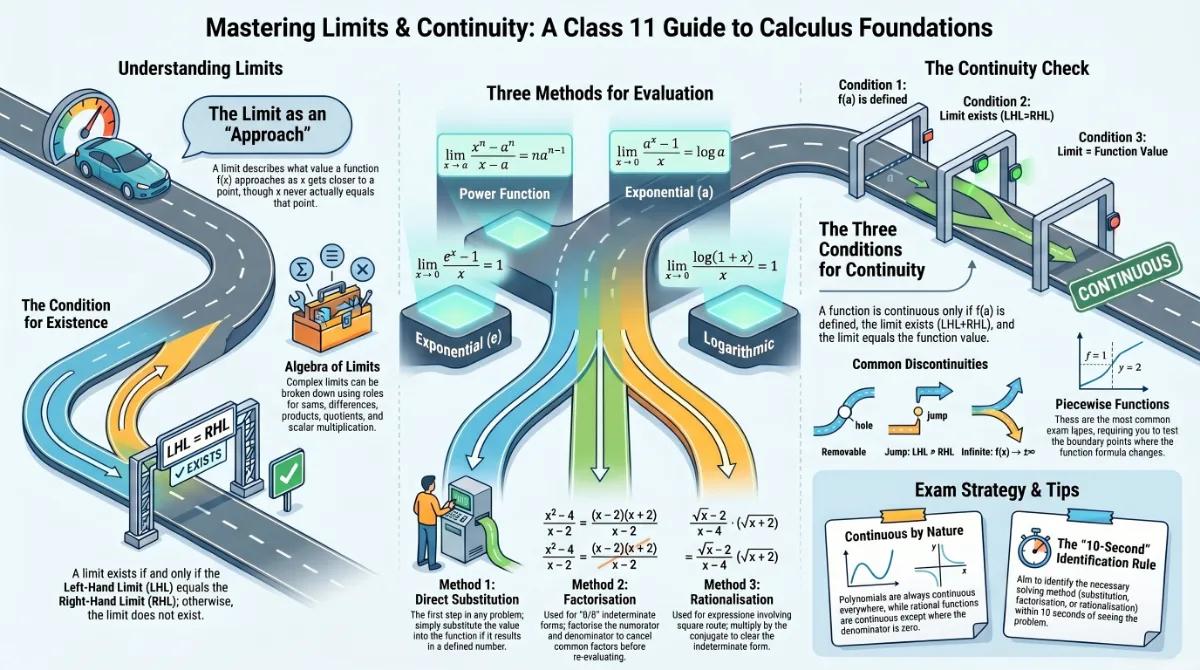
Imagine a car’s speedometer at any given instant — that reading is the limit of average speed as the time interval shrinks toward zero. This real-world intuition is precisely what Limits (Chapter 7) formalises. Continuity (Chapter 8) then asks whether a function behaves smoothly without any breaks or jumps. Together, they form the entry point to calculus — the most powerful analytical tool in both science and economics. Here is everything you need to master both topics for board exams and entrance tests.
📊 Interactive Practice: Visualise how left and right-hand limits snap together or create jumps with our Interactive Piecewise Function Continuity Sandbox in the middle of this guide!
What Is a Limit? Building Intuition
Consider f(x) = x + 3. As x gets closer to 3 (but never equals 3), what does f(x) approach?
| x → 3 from left | f(x) |
|---|---|
| 2.9 | 5.9 |
| 2.99 | 5.99 |
| 2.999 | 5.999 |
| x → 3 from right | f(x) |
|---|---|
| 3.1 | 6.1 |
| 3.01 | 6.01 |
| 3.001 | 6.001 |
From both sides, f(x) → 6. We write:
The key insight: x never actually equals 3. The limit is about the approach, not the arrival.
Left-Hand and Right-Hand Limits
-
Left-Hand Limit (LHL): Value f(x) approaches as x → a from the left (x < a)
-
Right-Hand Limit (RHL): Value f(x) approaches as x → a from the right (x > a)
The limit exists if and only if LHL = RHL. If they differ, the limit does not exist at that point.
This is tested frequently through piecewise-defined functions where different formulas apply to x < a and x > a. Always calculate both one-sided limits and compare.
Algebra of Limits
If lim f(x) and lim g(x) both exist as x → a:
-
Sum/Difference: lim [f ± g] = lim f ± lim g
-
Product: lim [f × g] = lim f × lim g
-
Quotient: lim [f/g] = lim f / lim g, provided lim g ≠ 0
-
Scalar: lim [k × f] = k × lim f
These rules allow you to break complex limits into simpler components and evaluate each part separately.
Three Methods for Evaluating Limits
Method 1 — Direct Substitution
Simply substitute $x = a$. This works when the denominator is non-zero at $x = a$.
Example:
Always try this first. If it gives a defined value, you’re done.
Method 2 — Factorisation (for 0/0 forms)
When direct substitution gives 0/0, factorise numerator and denominator and cancel the common $(x - a)$ factor.
Example:
This cancellation is valid because x approaches 2 but never equals 2, so (x − 2) ≠ 0.
Method 3 — Rationalisation (for square root forms)
When the expression involves √, multiply numerator and denominator by the conjugate.
Example:
Multiply by the conjugate $\frac{\sqrt{x+1} + 1}{\sqrt{x+1} + 1}$:
Standard Limits — Memorise These
These appear directly in board exam questions and must be known without derivation:
These standard limits are frequently useful in exam-style problems. Write them on a flashcard and review daily.
What Is Continuity? The Three Conditions
A function f(x) is continuous at x = a if all three of the following hold simultaneously:
-
f(a) is defined — no gap or hole at x = a
-
lim (x → a) f(x) exists — LHL = RHL
-
lim (x → a) f(x) = f(a) — the limit equals the function value
If even one condition fails, f is discontinuous at x = a.
Types of Discontinuity
Understanding the type of discontinuity often determines the marks available in a question:
-
Removable Discontinuity: The limit exists, but f(a) is either undefined or ≠ limit. The graph has a “hole.” Can be fixed by redefining f(a).
-
Jump Discontinuity: LHL ≠ RHL. The function makes a sudden jump. Common in piecewise-defined functions.
-
Infinite Discontinuity: f(x) → ±∞ as x → a. Example: f(x) = 1/x at x = 0.
Testing Continuity — Step-by-Step
Step 1: Compute f(a) — is it defined? Step 2: Compute LHL = lim (x → a⁻) f(x) Step 3: Compute RHL = lim (x → a⁺) f(x) Step 4: Check: LHL = RHL = f(a)?
-
Yes → continuous at x = a
-
No → discontinuous; identify which condition failed
Example: Test continuity of f(x) = |x| at x = 0
-
f(0) = 0 ✓
-
LHL = lim (x → 0⁻) (−x) = 0
-
RHL = lim (x → 0⁺) (x) = 0
-
LHL = RHL = f(0) = 0 → Continuous ✓
Continuity Over an Interval
A function is continuous over an interval if it is continuous at every point in that interval.
Key facts:
-
All polynomial functions are continuous everywhere on ℝ
-
Rational functions are continuous everywhere except where the denominator is zero
-
Exponential and logarithmic functions are continuous on their natural domains
-
The sum, difference, product, and quotient of continuous functions are continuous (quotient requires non-zero denominator)
(Advanced Extension) The Intermediate Value Theorem is a powerful consequence: if f is continuous on [a, b] and k is any value between f(a) and f(b), there exists some c ∈ (a, b) where f(c) = k. This guarantees the existence of roots between two points where the function changes sign.
Piecewise Functions — The Most Common Exam Type
Most continuity problems in board exams use piecewise-defined functions like:
f(x) = 3x + 1 for x < 1 f(x) = 5x − 1 for x ≥ 1
To test continuity at x = 1:
-
f(1) = 5(1) − 1 = 4
-
LHL = lim (x → 1⁻) (3x + 1) = 4
-
RHL = lim (x → 1⁺) (5x − 1) = 4
-
LHL = RHL = f(1) → Continuous at x = 1
Always evaluate the boundary point from both sides, using the appropriate piece of the function.
Piecewise Function Continuity Sandbox
Set parameters for f(x) = kx + 2 (for x < 2) and f(x) = x^2 - c (for x >= 2) to see if LHL equals RHL at x=2.
Boundary Limits at x = 2
Visual Function Plot
Continuity Check
LHL matches RHL (4). The two pieces join perfectly at x=2.
Syllabus Checkpoints & Exam Watch-Outs
- Continuous condition: For f(x) to be continuous at x=a, LHL must equal RHL AND both must equal the actual function value f(a).
- If LHL ≠ RHL, the limit does not exist at all, resulting in a jump discontinuity on the graph.
Exam Tips
-
Try direct substitution first — if it works, use it.
-
For 0/0 forms, factorise before rationalising.
-
In continuity problems, explicitly check all three conditions.
-
Piecewise functions always test the boundary points.
-
Memorise the four standard limit formulas.
Related Posts
-
_See also: _ Differentiation Class 11 Commerce – Derivatives, Rules & Applications
-
_Related: _ Determinants Class 11 Commerce – Cramer’s Rule Explained
-
_Explore: _ 30-Day Revision Plan for Class 11 Commerce Maths Board Exams
Summary & Study Action Plan
Limits and Continuity appear abstract at first, but board exam questions follow tight, predictable patterns. Once you can identify the method (direct, factorisation, rationalisation) in under 10 seconds, and apply the three-condition continuity check fluently, this chapter becomes one of the most reliable sources of marks.
📌 Solve 5 limit problems from each method, then 5 continuity problems on piecewise functions. Revisit the four standard limits daily for a week.
Frequently Asked Questions
What is the difference between a limit and the value of a function? +
The limit describes what f(x) approaches as x → a, while f(a) is the actual value at x = a. They are equal only when the function is continuous at a.
Can a limit exist if the function is undefined at that point? +
Yes. lim (x → 2) (x² − 4)/(x − 2) = 4, even though the function is undefined at x = 2 due to division by zero.
What does LHL ≠ RHL tell you? +
The limit does not exist at that point, and the function has a jump discontinuity.
Is a polynomial function always continuous? +
Yes. Polynomials are continuous at every real number because they are defined and smooth everywhere.
What is an indeterminate form? +
A result like 0/0 or ∞/∞ when you substitute x = a directly. It signals that further algebraic work — factorisation or rationalisation — is needed.
Are limits tested in CUET and IPMAT for commerce students? +
Yes. CUET Mathematics includes limit problems, and foundational calculus concepts appear in IPMAT quantitative aptitude sections.
AI-powered practice — free to start