
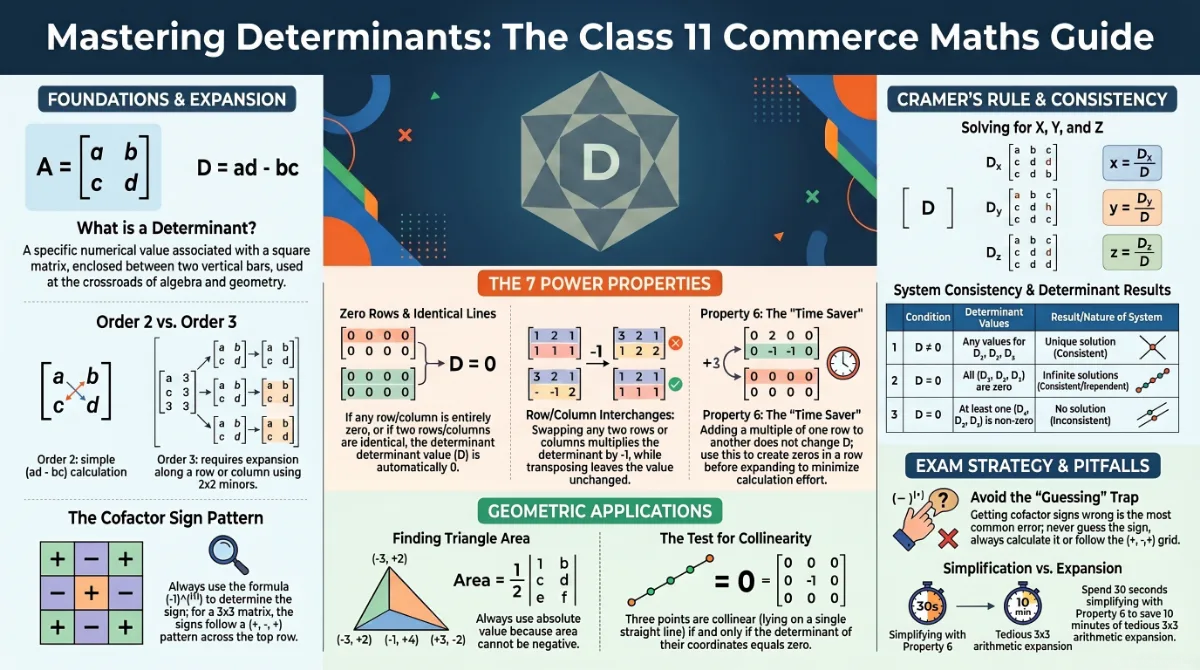
Determinants sit at the crossroads of algebra and geometry in your Class 11 Commerce Maths curriculum. You met them briefly in Class 10 for solving simultaneous equations in two variables. Chapter 6 expands that concept significantly: 3×3 determinants, powerful simplification properties, Cramer’s Rule for three-variable systems, and elegant geometric applications — finding triangle areas and checking whether three points are collinear.
📊 Interactive Practice: Try solving simultaneous equations and check for singular matrices with our Interactive Cramer’s Rule Solver in the middle of this guide!
What Is a Determinant?
Determinants were studied by mathematicians including G.W. Leibniz, and Cramer’s Rule is named after Gabriel Cramer.
Determinant of Order 2
For the 2×2 arrangement of a, b, c, d:
Product of the main diagonal minus product of the anti-diagonal. This simple rule is the building block for everything that follows.
Determinant of Order 3
A 3×3 determinant has nine elements arranged in 3 rows and 3 columns. Element aᵢⱼ occupies row i and column j.
Expansion along Row 1:
Each term uses the 2×2 minor formed by deleting that element’s row and column. The signs follow the pattern +, −, + for the first row.
You can expand along any row or column — the result is always the same, but choosing a row or column with zeros minimises calculation effort.
Minors and Cofactors
-
Minor Mᵢⱼ: The 2×2 determinant obtained by deleting row i and column j.
-
Cofactor Cᵢⱼ = (−1)^(i+j) × Mᵢⱼ: The signed minor.
The sign pattern for cofactors across a 3×3 matrix:
+ − +
− + −
+ − +
Getting the cofactor signs wrong is the single most common source of errors in this chapter. Always apply (−1)^(i+j) — never guess.
Properties of Determinants — Save Time in Exams
These properties let you simplify a complex determinant before expanding, cutting calculation time dramatically.
Property 1 — Zero row/column: If any row or column is entirely zero, D = 0.
Property 2 — Row/column interchange: Swapping any two rows (or columns) multiplies D by −1.
Property 3 — Identical rows/columns: If two rows (or columns) are identical, D = 0.
Property 4 — Scalar multiplication: Multiplying any one row or column by k multiplies D by k.
Property 5 — Sum splitting: If elements of one row are sums, D splits into two determinants.
Property 6 — Row operations (most powerful): Adding a multiple of one row to another does not change D. Use this to introduce zeros into a row or column, then expand along that row/column for a much simpler calculation.
Property 7 — Transpose: D equals the determinant of its transpose (rows and columns swapped).
Exam strategy: Before expanding a 3×3 determinant, spend 30 seconds using Property 6 to create two zeros in one row or column. Then a single 2×2 expansion does the whole problem.
Solving Linear Equations — Cramer’s Rule
Cramer’s Rule solves systems of simultaneous linear equations using determinants. For 3 equations in 3 unknowns:
Let D = determinant of the coefficient matrix. Let Dₓ = D with the x-coefficients replaced by the constants. Let Dᵧ = D with the y-coefficients replaced by the constants. Let D_z = D with the z-coefficients replaced by the constants.
(when D ≠ 0)
Consistency Conditions
| D | Dₓ, Dᵧ, D_z | Result |
|---|---|---|
| D ≠ 0 | Any values | Unique solution (consistent) |
| D = 0 | All zero | Infinite solutions (consistent, dependent) |
| D = 0 | At least one non-zero | No solution (inconsistent) |
Memorise this table — questions on consistency of systems appear regularly in both board exams and entrance tests.
Area of a Triangle Using Determinants
The area of a triangle with vertices (x₁, y₁), (x₂, y₂), (x₃, y₃) is:
where Δ is the determinant:
|x₁  y₁  1|
|x₂  y₂  1|
|x₃  y₃  1|
The absolute value ensures area is always non-negative. If this determinant equals zero, the three points are collinear — they lie on one straight line and form no triangle.
This formula is cleaner and faster than the traditional coordinate geometry approach, especially when coordinates are fractions or large numbers.
Collinearity of Three Points
Three points (x₁, y₁), (x₂, y₂), (x₃, y₃) are collinear if and only if:
|x₁  y₁  1|
|x₂  y₂  1| = 0
|x₃  y₃  1|
This is the neatest test for collinearity available in Class 11 and should be your default method in exams.
Step-by-Step: Applying Cramer’s Rule (2-Variable System)
System: x + y = 3; 2x − y = 6
-
D = |1 1; 2 −1| = (1)(−1) − (1)(2) = −3
-
Dₓ = |3 1; 6 −1| = (3)(−1) − (1)(6) = −9
-
Dᵧ = |1 3; 2 6| = (1)(6) − (3)(2) = 0
-
x = −9/−3 = 3; y = 0/−3 = 0
-
Verify: 3 + 0 = 3 ✓; 6 − 0 = 6 ✓
Cramer's Rule & Singularity Solver
Adjust coefficients of the system a1*x + b1*y = c1 and a2*x + b2*y = c2 to see determinant calculation and solutions.
Determinant Values
Solution Set
The system is consistent with a single intersection point at (1, 2).
Syllabus Checkpoints & Exam Watch-Outs
- Trap: Cramer's rule fails if D = 0. The system has either no solution or infinitely many solutions, and the matrix of coefficients is singular.
- Beware of signs! D = (a1 * b2) - (a2 * b1). If either term is negative, the double negative becomes an addition.
(Note: The same method extends to three variables by calculating $D, D_x, D_y,$ and $D_z$ using 3x3 determinants.)
Cramer’s Rule for a 3-Variable System
System:
- D = $\det \begin{pmatrix} 1 & 1 & 1 \\ 1 & -1 & 1 \\ 2 & 1 & -1 \end{pmatrix} = 1((-1)(-1) - (1)(1)) - 1((1)(-1) - (1)(2)) + 1((1)(1) - (-1)(2))$
$D = 1(0) - 1(-3) + 1(3) = 6$
-
Dₓ = $\det \begin{pmatrix} 6 & 1 & 1 \\ 2 & -1 & 1 \\ 1 & 1 & -1 \end{pmatrix} = 6(0) - 1(-3) + 1(3) = 6$
-
Dᵧ = $\det \begin{pmatrix} 1 & 6 & 1 \\ 1 & 2 & 1 \\ 2 & 1 & -1 \end{pmatrix} = 1((2)(-1) - (1)(1)) - 6((1)(-1) - (1)(2)) + 1((1)(1) - (2)(2))$
$D_y = 1(-3) - 6(-3) + 1(-3) = -3 + 18 - 3 = 12$
- D_z = $\det \begin{pmatrix} 1 & 1 & 6 \\ 1 & -1 & 2 \\ 2 & 1 & 1 \end{pmatrix} = 1((-1)(1) - (2)(1)) - 1((1)(1) - (2)(2)) + 6((1)(1) - (-1)(2))$
$D_z = 1(-3) - 1(-3) + 6(3) = -3 + 3 + 18 = 18$
- Solutions:
$x = \frac{D_x}{D} = \frac{6}{6} = 1$ $y = \frac{D_y}{D} = \frac{12}{6} = 2$ $z = \frac{D_z}{D} = \frac{18}{6} = 3$
- Verification:
$1 + 2 + 3 = 6$ ✓ $1 - 2 + 3 = 2$ ✓ $2(1) + 2 - 3 = 1$ ✓
Common Mistakes to Avoid
-
Wrong cofactor signs. Always compute (−1)^(i+j) — never rely on memory for the sign pattern alone.
-
Forgetting the absolute value in the area formula. Area is always positive.
-
Expanding without simplifying first. A 5-minute simplification saves 10 minutes of expansion.
-
Using Cramer’s Rule when D = 0. If D = 0, you must check Dₓ, Dᵧ, D_z to classify the system.
Related Posts
-
_See also: _ Locus and Straight Lines Class 11 Commerce – Slope, Intercepts, and Equations
-
_Related: _ Sequences and Series Class 11 Commerce – GP and Sum Formulas
-
_Explore: _ Class 11 Commerce Maths Formula Sheet – Complete Revision Notes
Summary & Study Action Plan
Determinants rewards methodical, systematic practice. The formulas are fixed, the steps are predictable, and exam questions are highly repetitive in structure. Once you’ve solved 15–20 problems using Cramer’s Rule, the process becomes near-automatic.
📌 Solve 10 Cramer’s Rule problems (including one inconsistent system). Then do 5 triangle area problems. That’s the full chapter covered.
Frequently Asked Questions
What is the difference between a matrix and a determinant? +
A matrix is a rectangular array of numbers. A determinant is a specific numerical value computed from a square matrix. Rectangular matrices do not have determinants.
When does Cramer's Rule fail? +
When D = 0. You must then check Dₓ, Dᵧ, D_z to determine whether the system has no solution or infinitely many solutions.
Can you expand a 3×3 determinant along any row or column? +
Yes. The determinant value is the same regardless of which row or column you use — but cofactor signs must be applied correctly via (−1)^(i+j).
What does a zero area mean when using the triangle determinant formula? +
The three points are collinear — they lie on a single straight line and cannot form a triangle.
How do determinant properties save time? +
By creating zeros in a row or column using row operations (Property 6), you reduce a full 3×3 expansion to a single 2×2 calculation, cutting arithmetic significantly.
Are determinants tested in CUET and IPMAT? +
Yes. Linear equation systems and determinant-based problems appear in CUET Mathematics and in quantitative sections of IPMAT and NPAT.
AI-powered practice — free to start