
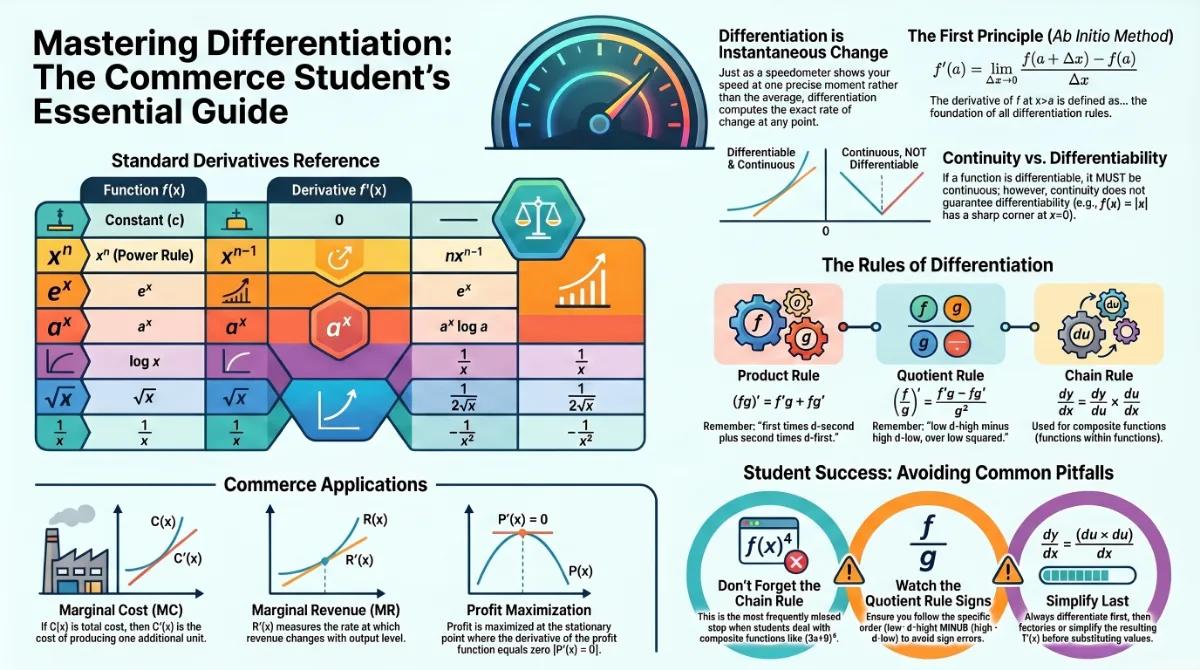
If limits answer “what does f(x) approach?”, differentiation (Chapter 9) is the natural next step — it uses limits to compute the exact rate of change of a function at any point. For commerce students, this is not abstract. Derivatives measure marginal cost, marginal revenue, and marginal profit — concepts central to economics and business mathematics. Mastering differentiation in Class 11 builds the analytical foundation you’ll use throughout your academic and professional life.
📊 Interactive Practice: Visualise how secant lines converge onto the tangent line as step size h approaches 0 with our Interactive Secant to Tangent Convergence Simulator in the middle of this guide!
What Is a Derivative? The Intuition
Picture a car travelling from Mumbai to Pune. Average speed over the whole trip = total distance ÷ total time. But at any specific instant, the speedometer shows instantaneous speed — the speed at one precise moment.
Mathematically, instantaneous speed is the limiting value of (change in distance) / (change in time) as the time interval shrinks toward zero. This process of finding the instantaneous rate of change of any function is called differentiation, and the result is called a derivative.
Definition — The First Principle
The derivative of f at x = a is:
provided this limit exists. This is the first principle of differentiation (also called differentiation from first principles or the ab initio method). Every differentiation rule ultimately derives from this single definition.
If f is differentiable at every point in its domain, we say f is a differentiable function, and its derivative f’(x) is itself a function of x.
Secant to Tangent Convergence Simulator
For f(x) = x^2, adjust x and step size h. See how the secant slope converges to the true tangent slope as h approaches 0.
Secant vs Tangent Slopes
Visual Tangent Convergence
Convergence Analysis
At h = 1, the secant line is an approximation. Reduce step h to see it converge.
Syllabus Checkpoints & Exam Watch-Outs
- Exam Trap: In the First Principle of Derivatives, we cannot substitute h = 0 directly, as it results in a 0/0 division. We must evaluate the limit analytically first.
- Quotient Rule Trap: When differentiating u/v, the numerator is u'v - uv'. Swapping the terms in subtraction changes the sign of the entire derivative.
Notation for Derivatives
All four of these mean the same thing — the derivative of y = f(x):
-
f’(x) — Lagrange’s notation
-
dy/dx — Leibniz’s notation (most common in applications)
-
y’ — shorthand
-
Df(x) — operator notation
Differentiability and Its Relationship to Continuity
A critical fact: if f is differentiable at a point, it is necessarily continuous there. But the converse is not guaranteed — continuity does not imply differentiability.
Classic example: f(x) = |x| is continuous everywhere, including at x = 0. But it is NOT differentiable at x = 0 — the left-hand derivative is −1 and the right-hand derivative is +1, so no unique tangent exists at the sharp corner.
Standard Derivatives — The Building Blocks
Memorise these completely before attempting any differentiation problem:
| Function f(x) | Derivative f'(x) |
|---|---|
| c (any constant) | 0 |
| xⁿ (any real n) | nxⁿ⁻¹ |
| eˣ | eˣ |
| aˣ | aˣ log a |
| log x (natural log, base e) | 1/x |
| log_a x | 1/(x log a) |
| √x | 1/(2√x) |
| 1/x | −1/x² |
The power rule d/dx(xⁿ) = nxⁿ⁻¹ is the most applied rule and works for all real values of $n$, including fractions and negatives (subject to domain restrictions where $x > 0$ for fractional powers or $x \neq 0$ for negative powers).
Rules of Differentiation
Constant and Scalar Rules
d/dx [c] = 0 and d/dx [k·f(x)] = k·f’(x). Constants vanish; scalar multiples factor out.
Sum and Difference Rule
d/dx [f(x) ± g(x)] = f’(x) ± g’(x)
Differentiate each term independently. Works for any finite number of terms.
Product Rule
d/dx [f(x) · g(x)] = f’(x)·g(x) + f(x)·g’(x)
Memory aid: “first times d-second plus second times d-first”
Example: d/dx [x² · eˣ] = 2x·eˣ + x²·eˣ = xeˣ(x + 2)
Quotient Rule
d/dx [f(x)/g(x)] = [f’(x)·g(x) − f(x)·g’(x)] / [g(x)]²
Memory aid: “low d-high minus high d-low, over low squared”
Example: d/dx [(x²+1)/(x−1)] = [(2x)(x−1) − (x²+1)(1)] / (x−1)² = (2x² − 2x − x² − 1) / (x−1)² = (x² − 2x − 1) / (x−1)²
Chain Rule — Most Commonly Missed
If y = f(u) and u = g(x), then:
The chain rule handles composite functions — functions within functions. It is the most commonly forgotten rule, yet it appears in the majority of differentiation problems.
Example: y = (3x + 5)⁴ Let u = 3x + 5 → y = u⁴ dy/du = 4u³ = 4(3x + 5)³; du/dx = 3 dy/dx = 4(3x + 5)³ × 3 = 12(3x + 5)³
Example: y = e^(2x) dy/dx = e^(2x) × d/dx(2x) = 2e^(2x)
Applications of Differentiation
Rate of Change
dy/dx gives the instantaneous rate of change of y with respect to x. In commerce:
-
Marginal Cost: If C(x) = total cost for x units, then C’(x) = marginal cost
-
Marginal Revenue: R’(x) = rate at which revenue changes with output
-
Marginal Profit: $P’(x) = R’(x) − C’(x)$. Profit candidates (stationary points) occur where $P’(x) = 0$, subject to further testing to confirm a maximum.
These interpretations directly connect Class 11 calculus to the economics you study alongside it.
Increasing and Decreasing Functions
-
f’(x) > 0 on an interval → f is increasing (graph rises)
-
f’(x) < 0 on an interval → f is decreasing (graph falls)
-
f’(x) = 0 → stationary point (candidate for maximum or minimum). Use a sign change check or the second derivative test to confirm a maximum.
Second Derivative
f”(x) is the derivative of f’(x). It measures how the slope itself changes:
-
f”(x) > 0 → concave up, local minimum
-
f”(x) < 0 → concave down, local maximum
The second derivative test for extrema is a key Class 12 topic that builds directly on what you learn here.
Common Mistakes to Avoid
-
Forgetting the chain rule when differentiating composite functions — the most frequent error in Class 11.
-
Applying product rule to a constant multiple — d/dx[5x²] uses the scalar rule, not the product rule.
-
Sign errors in the quotient rule — always (low · d-high) minus (high · d-low), in that exact order.
-
Not simplifying after differentiating — always factorise f’(x) before interpreting or substituting values.
Quick Reference — Differentiation Rules Summary
| Rule | Formula |
|---|---|
| Constant | d/dx[c] = 0 |
| Power | d/dx[xⁿ] = nxⁿ⁻¹ |
| Sum/Difference | d/dx[f±g] = f'±g' |
| Product | (fg)' = f'g + fg' |
| Quotient | (f/g)' = (f'g − fg')/g² |
| Chain | dy/dx = (dy/du)(du/dx) |
Related Posts
-
_See also: _ Limits and Continuity Class 11 Commerce – Methods and Exam Tips
-
_Related: _ Functions Class 11 Commerce – Types, Graphs & Inverse Functions
-
_Explore: _ Marginal Cost and Revenue in Commerce Maths – Calculus Applications for Economics
Summary & Study Action Plan
Differentiation is the engine behind optimisation — and optimisation is at the heart of economics, business, and quantitative aptitude. Mastering this chapter gives you both board exam marks and a genuine analytical tool for understanding how things change.
📌 20 minutes daily: start with standard derivatives, move to product and quotient rule problems, finish each session with a chain rule example. Two weeks of this and differentiation becomes effortless.
Frequently Asked Questions
What is the difference between a derivative and differentiation? +
Differentiation is the process; the derivative f'(x) is the result. When you differentiate f(x), you obtain f'(x) — the instantaneous rate of change at any x.
What does dy/dx represent physically? +
The instantaneous rate of change of y with respect to x. In commerce, this represents concepts like marginal cost or instantaneous speed.
Is continuity sufficient for differentiability? +
No. Continuity is necessary but not sufficient. The function f(x) = |x| is continuous everywhere but not differentiable at x = 0.
How does the chain rule apply to y = √(2x + 3)? +
Let u = 2x + 3, y = u^(1/2). dy/du = (1/2)u^(−1/2); du/dx = 2. Chain rule: dy/dx = (1/2)(2x+3)^(−1/2) × 2 = 1/√(2x+3).
What is marginal cost in terms of differentiation? +
If C(x) is the total cost for x units, then marginal cost = C'(x) = dC/dx, representing the cost of producing one additional unit at output level x.
Is differentiation tested in CUET and IPMAT? +
Yes. CUET Mathematics includes derivative questions and applications. IPMAT quantitative aptitude sections also feature rate-of-change and optimisation problems.
AI-powered practice — free to start