
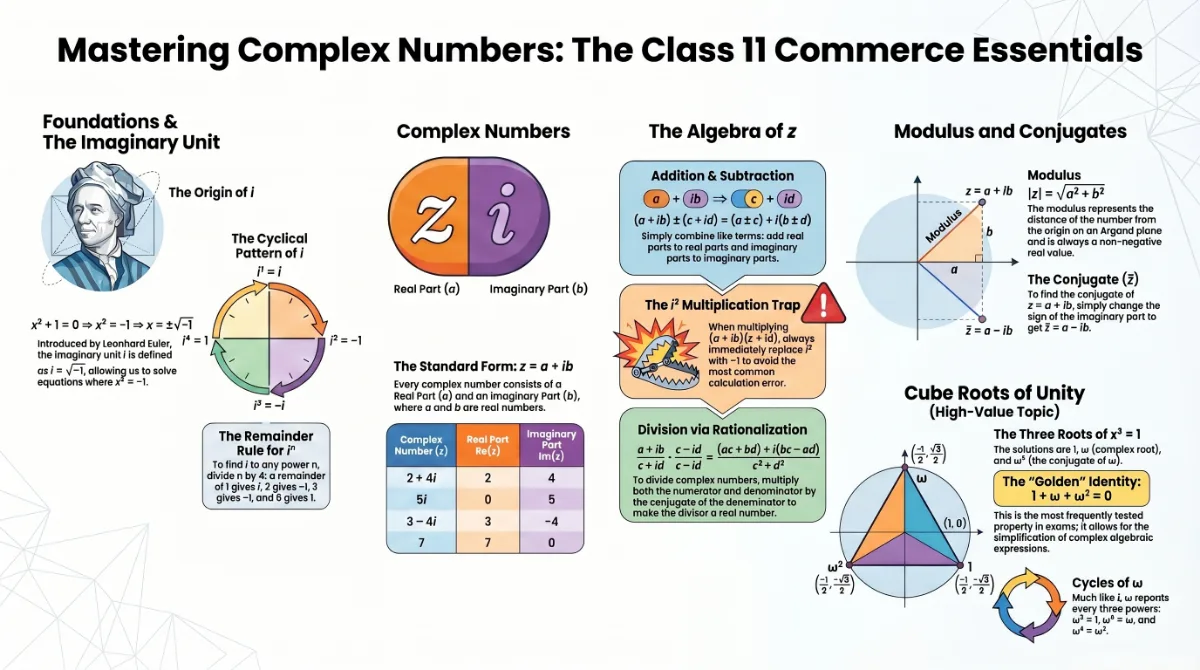
If you’ve ever tried solving x² + 1 = 0 and hit a wall because “no real number squared gives −1,” you’ve stumbled upon exactly the problem that led to the invention of complex numbers. Chapter 3 of your Class 11 Commerce Maths textbook opens up a completely new number system — one that extends real numbers and has deep applications in economics modelling, signal processing, and advanced mathematics.
📊 Interactive Practice: Visualise complex vectors on the Argand plane and calculate powers of i with our Interactive Argand & Powers of i Solver in the middle of this guide!
Why Complex Numbers? The Origin Story
The equation x² + 1 = 0 gives x² = −1. Since squaring any real number is always non-negative, no real number satisfies this. For centuries, such equations were labelled unsolvable. The solution: introduce the imaginary unit i, which is defined by the property: i² = −1 (often written as $i = \sqrt{-1}$).
This symbol was formally pioneered by Swiss mathematician Leonhard Euler (1707–1783). With i defined, the real number system expands into the complex number system — and suddenly every quadratic equation has a solution.
Powers of i — The Cyclical Pattern
One of the most MCQ-tested facts about complex numbers is the behaviour of powers of i:
-
i¹ = i
-
i² = −1
-
i³ = −i
-
i⁴ = 1
-
i⁵ = i (cycle repeats)
Quick formula: To find i^n, divide n by 4 and use the remainder: 1→i, 2→−1, 3→−i, 0→1.
Example: i⁵⁰ → 50 ÷ 4 = remainder 2 → i⁵⁰ = i² = −1
Definition of a Complex Number
A complex number is any number of the form z = a + ib, where:
-
a, b ∈ R
-
i is defined by $i^2 = -1$
-
a = real part → Re(z)
-
b = imaginary part → Im(z)
The set of all complex numbers is C. Every real number is a complex number (with b = 0). Every imaginary number is a complex number (with a = 0).
| z | Re(z) | Im(z) |
|---|---|---|
| 2 + 4i | 2 | 4 |
| 5i | 0 | 5 |
| 3 − 4i | 3 | −4 |
| 7 | 7 | 0 |
Algebra of Complex Numbers
Equality
z₁ = a + ib and z₂ = c + id are equal if a = c and b = d. Both real and imaginary parts must match independently.
Addition and Subtraction
z₁ ± z₂ = (a ± c) + i(b ± d). Add real parts together; add imaginary parts together. Simple and direct.
Multiplication
(a + ib)(c + id) = (ac − bd) + i(ad + bc)
Remember: i²bd = −bd, which flips the sign. This is the most common computation error — always replace i² with −1 immediately.
Conjugate
The conjugate of z = a + ib is z̄ = a − ib. Change the sign of the imaginary part only.
Key properties:
-
z + z̄ = 2a (always real)
-
z × z̄ = a² + b² (always a non-negative real number)
-
z̄̄ = z (conjugate of conjugate returns original)
Division — Rationalise with the Conjugate
To compute z₁ / z₂, multiply numerator and denominator by z̄₂:
The denominator z₂ × z̄₂ = c² + d² is always real, converting the division into a standard complex number in a + ib form.
Modulus of a Complex Number
The modulus of z = a + ib is |z| = √(a² + b²). It is always non-negative. Geometrically, it represents the distance of z from the origin in the Argand plane (complex number plane where the x-axis represents the real part and y-axis represents the imaginary part).
Properties: |z₁ × z₂| = |z₁| × |z₂|; |z₁/z₂| = |z₁|/|z₂|; |z| = |z̄|.
Powers of i & Cube Roots of Unity Solver
Set the real and imaginary parts of a number to view its modulus on the Argand plane, or adjust exponents of i.
Complex Number Algebra
Argand Plane
Syllabus Checkpoints & Exam Watch-Outs
- Trap: In multiplication (a + ib)(c + id), students often write the real part as ac + bd. Remember that i^2 = -1, which flips the sign to ac - bd.
- Key Identity: The sum of the three cube roots of unity (1 + ω + ω^2) is always exactly 0. You can use this to simplify complex algebraic fractions.
Square Root of a Complex Number
Every non-zero complex number has exactly two square roots. To find $\sqrt{a + ib}$, set $\sqrt{a + ib} = \pm(x + iy)$ and square both sides:
-
x² − y² = a
-
2xy = b
Solve these two equations simultaneously to find $x$ and $y$. For example, the square roots of $3 + 4i$ are $\pm(2 + i)$, and the square roots of $5 − 12i$ are $\pm(3 − 2i)$.
Solving Quadratic Equations Over Complex Numbers
For ax² + bx + c = 0 with b² − 4ac < 0, the roots are complex conjugates:
where √(b² − 4ac) becomes an imaginary number.
Example: x² + 2x + 5 = 0 → discriminant = 4 − 20 = −16 x = (−2 ± √(−16)) / 2 = (−2 ± 4i) / 2 = −1 ± 2i
The two roots are −1 + 2i and −1 − 2i — a complex conjugate pair.
Cube Roots of Unity — A High-Value Topic
The cube roots of unity are the three solutions to:
$$x^3 = 1$$ Factoring: x³ − 1 = (x − 1)(x² + x + 1) = 0.
The three cube roots are:
-
1 (real root)
-
ω = (−1 + i√3) / 2 (complex root)
-
ω² = (−1 − i√3) / 2 (complex root, conjugate of ω)
Properties You Must Know:
-
ω³ = 1
-
1 + ω + ω² = 0 ← most important identity; memorise this
-
ω and ω² are conjugates of each other
-
Powers of ω repeat: ω⁴ = ω, ω⁵ = ω², ω⁶ = 1, and so on
The identity 1 + ω + ω² = 0 is the single most tested result from this chapter and appears in problems across algebra, factorisation, and equation solving.
Exam Tips
-
Always write z in a + ib form before computing.
-
Replace i² with −1 immediately — never leave i² in your answer.
-
Rationalise denominators containing i by multiplying by the conjugate.
-
Verify cube root answers using ω³ = 1 and 1 + ω + ω² = 0.
-
For quadratic roots: if discriminant is negative, the roots are complex conjugates.
Related Posts
-
_See also: _ Sequences and Series in Class 11 Commerce – GP, Sigma Notation Explained
-
_Related: _ Functions Class 11 Commerce – Types and Inverse Functions
-
_Explore: _ How to Score 90+ in Class 11 Commerce Maths – Chapter-wise Study Plan
Summary & Study Action Plan
Complex numbers follow clean algebraic rules — which makes them one of the more scoring chapters once you’re comfortable. The algebra is mechanical; the only challenge is keeping track of i².
📌 Practise 10 multiplication and division problems. Then solve 5 problems using cube root of unity properties. Two focused sessions and this chapter is exam-ready.
Frequently Asked Questions
What is the difference between an imaginary number and a complex number? +
Every imaginary number is a complex number with zero real part (0 + ib). A complex number a + ib can have both parts non-zero.
What is i⁵⁰? +
50 ÷ 4 leaves remainder 2. So i⁵⁰ = i² = **−1**.
Is every real number a complex number? +
Yes. Any real number a is the complex number a + 0i — with zero imaginary part.
What does ω represent in cube roots of unity? +
ω = (−1 + i√3)/2, one of the two non-real cube roots of unity. Key properties: ω³ = 1 and 1 + ω + ω² = 0.
Can complex numbers be ordered (greater than or less than)? +
No. Complex numbers have no natural ordering. You can compare moduli (|z₁| vs |z₂|), but not the complex numbers themselves.
How are complex numbers relevant for commerce entrance exams? +
Complex numbers appear in IPMAT, CUET, and other quantitative aptitude papers in the form of powers of i, modulus problems, and cube root of unity identities.
AI-powered practice — free to start