
Sum and difference formulas — also called compound angle formulas — let you compute trigonometric ratios of angles like 15°, 75°, or 105° without a calculator, by expressing them as combinations of standard angles such as 30°, 45°, and 60°. CBSE Class 11 Maths Chapter 3 derives these formulas rigorously using the unit circle and distance formula, and they go on to form the backbone of multiple-angle formulas, product-to-sum identities, and much of Class 12 trigonometry.
Deriving cos(x + y) Using the Unit Circle
Consider a unit circle centred at the origin, and let x be the angle P₄OP₁, and y be the angle P₁OP₂, so that (x + y) is the angle P₄OP₂. The coordinates of the relevant points are P₁(cos x, sin x), P₂(cos(x+y), sin(x+y)), P₃(cos(−y), sin(−y)), and P₄(1, 0).
Since triangles P₁OP₃ and P₂OP₄ are congruent, the distances P₁P₃ and P₂P₄ must be equal. Computing both distances using the distance formula and equating them, after simplification, gives:
cos(x + y) = cos x cos y − sin x sin y
This is the single most important identity in this section — nearly every other formula in the chapter is derived from it.
The Complete List of Sum and Difference Formulas
Replacing y with −y in the identity above, and using cos(−y) = cos y, sin(−y) = −sin y, gives the difference formula. The sine formulas follow using cos(π/2 − x) = sin x. Here is the full set:
-
cos(x + y) = cos x cos y − sin x sin y
-
cos(x − y) = cos x cos y + sin x sin y
-
sin(x + y) = sin x cos y + cos x sin y
-
sin(x − y) = sin x cos y − cos x sin y
For tangent, dividing the sine formula by the cosine formula and then dividing numerator and denominator by cos x cos y gives:
-
tan(x + y) = (tan x + tan y) / (1 − tan x tan y), valid when none of x, y, (x+y) is an odd multiple of π/2
-
tan(x − y) = (tan x − tan y) / (1 + tan x tan y), valid when none of x, y, (x−y) is an odd multiple of π/2
And for cotangent:
-
cot(x + y) = (cot x cot y − 1) / (cot y + cot x)
-
cot(x − y) = (cot x cot y + 1) / (cot y − cot x)
Useful Corollaries: The Co-Function and Supplementary Angle Identities
By substituting specific values of x and y into the formulas above, several extremely useful shortcuts follow directly:
-
cos(π/2 − x) = sin x, sin(π/2 − x) = cos x
-
cos(π/2 + x) = −sin x, sin(π/2 + x) = cos x
-
cos(π − x) = −cos x, sin(π − x) = sin x
-
cos(π + x) = −cos x, sin(π + x) = −sin x
-
cos(2π − x) = cos x, sin(2π − x) = −sin x
These “reduction formulas” are what let you evaluate trigonometric ratios of angles related to π/2, π, and 2π almost instantly, without redoing the full compound-angle calculation each time.
Worked Example: Finding sin 15°
sin 15° = sin(45° − 30°) = sin 45° cos 30° − cos 45° sin 30°
= (1/√2)(√3/2) − (1/√2)(1/2) = (√3 − 1) / (2√2)
Worked Example: Finding tan(13π/12)
tan(13π/12) = tan(π + π/12) = tan(π/12) = tan(π/4 − π/6)
= (tan π/4 − tan π/6) / (1 + tan π/4 · tan π/6) = (1 − 1/√3) / (1 + 1/√3)
Multiplying numerator and denominator by √3: = (√3 − 1) / (√3 + 1) = 2 − √3
Worked Example: Proving a Trigonometric Identity
Prove that sin(x+y) / sin(x−y) = (tan x + tan y) / (tan x − tan y).
Starting from the left-hand side:
sin(x+y) / sin(x−y) = (sin x cos y + cos x sin y) / (sin x cos y − cos x sin y)
Dividing numerator and denominator by cos x cos y:
= (tan x + tan y) / (tan x − tan y), which matches the right-hand side.
This kind of “divide through by cos x cos y” technique is one of the most reusable tricks across the entire compound-angle section — it appears in the derivation of the tan(x+y) formula itself and in dozens of proof-based questions.
Why Compound Angle Formulas Matter Beyond This Chapter
These formulas are the direct foundation for the double and triple angle formulas (where y = x) and for the sum-to-product identities. In competitive exams like CUET and IPMAT, questions often combine two or three of these identities in a single problem, so fluency here pays off across the entire trigonometry unit.
Practice Compound Angle Problems with Instant Feedback
Sum and difference formulas reward repeated practice far more than memorisation alone. ChampionsPrep offers AI-powered question banks and step-by-step explanations aligned to the CBSE and Maharashtra State Board syllabus, along with focused preparation for CUET, IPMAT, JIPMAT, NPAT, and SET. It’s free to register, and you only pay as you use — so you can start working through Chapter 3’s compound angle problems right now. Visit app.championsprep.in to get started.
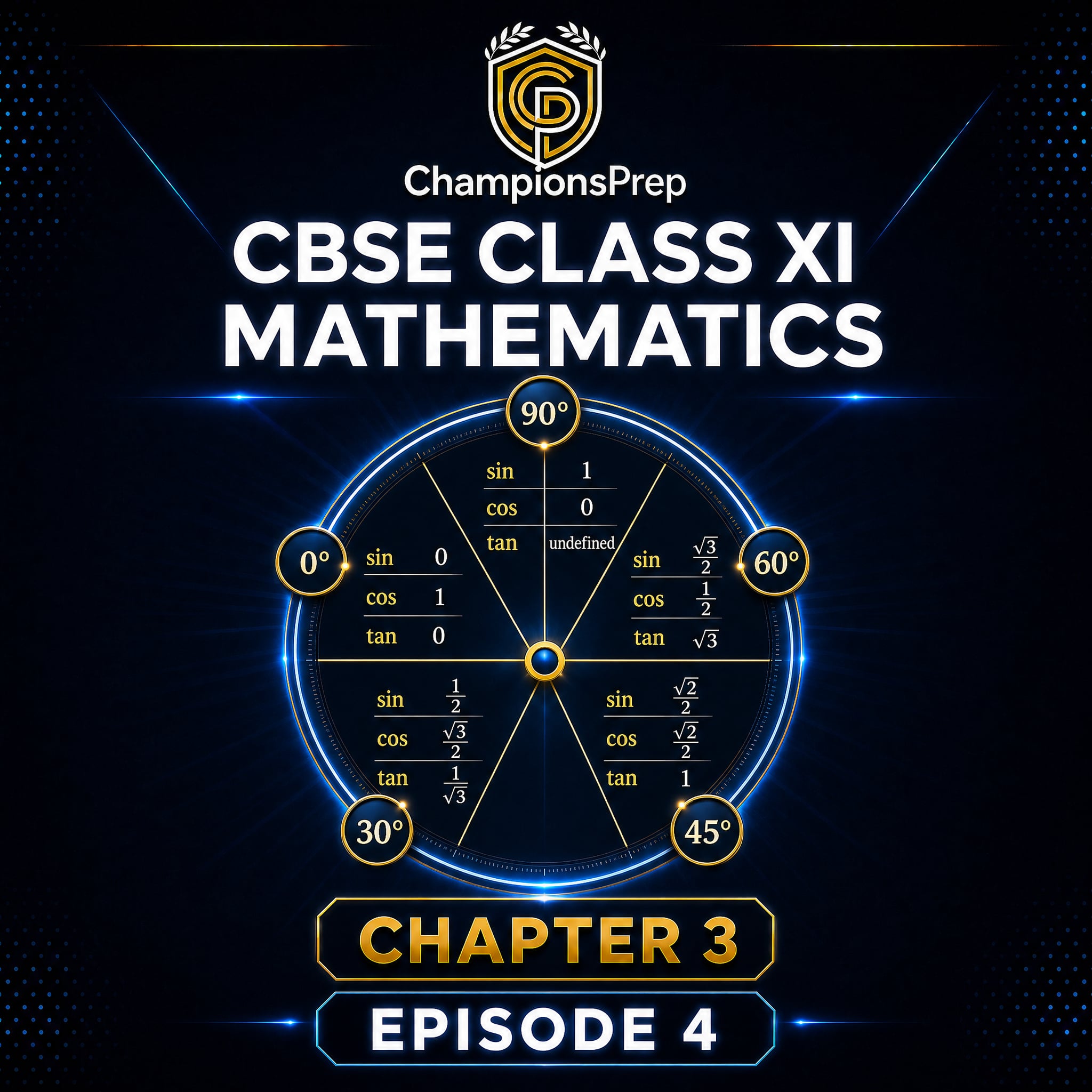
Sum and Difference Formulas for Trigonometric Functions: Class 11 Maths Guide
Frequently Asked Questions
What is the formula for cos(x + y)? +
cos(x + y) = cos x cos y − sin x sin y. This is derived using the unit circle and the distance formula, and is the base identity from which all other sum-difference formulas follow.
How do you derive sin(x + y) from cos(x + y)? +
Using sin(x+y) = cos(π/2 − (x+y)) = cos((π/2 − x) − y), then applying the cos(A − B) formula with A = π/2 − x and B = y gives sin(x+y) = sin x cos y + cos x sin y.
What is the condition for the tan(x + y) formula to be valid? +
None of the angles x, y, or (x + y) can be an odd multiple of π/2, since tan is undefined at those points and the formula's derivation requires dividing by cos x and cos y.
How do you find sin 75° using compound angle formulas? +
Write 75° = 45° + 30°, then apply sin(x+y) = sin x cos y + cos x sin y: sin 75° = sin 45° cos 30° + cos 45° sin 30° = (√6 + √2)/4.
What is the difference between cos(x − y) and cos x − cos y? +
cos(x − y) uses the compound angle formula cos x cos y + sin x sin y, while cos x − cos y is a separate sum-to-product identity equal to −2 sin((x+y)/2) sin((x−y)/2).
AI-powered practice — free to start