
A consumer has limited income and unlimited wants. How does they decide what to buy? At what point have they made the best possible use of every rupee they have?
This is the question consumer equilibrium answers. A consumer is in equilibrium when they have maximized their total satisfaction given their income and the prices they face — with no remaining incentive to reallocate their spending.
Two frameworks exist to analyze this: the Cardinal (Utility) Approach and the Ordinal (Indifference Curve) Approach. Both arrive at the same insight through different paths.
Approach 1: Cardinal Utility Approach
The Core Assumption
The cardinal approach assumes utility can be measured numerically — in imaginary units called “utils”. While unrealistic (you can’t actually count satisfaction), this assumption simplifies the analysis and produces useful results.
Single Commodity Equilibrium
When a consumer spends on only one good (X), equilibrium is reached when:
MUₓ / Pₓ = MUₘ
Where:
-
MUₓ = Marginal utility of good X
-
Pₓ = Price of good X
-
MUₘ = Marginal utility of money (assumed constant)
The Logic: The consumer compares the utility gained per rupee spent on the good against the utility of keeping that rupee (represented by MUₘ).
-
If MUₓ/Pₓ > MUₘ: The good gives more utility per rupee than holding money → buy more
-
If MUₓ/Pₓ < MUₘ: Holding money gives more utility than spending on the good → buy less
-
If MUₓ/Pₓ = MUₘ: No incentive to change → equilibrium reached
Two-Commodity Equilibrium
When income is allocated between two goods (X and Y), equilibrium requires all three conditions simultaneously:
MUₓ / Pₓ = MUᵧ / Pᵧ = MUₘ
AND the budget constraint must be satisfied:
Pₓ · X + Pᵧ · Y = M
(Total spending on both goods equals income M)
The Logic: The last rupee spent on each good must yield the same marginal utility. If any good gives more utility per rupee than another, the rational consumer shifts spending toward it — until the ratios equalize.
Numerical Example
Suppose:
-
Price of X (Pₓ) = ₹5, Price of Y (Pᵧ) = ₹4
-
MUₓ = 40 utils, MUᵧ = 24 utils
Calculate utility per rupee:
-
MUₓ/Pₓ = 40/5 = 8 utils per rupee
-
MUᵧ/Pᵧ = 24/4 = 6 utils per rupee
Since MUₓ/Pₓ > MUᵧ/Pᵧ, the consumer is getting more satisfaction per rupee from X than Y.
Action: Buy more X and less Y. As consumption of X rises, MUₓ falls (Law of Diminishing MU). As consumption of Y falls, MUᵧ rises. This continues until both ratios equalize — that is equilibrium.
Approach 2: Ordinal (Indifference Curve) Approach
The Core Assumption
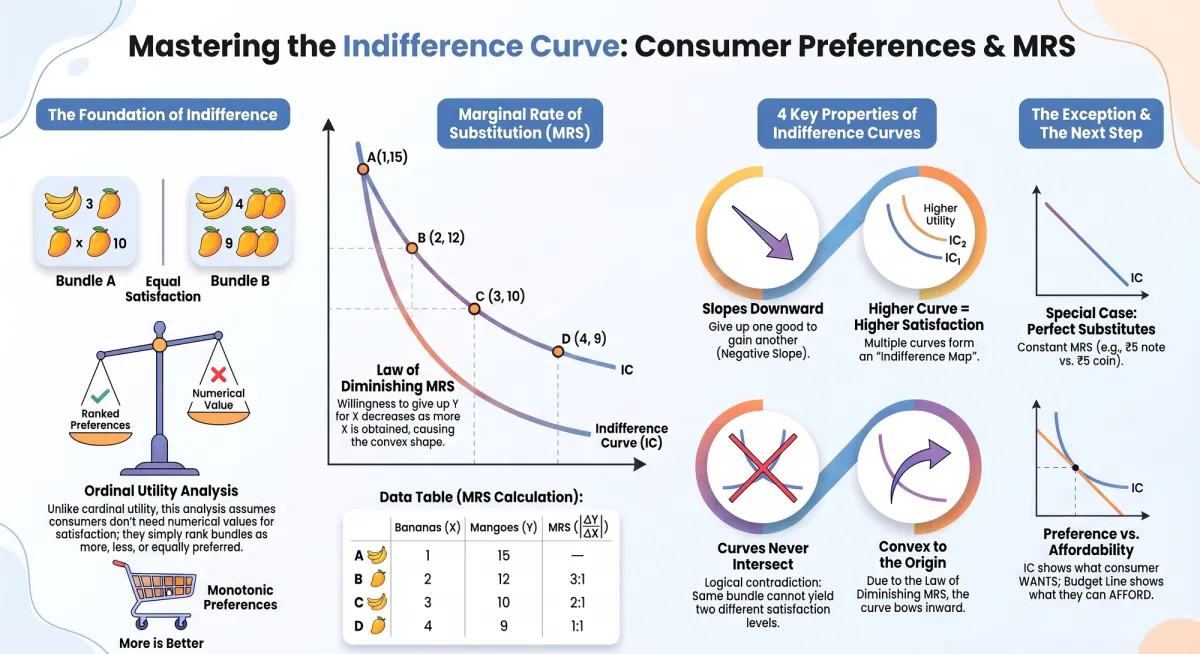
The ordinal approach is more realistic. It does not assume utility can be measured — only that consumers can rank combinations of goods. “I prefer combination A to B” is sufficient; no numbers needed.
This approach uses two tools: Indifference Curves and the Budget Line.
Indifference Curves (IC)
An Indifference Curve shows all combinations of two goods (X and Y) that give a consumer equal satisfaction. The consumer is indifferent between every point on the same curve.
4 Key Properties of Indifference Curves
1. Downward Sloping (Negative Slope) To keep satisfaction constant while consuming more of X, the consumer must give up some Y. More of one good requires less of the other — giving the curve its downward slope.
2. Convex to the Origin This is the most important property — and the one most frequently examined.
Convexity occurs because of diminishing Marginal Rate of Substitution (MRS). As a consumer has more and more of X, each additional unit of X becomes less valuable relative to Y — so they are willing to give up less and less Y for each additional unit of X.
3. Higher IC = Higher Satisfaction A curve further from the origin represents more of both goods — and therefore greater utility. A consumer always prefers to be on the highest possible IC.
4. Indifference Curves Never Intersect If two ICs crossed, a single point would represent two different levels of satisfaction — a logical contradiction that violates the consistency of preferences.
Marginal Rate of Substitution (MRS)
MRSₓᵧ = ΔY ÷ ΔX (along the IC)
MRS measures how many units of Y a consumer willingly sacrifices to gain one more unit of X, while remaining equally satisfied.
Diminishing MRS: As consumption of X increases, MRSₓᵧ falls. The consumer has plenty of X and relatively little Y — so X becomes less precious to them and Y more precious. They’re willing to give up less Y for more X.
This diminishing MRS is what makes the IC convex (bowed toward the origin).
| Units of X | Units of Y Given Up (ΔY) | MRS (ΔY/ΔX) |
|---|---|---|
| 1 → 2 | 4 | 4 |
| 2 → 3 | 3 | 3 |
| 3 → 4 | 2 | 2 |
| 4 → 5 | 1 | 1 |
MRS clearly diminishes — confirming the convex shape.
The Budget Line
The Budget Line shows all combinations of X and Y a consumer can afford given their income and prevailing prices.
Equation:
Pₓ · X + Pᵧ · Y = M
Slope:
−Pₓ / Pᵧ (the price ratio)
Intercepts:
-
Horizontal axis: M/Pₓ (maximum X if all income spent on X)
-
Vertical axis: M/Pᵧ (maximum Y if all income spent on Y)
How the Budget Line Shifts
| Change | Effect on Budget Line |
|---|---|
| Income increases | Parallel shift outward (can afford more of both) |
| Income decreases | Parallel shift inward |
| Price of X falls | Rotates outward on X-axis (horizontal intercept moves right) |
| Price of X rises | Rotates inward on X-axis (horizontal intercept moves left) |
Consumer Equilibrium: Ordinal Approach
The consumer maximizes satisfaction at the point where the budget line is tangent to the highest possible indifference curve.
Equilibrium Condition:
MRSₓᵧ = Pₓ / Pᵧ
The Logic:
-
MRSₓᵧ is the rate at which the consumer is willing to substitute X for Y (subjective preference)
-
Pₓ/Pᵧ is the rate at which the market allows substitution (objective prices)
At equilibrium, what the consumer is willing to give up for X exactly matches what the market requires them to give up — no further beneficial trade is possible.
Why not below the highest tangent point?
-
Points on lower ICs are affordable but suboptimal — the consumer could reach a higher IC
-
Points on higher ICs are desirable but unaffordable — beyond the budget line
The tangency point is uniquely optimal — the best the consumer can do given their budget.
Cardinal vs Ordinal: A Quick Comparison
| Feature | Cardinal Approach | Ordinal Approach |
|---|---|---|
| Utility measurement | Numerical (utils) | Rankings only |
| Realism | Less realistic | More realistic |
| Key tool | MU ratios | Indifference curves + budget line |
| Equilibrium condition | MUₓ/Pₓ = MUᵧ/Pᵧ | MRS = Pₓ/Pᵧ |
| Key assumption | Utility measurable, MUₘ constant | Diminishing MRS, consistent preferences |
Key Takeaway
Both approaches answer the same question — how does a rational consumer maximize satisfaction given a budget constraint? — through different methods. The cardinal approach uses measurable utility ratios; the ordinal approach uses the geometric tangency of the budget line and the highest indifference curve. For CBSE board exams, you need to be fluent in both.
Related Posts:
-
Utility in Economics: Total Utility, Marginal Utility & the Law of Diminishing Marginal Utility
-
Law of Demand, Elasticity & Exceptions: A Complete Guide
AI-powered practice — free to start