
Linear differential equations round out the three core solving techniques in Chapter 9, and for many CBSE students, this is actually the easiest of the three once the integrating factor formula is memorized correctly. Unlike homogeneous equations, there is no need to check for a special structure — as long as the equation is linear in the dependent variable and its derivative, a fixed formula takes you straight to the answer. This guide covers the definition, the formula, and several fully solved examples, including particular solutions and curve-based application problems.
What Is a Linear Differential Equation?
A differential equation of the form:
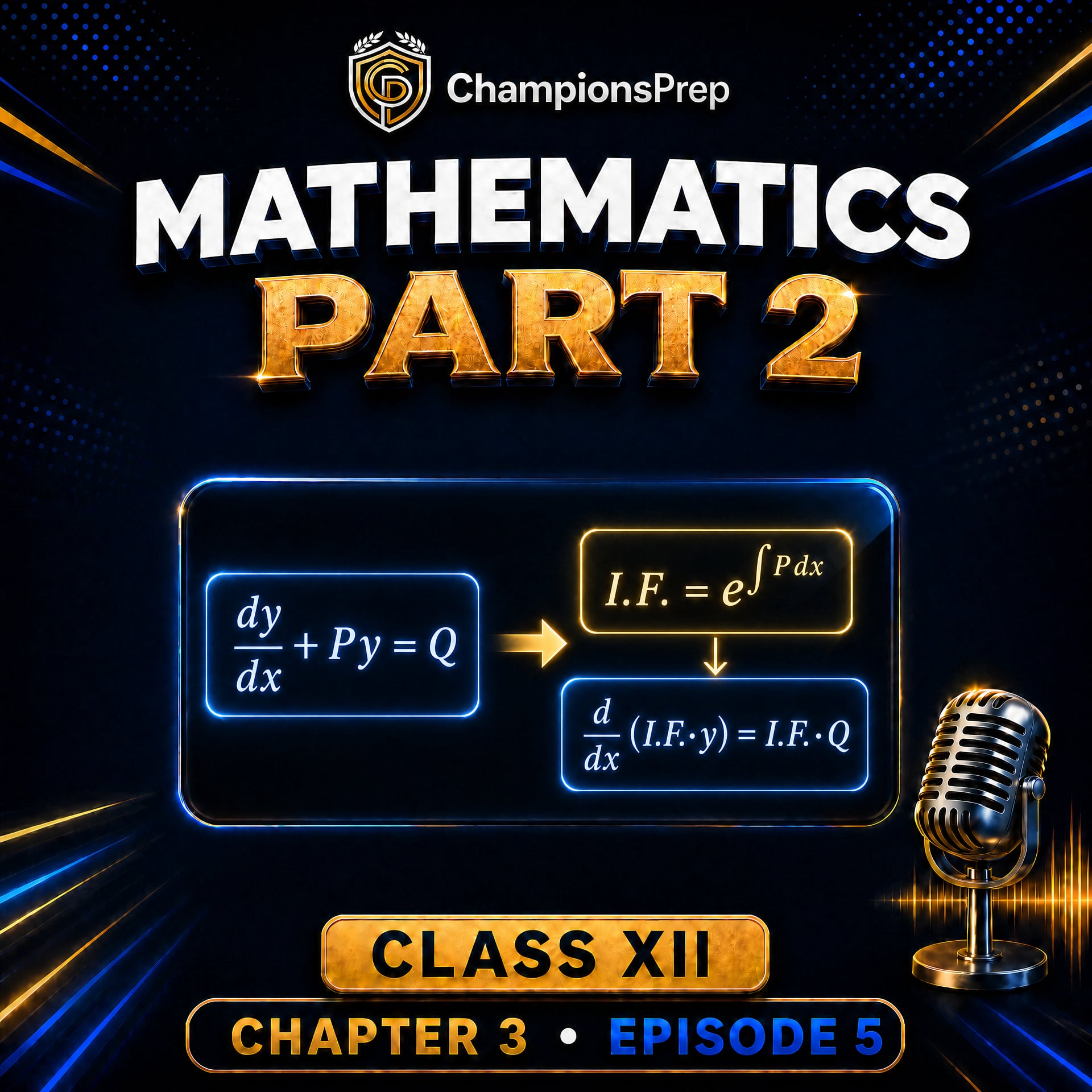
dy/dx + Py = Q
where P and Q are either constants or functions of x alone (never of y), is called a first-order linear differential equation. The key requirement is that y and dy/dx appear only to the first power, with no products like y·(dy/dx) or powers like y².
Common examples include dy/dx + y = sin x, dy/dx + (1/x)y = eˣ, and dy/dx + (y/(x log x)) = 1/x.
There is also a second form, useful when the equation is easier to express with x as the dependent variable:
dx/dy + P₁x = Q₁
where P₁ and Q₁ are functions of y alone.
The Integrating Factor Formula
To solve dy/dx + Py = Q, you first compute the integrating factor (I.F.):
I.F. = e^(∫P dx)
Multiplying both sides of the original equation by this integrating factor makes the left-hand side into the exact derivative of y multiplied by the integrating factor. The general solution is then given by:
y · (I.F.) = ∫[Q · (I.F.)] dx + C
For the alternate form dx/dy + P₁x = Q₁, the integrating factor is I.F. = e^(∫P₁ dy), and the solution is:
x · (I.F.) = ∫[Q₁ · (I.F.)] dy + C
Step-by-Step Method
-
Rewrite the given equation in the standard form dy/dx + Py = Q (or the x-form if more convenient).
-
Identify P and compute the integrating factor: I.F. = e^(∫P dx).
-
Multiply both sides of the standard-form equation by the integrating factor.
-
Write the solution as y · (I.F.) = ∫[Q · (I.F.)] dx + C.
-
Evaluate the integral on the right-hand side, and apply any given initial condition to find C for a particular solution.
Solved Example 1: General Solution
Find the general solution of dy/dx − y = cos x.
Here P = −1 and Q = cos x, so I.F. = e^(∫−1 dx) = e⁻ˣ.
Multiplying through: d/dx(y·e⁻ˣ) = e⁻ˣ cos x.
Integrating the right-hand side (using integration by parts twice) gives ∫e⁻ˣ cos x dx = [e⁻ˣ(sin x − cos x)]/2.
So the general solution is y = (sin x − cos x)/2 + Ceˣ.
Solved Example 2: Using the x-Form
Find the general solution of y dx − (x + 2y²) dy = 0.
Rewriting: dx/dy − x/y = 2y. Here P₁ = −1/y and Q₁ = 2y.
I.F. = e^(∫−1/y dy) = e^(−log y) = 1/y.
Solution: x·(1/y) = ∫2y·(1/y) dy + C = ∫2 dy + C = 2y + C.
So x/y = 2y + C, which gives x = 2y² + Cy.
Solved Example 3: Particular Solution
Find the particular solution of dy/dx + y cot x = 2x + x² cot x (x ≠ 0), given y = 0 when x = π/2.
Here P = cot x, so I.F. = e^(∫cot x dx) = e^(log sin x) = sin x.
Solution: y sin x = ∫(2x + x² cot x) sin x dx + C = ∫2x sin x dx + ∫x² cos x dx + C.
Using integration by parts on the first integral and simplifying (the second integral cancels part of the first), this reduces neatly to y sin x = x² sin x + C.
Applying y = 0 at x = π/2: 0 = (π/2)² · 1 + C, so C = −π²/4.
The particular solution is y sin x = x² sin x − π²/4, or y = x² − π²/(4 sin x).
Application: Equation of a Curve
Find the equation of a curve passing through (0, 1), given that the slope of the tangent at any point (x, y) equals the sum of the x-coordinate and the product of the x-coordinate and y-coordinate.
The condition translates to dy/dx = x + xy, i.e., dy/dx − xy = x. Here P = −x, so I.F. = e^(−x²/2).
Solving gives y·e^(−x²/2) = −e^(−x²/2) + C, so y = −1 + Ce^(x²/2).
Using (0, 1): 1 = −1 + C, so C = 2. The required curve is y = 2e^(x²/2) − 1.
Common Mistakes with Linear Differential Equations
The most frequent error is forgetting to divide the equation into the exact standard form dy/dx + Py = Q before reading off P — students sometimes use the coefficient of y directly from an unrearranged equation, which gives the wrong integrating factor. Another common slip is misapplying logarithm rules while simplifying I.F. = e^(∫P dx), especially when P involves 1/x or cot x. Always simplify e^(log f(x)) to f(x) directly, since this identity is used in nearly every integrating factor calculation in this chapter.
Ready to Practice?
The integrating factor method becomes fast and reliable only with repeated, timed practice across varied problem types. On ChampionsPrep (app.championsprep.in), get AI-powered, pay-per-use practice sessions with PrepCoin packs from ₹59, built for CBSE and Maharashtra State Board Class 11–12 Commerce students, plus CUET, IPMAT, JIPMAT, NPAT, and SET aspirants. Start a Differential Equations practice session today and master this scoring technique.
Linear Differential Equations Class 12: Integrating Factor Method Explained
Frequently Asked Questions
What is the standard form of a linear differential equation? +
dy/dx + Py = Q, where P and Q are constants or functions of x alone, with y and dy/dx appearing only to the first power.
What is the formula for the integrating factor? +
I.F. = e raised to the integral of P dx, for the standard form dy/dx + Py = Q.
What is the general solution formula once the integrating factor is found? +
y times the integrating factor equals the integral of Q times the integrating factor, dx, plus C.
When should I use the dx/dy + P1x = Q1 form instead? +
Use this form when the equation is more naturally linear in x with y as the independent variable, typically when x and dx/dy appear to the first power but y does not fit the standard dy/dx form easily.
How do I simplify e to the log of f(x) when computing the integrating factor? +
Using the identity e to the log of f(x) equals f(x), so e to the 2 log x simplifies to x squared, and e to the log of sin x simplifies to sin x.
AI-powered practice — free to start