
Some mathematical statements are easy to check for a few values — you test n = 1, n = 2, n = 5, and they all work. But how do you move from “works for every value I’ve tried” to “works for every positive integer”? That leap requires a formal technique: mathematical induction.
Mathematical induction is a foundational proof method that underpins later Class XII work, and it still appears in CUET, IPMAT, and JIPMAT reasoning sections. This guide explains the underlying logic, the three-step structure, and how to write an induction proof that earns full marks.
What is Mathematical Induction?
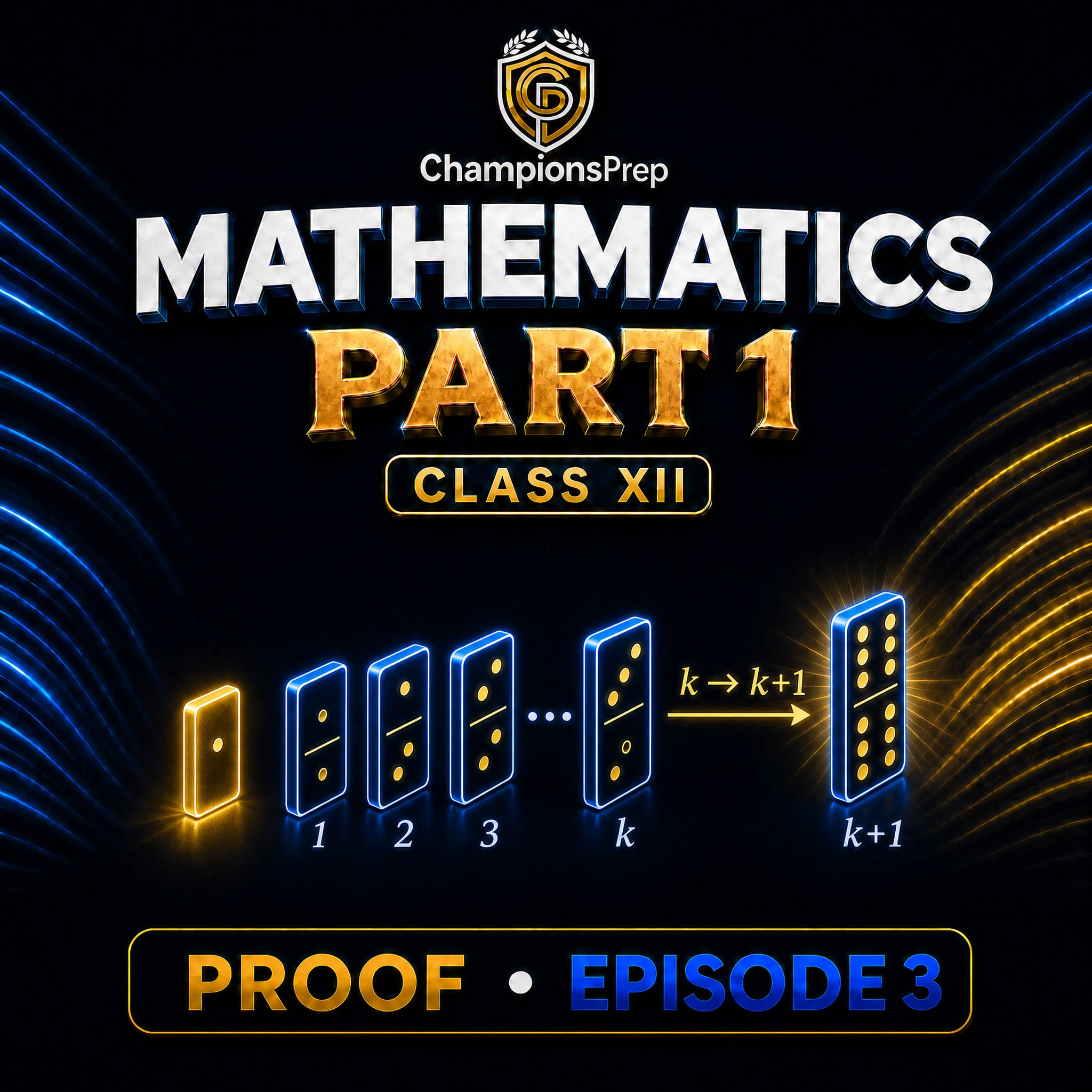
Mathematical induction is a direct proof technique designed to prove propositions that involve all natural numbers (or all integers from a given starting point). It is sometimes described as the “domino effect” — if the first domino falls, and every domino knocks over the next one, then all dominoes will eventually fall.
The method rests on an axiom about N: if a subset S contains 1, and whenever it contains k it also contains k + 1, then S = N. Mathematical induction formalises this axiom into a proof strategy.
The Three-Step Structure of Every Induction Proof
Every valid induction proof contains exactly three clearly labelled components:
Step 1 — State the Proposition
Write out clearly what you are trying to prove for a general n. Call this P(n). For example:
P(n): The n-th power of the rotation matrix A equals the matrix with nθ in place of θ.
This statement must be precise enough that you can check whether it is true or false for any specific value of n.
Step 2 — Base Case
Verify that P(1) is true — that is, the statement holds for the smallest value of n (usually n = 1, unless a different starting point is specified). This is the first domino.
Step 3 — Inductive Step
Assume P(k) is true for some arbitrary positive integer k. This is called the inductive hypothesis. Using this assumption, prove that P(k + 1) must also be true. This step — showing that each domino knocks over the next — is the heart of the proof.
Once Steps 2 and 3 are complete, you conclude: since P(1) is true, and since P(k) true implies P(k + 1) true, P(n) is true for all n ∈ N.
Worked Example: Powers of a Rotation Matrix
Problem: Let the matrix A = [[cos θ, sin θ], [−sin θ, cos θ]]. Show by mathematical induction that:
A^n = [[cos nθ, sin nθ], [−sin nθ, cos nθ]] for all n ≥ 1.
Proof:
Let P(n) be the statement: A^n = [[cos nθ, sin nθ], [−sin nθ, cos nθ]].
Base case (n = 1): A¹ = A = [[cos θ, sin θ], [−sin θ, cos θ]], which matches [[cos 1·θ, sin 1·θ], [−sin 1·θ, cos 1·θ]]. Therefore P(1) is true.
Inductive step: Assume P(k) is true, i.e., A^k = [[cos kθ, sin kθ], [−sin kθ, cos kθ]].
We need to show P(k + 1): A^(k+1) = [[cos(k+1)θ, sin(k+1)θ], [−sin(k+1)θ, cos(k+1)θ]].
Now, A^(k+1) = A^k · A (by the definition of matrix powers).
Substituting the inductive hypothesis for A^k and performing the matrix multiplication:
A^(k+1) = [[cos kθ, sin kθ], [−sin kθ, cos kθ]] · [[cos θ, sin θ], [−sin θ, cos θ]]Computing each entry using the angle-addition identities (cos(A+B) = cosA·cosB − sinA·sinB, and sin(A+B) = sinA·cosB + cosA·sinB):
-
Top-left entry: cos kθ · cos θ − sin kθ · sin θ = cos(kθ + θ) = cos(k+1)θ
-
Top-right entry: cos kθ · sin θ + sin kθ · cos θ = sin(kθ + θ) = sin(k+1)θ
-
Bottom-left entry: −(sin kθ · cos θ + cos kθ · sin θ) = −sin(k+1)θ
-
Bottom-right entry: −sin kθ · sin θ + cos kθ · cos θ = cos(k+1)θ
So A^(k+1) = [[cos(k+1)θ, sin(k+1)θ], [−sin(k+1)θ, cos(k+1)θ]].
Therefore P(k + 1) is true whenever P(k) is true. By the principle of mathematical induction, P(n) is true for all n ≥ 1. ∎
Why Induction is More Than a Mechanical Template
The inductive step creates an unbreakable chain. Once you have shown that P(k) implies P(k+1), and P(1) is confirmed true, you can deduce P(2), then P(3) — and P(n) for every natural number n. Testing P(1) through P(100) leaves infinitely many untested cases; induction covers them all in one argument.
Common Errors in Induction Proofs
Forgetting the base case: The inductive step alone proves nothing. Always verify P(1) explicitly.
Not writing the inductive hypothesis: Examiners look for “Assume P(k) is true.” Without it, the induction is not formally activated.
Forgetting to conclude: Write the final statement: “By the principle of mathematical induction, P(n) is true for all n ∈ N.”
Nail Induction in Your Board Exam
The three-step structure is learnable — and once you practise it enough times, it becomes second nature.
Practise Mathematical Induction on ChampionsPrep → PrepCoin packs from ₹59
ChampionsPrep gives you targeted MCQs and long-answer induction questions at every difficulty level, with step-by-step AI doubt resolution to help you understand exactly where your logic went wrong.
Mathematical Induction Explained: Step-by-Step Proof Guide for Class XII CBSE
Frequently Asked Questions
Is mathematical induction the same as deductive reasoning? +
Yes. Mathematical induction is a deductive proof method. The name refers to the movement from individual cases to a general conclusion, but each step is a deductive argument where the conclusion follows necessarily from the premises.
When should I use mathematical induction rather than direct proof? +
Use induction when the statement involves all natural numbers and when you can express P(k+1) in terms of P(k). Series formulae, divisibility claims, and matrix power results are the most common contexts.
Can I use induction to prove something that is actually false? +
No. If a statement is false, at least one of the two steps — base case or inductive step — will fail. A correctly executed induction proof guarantees the statement is true for all n from the base case onwards.
How is an induction proof marked in exams? +
Where it is examined, an induction proof is marked on five components: stating P(n), verifying the base case, writing the inductive hypothesis, carrying out the inductive step, and stating the conclusion. Note that CBSE Class XI treats the Principle of Mathematical Induction as formative-only, outside summative board marks; the technique still appears in competitive exams such as CUET and IPMAT.
What are common applications of mathematical induction in Class XII? +
Common applications include proving formulae for the sum of series (sum of first n natural numbers, sum of squares), divisibility results (e.g., 3^n - 1 is divisible by 2), inequalities, and matrix power identities like the rotation matrix example.
AI-powered practice — free to start