
Every graph has its hills and valleys — points where the function stops climbing and starts falling, or vice versa. The First Derivative Test gives you a reliable, step-by-step way to locate these turning points and classify them as local maxima or local minima. This is one of the highest-weightage concepts in the “Application of Derivatives” chapter.
What Are Local Maxima and Minima?
A point c is a point of local maxima of f if f(c) is greater than or equal to f(x) for all x in some small neighbourhood around c — the function’s value there is higher than at nearby points, even if it isn’t the highest value overall. Similarly, c is a point of local minima if f(c) is less than or equal to f(x) for all x near c. The key word is “local” — these are turning points relative to their neighbourhood, not necessarily the extreme value across the whole domain.
What Is a Critical Point?
Before applying the First Derivative Test, you need the critical points of the function. A point c in the domain of f is a critical point if either f’(c) = 0, or f is not differentiable at c. Every local extremum of a differentiable function must occur at a critical point — but not every critical point is automatically a maximum or minimum. Some are points where the graph flattens momentarily before continuing in the same direction; these are called points of inflection.
The First Derivative Test: Step by Step
Let f be continuous at a critical point c. Then:
-
If f’(x) changes sign from positive to negative as x increases through c, then c is a point of local maxima.
-
If f’(x) changes sign from negative to positive as x increases through c, then c is a point of local minima.
-
If f’(x) does not change sign as x passes through c, then c is neither — it’s a point of inflection.
Step-by-Step Method to Solve These Problems
Step 1: Differentiate and Find Critical Points
Compute f’(x), then solve f’(x) = 0. Also note any points where f’(x) is undefined — both types count as critical points.
Step 2: Build a Sign Chart
Mark the critical points on a number line and test the sign of f’(x) in each resulting interval using a convenient test value.
Step 3: Apply the Test and State the Value
Check the sign change across each critical point to classify it as local maxima, local minima, or inflection. Then substitute the critical point back into f(x) — not f’(x) — to get the actual maximum or minimum value.
Solved Examples
Example 1: A Standard Cubic Function
Question: Find all points of local maxima and local minima of f(x) = x³ - 3x² - 9x + 10.
Solution:
f’(x) = 3x² - 6x - 9 = 3(x - 3)(x + 1)
Critical points: x = 3 and x = -1
Sign chart:
-
For x < -1: f’(x) > 0 (increasing)
-
For -1 < x < 3: f’(x) < 0 (decreasing)
-
For x > 3: f’(x) > 0 (increasing)
At x = -1, f’ changes from + to −, so x = -1 is a point of local maxima. Local maximum value: f(-1) = -1 - 3 + 9 + 10 = 15
At x = 3, f’ changes from − to +, so x = 3 is a point of local minima. Local minimum value: f(3) = 27 - 27 - 27 + 10 = -17
Example 2: A Function With a Point of Inflection
Question: Examine f(x) = (x - 1)³ + 2 for local maxima and minima.
Solution:
f’(x) = 3(x - 1)²
Setting f’(x) = 0 gives x = 1. But (x - 1)² is always non-negative, so f’(x) never changes sign — it’s zero exactly at x = 1 and positive everywhere else.
Conclusion: x = 1 is neither a local maximum nor a local minimum; it is a point of inflection.
Example 3: A Function Involving a Modulus
Question: Find the local minimum value of f(x) = 4 + |x|.
Solution:
For x < 0, f(x) = 4 - x, so f’(x) = -1 < 0 (decreasing). For x > 0, f(x) = 4 + x, so f’(x) = 1 > 0 (increasing).
At x = 0, f’ changes from negative to positive, so x = 0 is a point of local minima, even though f is not differentiable there — a classic example showing why critical points include non-differentiable points too.
Local minimum value: f(0) = 4
Common Mistakes to Avoid
-
Assuming every critical point is a maximum or minimum — always check for sign change; some are inflection points.
-
Forgetting non-differentiable points — modulus and piecewise functions often hide critical points where the derivative doesn’t exist.
-
Reporting the critical point instead of the function value — students often find x = 3 but forget to compute f(3), the actual “local minimum value.”
Why This Topic Is Exam-Critical
The First Derivative Test appears almost every year in CBSE boards as a 5-mark question, and it’s a prerequisite for the faster Second Derivative Test covered next. It also underpins nearly every optimisation problem in this chapter.
Practice Makes the Difference
The First Derivative Test rewards careful, methodical practice — the more sign charts you draw, the faster and more accurate you become.
Want personalised practice sets and instant answers to your doubts on local maxima and minima? ChampionsPrep offers pay-per-use AI doubt resolution with PrepCoin packs from ₹59, along with topic-wise practice built for CBSE boards and CUET Commerce. Start solving First Derivative Test problems on ChampionsPrep and build real exam confidence.
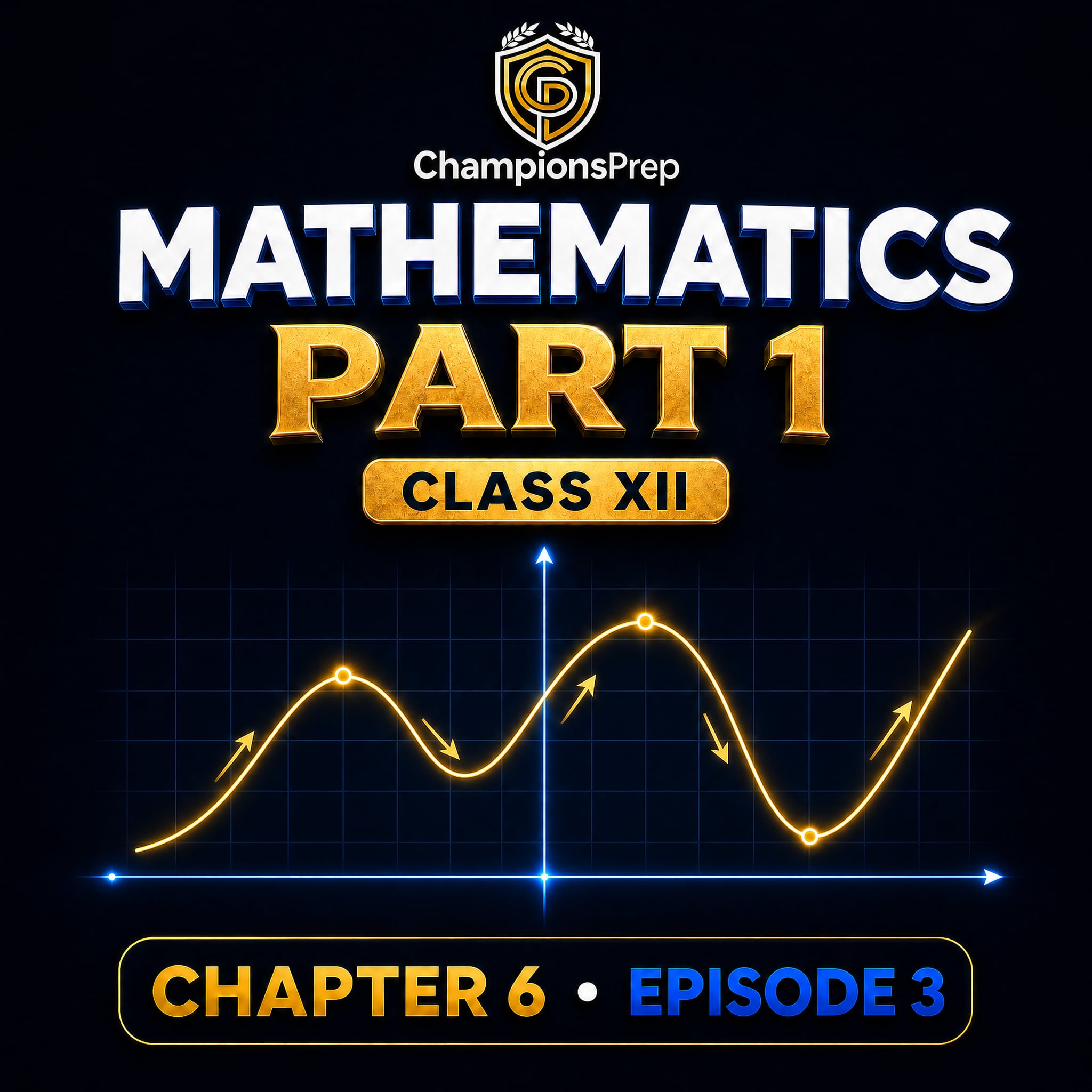
First Derivative Test Class 12: Finding Local Maxima and Minima
Frequently Asked Questions
What is the difference between a critical point and a point of local maxima? +
A critical point is any point where the derivative equals zero or the function is not differentiable. A point of local maxima is a specific type of critical point where the derivative changes sign from positive to negative.
Can the First Derivative Test fail? +
The test itself does not fail, but if the function is not continuous at the critical point, the test cannot be applied directly and other methods must be used.
What is a point of inflection? +
A point of inflection is a critical point where the derivative does not change sign, meaning the function keeps increasing or decreasing on both sides even though the graph flattens momentarily.
Do all local maxima and minima occur at critical points? +
Yes, for functions defined on an interval, every local maximum or minimum must occur at a critical point, though not every critical point is a maximum or minimum.
How is the First Derivative Test different from the Second Derivative Test? +
The First Derivative Test checks the sign change of the derivative around a critical point, while the Second Derivative Test checks the sign of the second derivative directly at that point. The second method is often faster but fails when the second derivative equals zero.
AI-powered practice — free to start